

Nestable Plastic Pallets Explained
How the nesting design works, what it saves you, and when it's the right pallet for the job.
Published October 14, 2026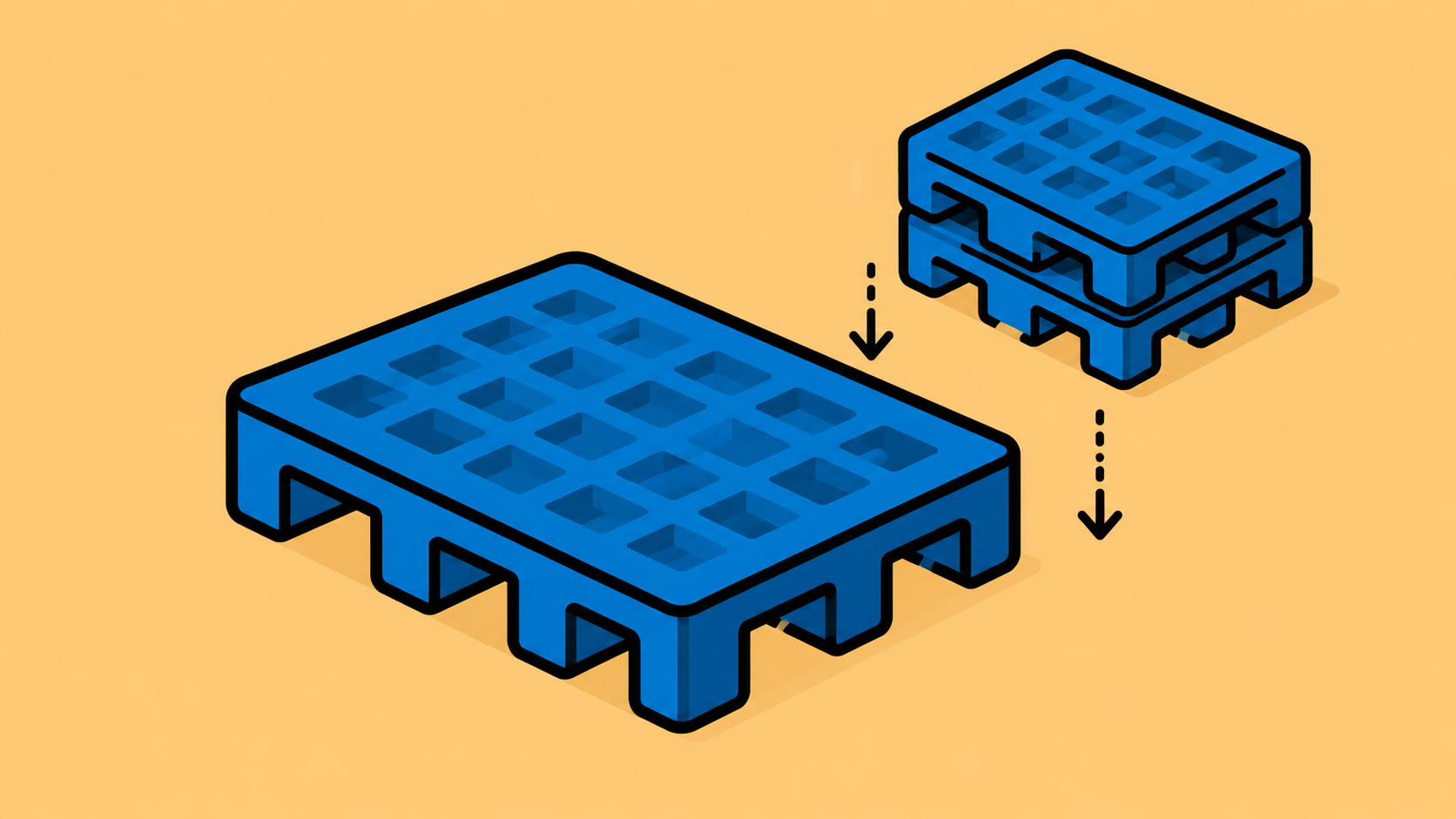
By John Anderson, Owner of Verde Trader
10+ years buying and selling used industrial packaging.
Key takeaways
- What makes them nestable: a legged or footed bottom deck (no full perimeter base) lets empty pallets drop inside one another, cutting stack height by roughly 40% compared to conventional pallets.
- The main payoff: dramatically reduced storage footprint and lower empty-return freight costs, the reason nestable pallets dominate one-way and distribution shipping.
- The core trade-off: no continuous bottom surface means they are not rack-safe and carry lower dynamic and static load ratings than rackable or stackable designs.
- Best fit: one-way and one-trip shipments, high-volume distribution, retail display, and any operation that stores or ships large quantities of empty pallets.
- Most common size: 48x40 inches, compatible with standard GMA dimensions and the vast majority of North American handling equipment.
How nesting works
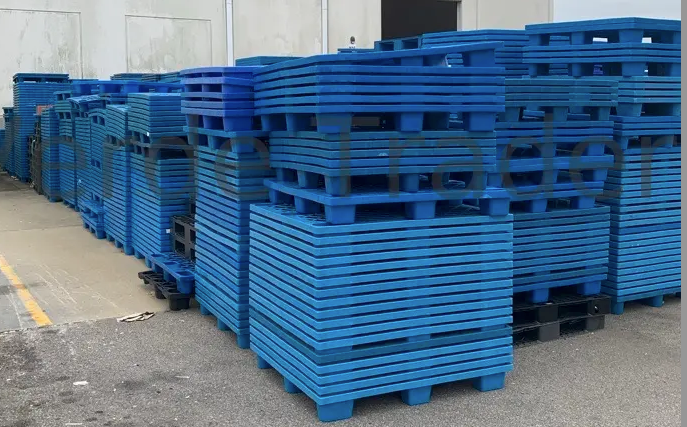
Empty nestable pallets stacked - the legged bottom deck drops each pallet down into the one below it.
The nesting mechanism comes entirely from the bottom deck. A rackable or stackable plastic pallet has a continuous perimeter base or a set of full-length runners that hold each pallet level and separate from the one below it. A nestable pallet replaces that solid base with a set of individual legs or a partial-contact footing. When you set one empty nestable pallet on top of another, those legs drop through or around the top deck of the lower pallet and the upper pallet sinks down, reducing the combined height. Repeat that across a full stack and the space savings add up quickly.
Published lifecycle research comparing plastic and wood pallets found that a 1.44-meter column fits 17 nestable plastic pallets where it would only hold 10 conventional block-type wood pallets - a ratio of roughly 1.7 to 1 in favor of the nestable design. In practical terms, that means a trailer that hauls back 170 empty nestable pallets would need nearly two trailers to return the same count of conventional pallets. That freight difference is the entire economic case for nestable pallets in one-way and return-lane shipping.
The nesting depth, how far one pallet drops into the next, varies by design. Most 48x40 nestable pallets nest to a combined height of roughly 5-7 inches per pallet in a stack, compared to the full deck height of around 5-6 inches each when loaded. Tighter nesting ratios generally mean a lighter, more economical pallet. Wider-legged designs nest less aggressively but typically carry higher load ratings because the base is more distributed.
How the top deck is built
The top deck of a nestable pallet is either open or closed. Open-deck models have a grid or runner pattern with gaps, which saves resin, reduces weight, and allows drainage - important in food and beverage environments. Closed-deck models have a continuous solid surface, which provides more even load distribution and prevents small items from falling through. Most nestable pallets in North American distribution use an open-deck design because the weight savings reinforce the whole point of the nestable format: lightweight, low-cost, easy to handle and return.
Nearly all nestable plastic pallets are manufactured by injection molding, the same process used for the majority of plastic pallets. The primary raw material is high-density polyethylene (HDPE), which is moisture-resistant, chemical-resistant, and can be fully recycled at end of life. Some lower-cost nestable pallets use polypropylene instead, which is lighter but slightly more brittle at low temperatures. See our roundup of top plastic pallet manufacturers for how leading brands' designs compare.
Because plastic pallets cannot be repaired the way wood pallets can, the material quality of the original molding matters more over time. Peer-reviewed lifecycle research puts the expected service life of a nestable plastic pallet at 50-100 cycles, with 66 cycles as a commonly cited central estimate - significantly longer than the 15-20 cycles typical for a wood pallet.
For a full breakdown of what those cycle counts mean for total cost and return on investment, see our guide to how much plastic pallets are worth.
What you gain and give up
Every nestable pallet is a deliberate trade between storage efficiency and structural performance. Understanding that trade is how you avoid buying the wrong pallet for the job.
What you gain
- Storage density. The nesting ratio of roughly 1.7 to 1 over conventional pallets means you can store nearly twice as many empties in the same floor space or trailer cube. For operations that accumulate large numbers of empties between shipment cycles, that difference directly reduces the warehouse space dedicated to empty pallet storage.
- Lower empty-return freight cost. Fitting more empties per trailer is the single biggest cost advantage of the nestable format. In a one-way supply chain where pallets travel loaded in one direction and empty in the other, the return leg is pure overhead. Nestable pallets cut that overhead proportionally.
- Light weight. Because nestable pallets use less material than rackable designs - no continuous runners, no full bottom deck - they tend to weigh less per unit. That matters when workers are manually handling empties, and it also reduces the tare weight added to every loaded shipment.
- Lower unit cost. Less resin means lower manufacturing cost, which flows through to a lower purchase price. Nestable pallets are consistently the most economical plastic pallet format per unit, making them practical for one-way applications where the pallet is not expected to make many return trips.
- Moisture and chemical resistance. Like all injection-molded HDPE plastic pallets, nestable models do not absorb water, will not harbor mold or bacteria in the deck material, and resist most common industrial cleaning chemicals. This makes them a practical choice in food, beverage, and pharmaceutical distribution where hygiene is a requirement.
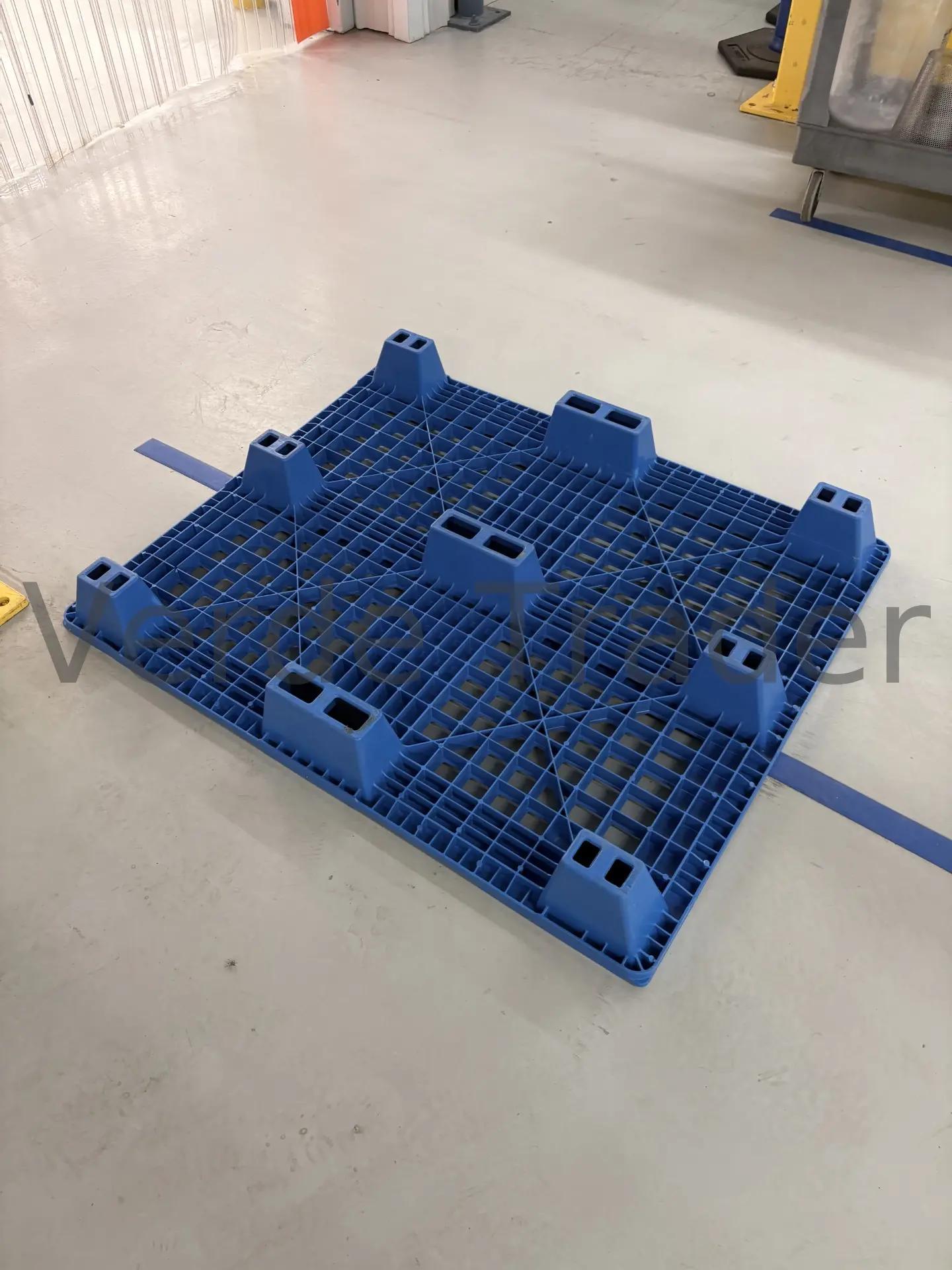
The individual legs on the underside are what give a nestable pallet its space-saving profile.
What you give up
- Racking compatibility. This is the most important limitation. Without a continuous bottom deck or full-length runners, a nestable pallet has no safe bearing surface to sit across the beams of a standard warehouse rack. Placing an unsupported nestable pallet on rack beams concentrates the load on the legs or feet rather than distributing it across a runner, which risks structural failure. Nestable pallets are floor-stacked or floor-staged, not racked. If your operation requires pallets to go into racking, a rackable plastic pallet is the correct choice.
- Lower load ratings. The legged base distributes weight across a smaller contact area than a perimeter base or runner design. As a result, nestable pallets generally carry lower dynamic (forklift-in-motion) and static (stacked, at rest) load ratings than rackable or stackable designs of comparable size. For light-to-medium loads in distribution and retail, that is rarely a problem. For heavy industrial loads, it often is.
- Less stability when stacked loaded. Stacking loaded nestable pallets on top of one another is different from nesting empties. The load on the top deck prevents the upper pallet from dropping down into the lower one, so loaded stacking behaves more like stacking any other pallet. Some nestable designs include a lip or rim around the top deck that provides a positive register point for loaded stacking, but this varies by model.
- No repair pathway. Unlike wood pallets, which can be repaired by replacing broken deck boards or blocks, plastic pallets cannot be field-repaired. A cracked or broken nestable pallet goes to a plastic recycler. The good news is that HDPE is fully recyclable and has a secondary market, so end-of-life value is retained - the pallet can be ground down and remolded into new product.
Source: Verde Trader product data; Springer Nature pallet materials review (2023); Int'l J. LCA (2021).
For more detail on how rackable pallets differ in construction and what load ratings to look for, see our rackable plastic pallets page. For load capacity specifics across all plastic pallet types, see how much weight plastic pallets can hold. For a full side-by-side comparison of every format, see our guide to types of plastic pallets.
Where nestable pallets fit best
Nestable pallets are not a universal format. They are optimized for a specific set of conditions, and the operations that use them well tend to share a few common characteristics: high pallet volume, light-to-medium loads, and a need to move or store large numbers of empties efficiently.
Nestable pallets are a common sight in high-throughput distribution operations where empty return trips are a significant cost.
- One-way and one-trip shipments. When a pallet ships loaded and is not expected to make a return trip to the sender, unit cost and empty-stack efficiency matter more than load rating or racking compatibility. Nestable pallets are built for exactly this use case - they are inexpensive enough to treat as semi-disposable and light enough that even a long empty-return run stays economical.
- High-volume distribution centers. Operations processing large daily pallet volumes accumulate empties faster than they can ship them back. A distribution center receiving hundreds of pallets per day needs somewhere to put the empties. Nestable pallets shrink that storage requirement dramatically, which in a busy DC translates directly to floor space that can be used for product instead of packaging.
- Food, beverage, and consumer goods. The combination of HDPE's hygiene properties - non-porous, washable, no splinter risk, ISPM-15 exempt - and the nestable format's cost efficiency makes these pallets popular in grocery distribution, beverage manufacturing, and consumer packaged goods supply chains. The loads in these sectors (cases of product on a grocery pallet, bottled beverages, packaged consumer goods) are generally well within nestable load rating ranges.
- Pharmaceutical and regulated industries. Plastic pallets are commonly specified in pharmaceutical manufacturing and distribution because they are cleanroom-compatible, do not introduce wood debris or pests, and can be fully sanitized. The nestable format works well in these environments when the loads are moderate and racking is not required.
- Retail display and last-mile delivery. Some nestable pallets are used directly on the retail floor as display pallets - the lower unit cost makes it economical to leave them at the point of sale rather than recover them, and the lightweight design makes them manageable without a forklift.
- Export shipping. Because plastic pallets are not subject to ISPM-15 phytosanitary treatment requirements that apply to wood pallets used in international trade, nestable HDPE pallets are a practical choice for export shipments where heat treatment certification adds cost and lead time to wood alternatives.
When nestable is the wrong choice
Nestable pallets are the wrong choice when loads are heavy enough to approach or exceed the pallet's dynamic or static rating, when pallets need to go into warehouse racking, or when the operation requires a fully closed bottom deck for floor-level hygiene containment. In those cases, a stackable or rackable pallet is the correct starting point. The space and cost savings of nesting only deliver value if the pallet can actually handle the load and the application - buying the cheapest format and having it fail under your product is not a saving.
If you are not sure whether a nestable is the right fit for your loads, you can browse our nestable plastic pallets for sale and request a quote - we can help you match spec to application before you commit to a volume purchase. Still comparing formats? Our guide on what to check before you buy plastic pallets covers the questions worth asking regardless of which type you choose.
Frequently asked questions about nestable plastic pallets
Can nestable plastic pallets go on a warehouse rack?
No. Nestable plastic pallets are not rack-compatible. Because they have a legged or footed base rather than a continuous perimeter or full-length runners, there is no safe bearing surface to rest across rack beams. Placing an unsupported nestable pallet on rack beams concentrates the entire load on the legs rather than spreading it across a runner, which creates a risk of structural failure. Nestable pallets are designed for floor storage, floor staging, and one-way transit. If your operation requires pallets to go into racking, a rackable plastic pallet is the correct choice.
What is the difference between a nestable and a stackable plastic pallet?
Both nestable and stackable pallets are designed to be stored flat rather than racked, but they handle empty storage differently. A stackable pallet has a solid or semi-solid base that holds each pallet flat and separate when stacked, so the stack height grows by the full height of each pallet. A nestable pallet has a legged base that allows each empty pallet to drop down inside the one below it, compressing the stack significantly. The trade-off is that stackable pallets generally carry higher load ratings and are more stable under heavy loads because the base is more evenly distributed. Nestable pallets are lighter, less expensive, and better suited for operations where empty-return storage density is the priority.
Are nestable plastic pallets 4-way entry?
Most nestable plastic pallets are 4-way entry, meaning a forklift or pallet jack can engage them from any of the four sides. This is one of the consistent advantages of injection-molded plastic pallet designs over wood stringer pallets, which typically only allow 2-way entry. Four-way entry speeds up loading and unloading in tight spaces and is considered standard for distribution applications. Some smaller or more economical nestable designs are 2-way entry, so it is worth confirming the entry specification when purchasing.
Do nestable plastic pallets work with a standard pallet jack?
Yes, provided the pallet is designed with pallet jack entry in mind. Most 48x40 nestable plastic pallets have leg or foot openings wide enough to accept standard pallet jack forks. The main thing to check is the clearance height between the bottom of the top deck and the floor when the pallet is loaded. Some nestable designs sit very low when loaded and may not provide enough clearance for a manual pallet jack to enter fully. When in doubt, confirm the entry height specification with the seller before buying in volume.
Can nestable plastic pallets be used for export shipping?
Yes, and this is one of the practical reasons buyers in export-facing supply chains choose them. Plastic pallets are not subject to ISPM-15 phytosanitary treatment requirements, which require wood pallets used in international trade to be heat-treated or fumigated to prevent the spread of invasive pests. That treatment adds cost and lead time to wood pallet shipments. Nestable HDPE pallets skip that step entirely, which simplifies documentation and speeds up export preparation. The lightweight profile also keeps the tare weight added to each shipment low.
How many nestable plastic pallets fit in a 53-foot trailer?
The number depends on whether the pallets are empty or loaded. Empty and nested, 48x40 nestable pallets stack at roughly 5 to 7 inches per pallet in a nested column, so a standard trailer can hold a significantly larger count of nested empties than non-nestable pallets. Loaded pallets follow the same rules as any other 48x40 pallet. Standard loaded 48x40 pallets typically fit 20 to 24 per floor-stacked trailer layer depending on the load height. The empty-return advantage is where nestable pallets make the real difference. Contact us for a quote if you need help estimating quantities for a specific lane or operation.
Will a nestable pallet still nest properly if it gets warped or slightly damaged?
Not always. Nesting depends on the legs of one pallet dropping cleanly into the openings of the pallet below it, so even minor warping or a cracked leg can throw off the fit and stop pallets from nesting flush. A pallet that no longer nests properly loses its main advantage - the compressed stack height - even if it's still structurally fine for floor use. If you're buying used nestable pallets, test-stack a sample before committing to a large order to confirm the nesting geometry still lines up.
Sources
This page draws on two types of sources: peer-reviewed lifecycle research that establishes the structural and environmental properties of nestable plastic pallets, and manufacturer specification sheets that document real-world design dimensions and load ratings. Where claims overlap, we cite both.
Peer-reviewed research
- Deviatkin, I. et al. - International Journal of Life Cycle Assessment, Springer Nature, 2021. The primary source for the nesting ratio cited in this article: 17 nestable plastic pallets fit in the same 1.44-meter height that holds 10 conventional wood pallets. Also sourced for the 50–100 cycle plastic pallet service life range, with 66 cycles as the central estimate.
- Anil, S.K. et al. - Journal of Industrial Ecology, Wiley, 2020. Sourced for the 48x40 GMA plastic pallet specification, HDPE injection molding as the standard manufacturing method, and pallet lifecycle trip assumptions used throughout this article.
- Kočí, V. - Science of the Total Environment, Elsevier, 2019. Sourced for plastic pallet material composition, the role of pallet weight in environmental and freight impact, and load capacity context comparing plastic and wood pallet formats.
- Weththasinghe, K.K. et al. - Journal of Cleaner Production, Elsevier, 2022. Sourced for HDPE injection molding lifecycle context and plastic pallet manufacturing process detail.
- Pulgar, A. and Oliveira, N.S. - Production and Material Types for Pallets: A Review, Springer Nature, 2023. Sourced for comparative pallet design characteristics across nestable, stackable, rackable, and other formats, and for injection molding as the primary production method for plastic pallets.
Manufacturer specifications
- Monoflo International - 48x40 Nestable Pallet specification sheet. Design and dimension reference for the standard 48x40 nestable plastic pallet format cited in this article.
- Monoflo International — 48x45 Nestable Pallet specification sheet. Design reference for the 48x45 nestable format referenced in the use-case and sizing discussion.
- Monoflo International - 30x42 Nestable Pallet specification sheet. Design reference for a smaller-footprint nestable format used in specialty distribution applications.
- Greystone Pallets - Nestable 3 Runner 48x40 specification sheet. Design and construction reference for the 3-runner nestable pallet format, used as a comparative reference for leg and runner base designs discussed in the nesting mechanism section.
Our sales data
- Verde Trader sold-order data. More than 1,000 nestable plastic pallet transactions processed through mid-2026 across the United States. Operational context, application fit observations, and handling notes on this page draw from these records. Archived and dead-deal orders are excluded.
