

What Are Export Plastic Pallets?
The lightweight, ISPM-15-exempt pallets built for international shipping.
Published October 14, 2026
An export plastic pallet is a lightweight plastic pallet built specifically to move goods across international borders without triggering the wood packaging treatment rules that apply under ISPM-15. Unlike a general-purpose plastic pallet, which is usually built for durability across hundreds of warehouse cycles, an export pallet is built around a different priority: getting through customs and onto a container or aircraft as cheaply and quickly as possible, often for a single one-way trip.
We handle export plastic pallets regularly at Verde Trader, and the questions that come up are different from the ones we get on rackable or nestable pallets used domestically. This post covers what actually defines an export plastic pallet: the ISPM-15 exemption that drives most of the demand, the weight and construction choices that come with it, and the sizing and testing specs that matter once a pallet is headed overseas.
Key takeaways
- Why exporters use them: plastic pallets are exempt from ISPM-15, the international rule that requires wood packaging to be heat treated or fumigated before crossing borders
- Built lighter: many export-oriented plastic pallets use nestable, lightweight designs that reduce pallet weight and empty-storage space, but construction methods vary by manufacturer and model.
- Weight varies by design: lightweight nestable plastic pallets may weigh substantially less than heavy-duty rackable models, so buyers should compare the tare weight listed on each manufacturer's specification sheet.
- No fixed size standard: unlike the Euro pallet or GMA wood pallet, plastic export pallets don't follow one universal footprint, so specs vary by manufacturer and lane
- Mostly one-way: most export plastic pallets are nestable and designed for a single outbound trip rather than a returnable pooling cycle
What makes a plastic pallet an export pallet
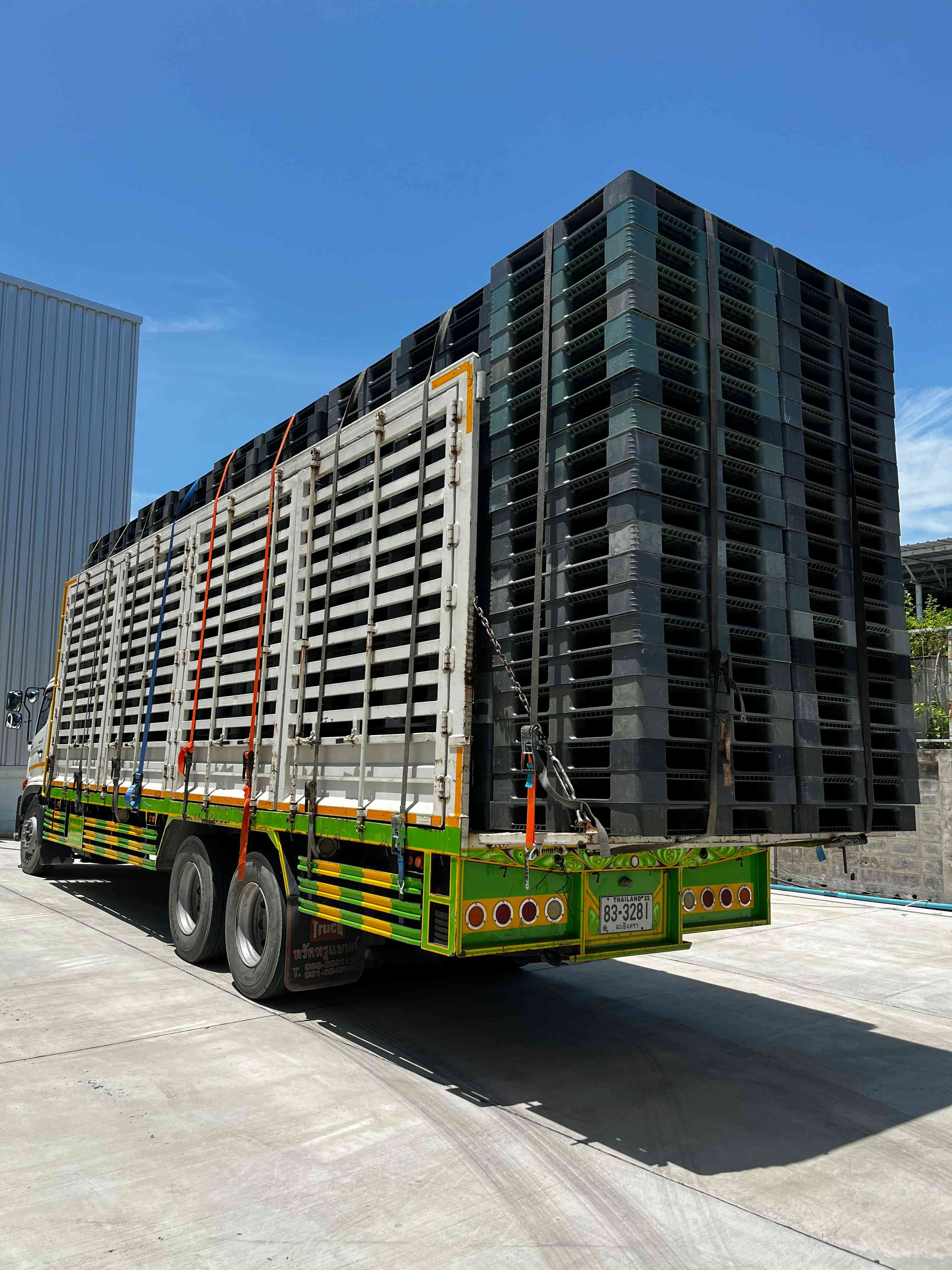
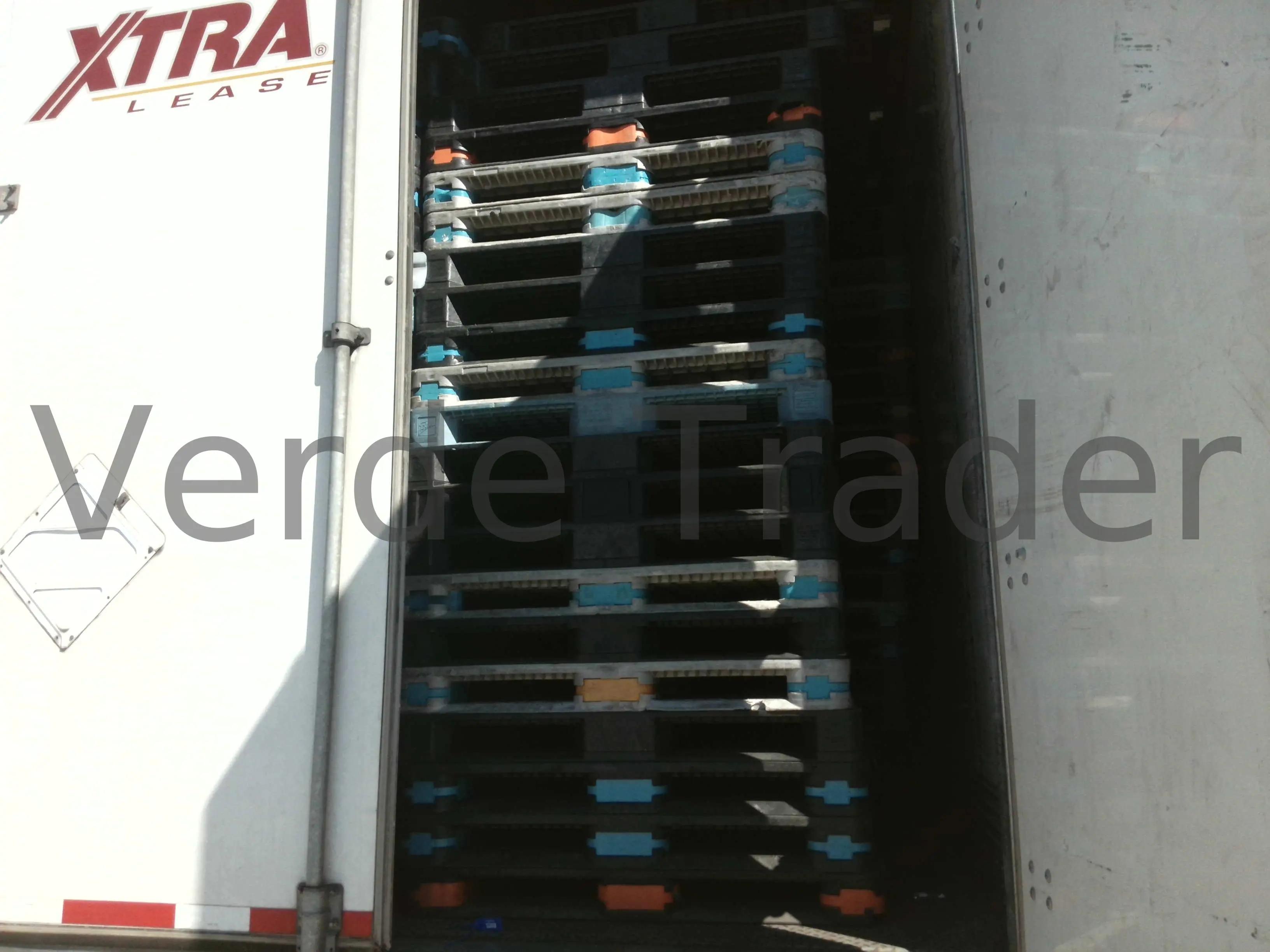
Nestable pallets loaded for export
There's no separate product category called an "export pallet" the way there is for rackable or nestable. In practice, the term describes a plastic pallet built and specified around one job: crossing an international border as cheaply and quickly as possible, usually on a single outbound trip. Three things tend to define it. It's nestable, so empty units take up minimal space on the return leg or in the exporter's yard. It's lightweight, because every pound of pallet is a pound of dunnage the shipper pays freight on without it being product. And it's plastic specifically because that material sidesteps a regulatory requirement that applies to wood.
That regulatory piece is the one most buyers don't fully understand until they've been burned by it once, so it's worth walking through in detail before getting into construction and sizing.
Why plastic pallets are exempt from ISPM-15
ISPM-15 (International Standards for Phytosanitary Measures No. 15) requires wood packaging material used in international trade to be treated before it crosses a border, specifically to kill wood-boring insect pests that could otherwise spread between countries. ISPM-15 recognizes approved heat-treatment and fumigation schedules for regulated wood packaging. These include conventional heat treatment, dielectric heating, methyl bromide fumigation, and sulfuryl fluoride fumigation, although the treatments available in a particular country may vary. A wood pallet has to go through one of these before it's cleared to ship, and it has to carry the stamped mark proving it.
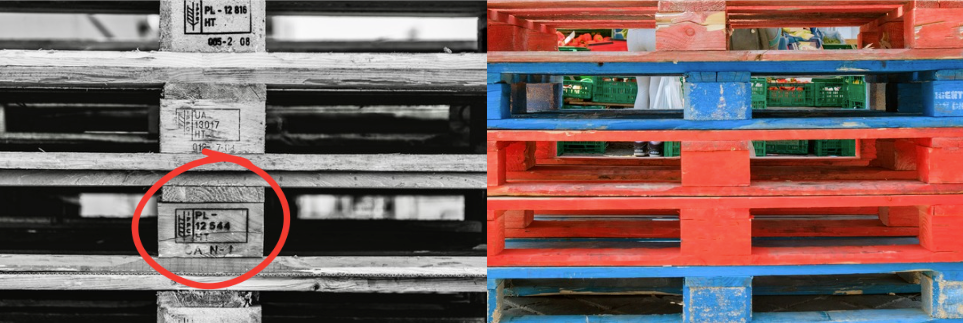
The IPPC stamp wood pallets must carry. Plastic pallets carry no equivalent mark because none is required.
Plastic pallets are outside the scope of ISPM-15 because the standard regulates wood packaging material that can carry wood-boring pests. Therefore, an all-plastic pallet does not require an ISPM-15 treatment mark or treatment certificate. Exporters must still comply with any other customs, sanitation, food-safety, or destination-country requirements that apply to the shipment.
Heat treatment requires heating the wood core to 56°C and holding it there for 30 minutes in a dry kiln. Methyl bromide fumigation seals the pallets in a chamber and fumigates them directly. Both add a processing step, a cost, and a scheduling dependency that a plastic pallet simply doesn't carry.
This is the reason plastic shows up disproportionately in export lanes even though it isn't necessarily the cheaper or more sustainable option on every other metric. For a one-way international shipment, skipping the treatment step and its associated delay can outweigh a higher per-unit purchase price.
How export pallets are built lighter
Plastic pallet production doesn't follow one fixed weight or size standard the way wood pallets loosely do around the Euro pallet or GMA footprint. Plastic pallet weight varies widely by footprint, construction method, load rating, and whether the pallet is nestable, stackable, or rackable. Export-focused models are often designed to minimize tare weight, but the manufacturer's specification sheet should be used rather than applying a universal weight ceiling. Manufacturers reduce weight through design choices such as nestable legs, optimized ribbing, thinner sections, and lower material use. Depending on the model, an export-oriented pallet may be injection molded or structural-foam molded.
Manufacturer product lines reflect this directly. Monoflo International's nestable pallets, for example, are built specifically around compact footprints and lightweight, ergonomic construction, with impact-resistant ribbing engineered into the legs rather than added mass. The nine-leg nestable designs used across their 48x40, 48x45, and 30x42 pallets are built to survive repeated forklift handling without carrying the weight penalty of a rackable, beam-spanning design.
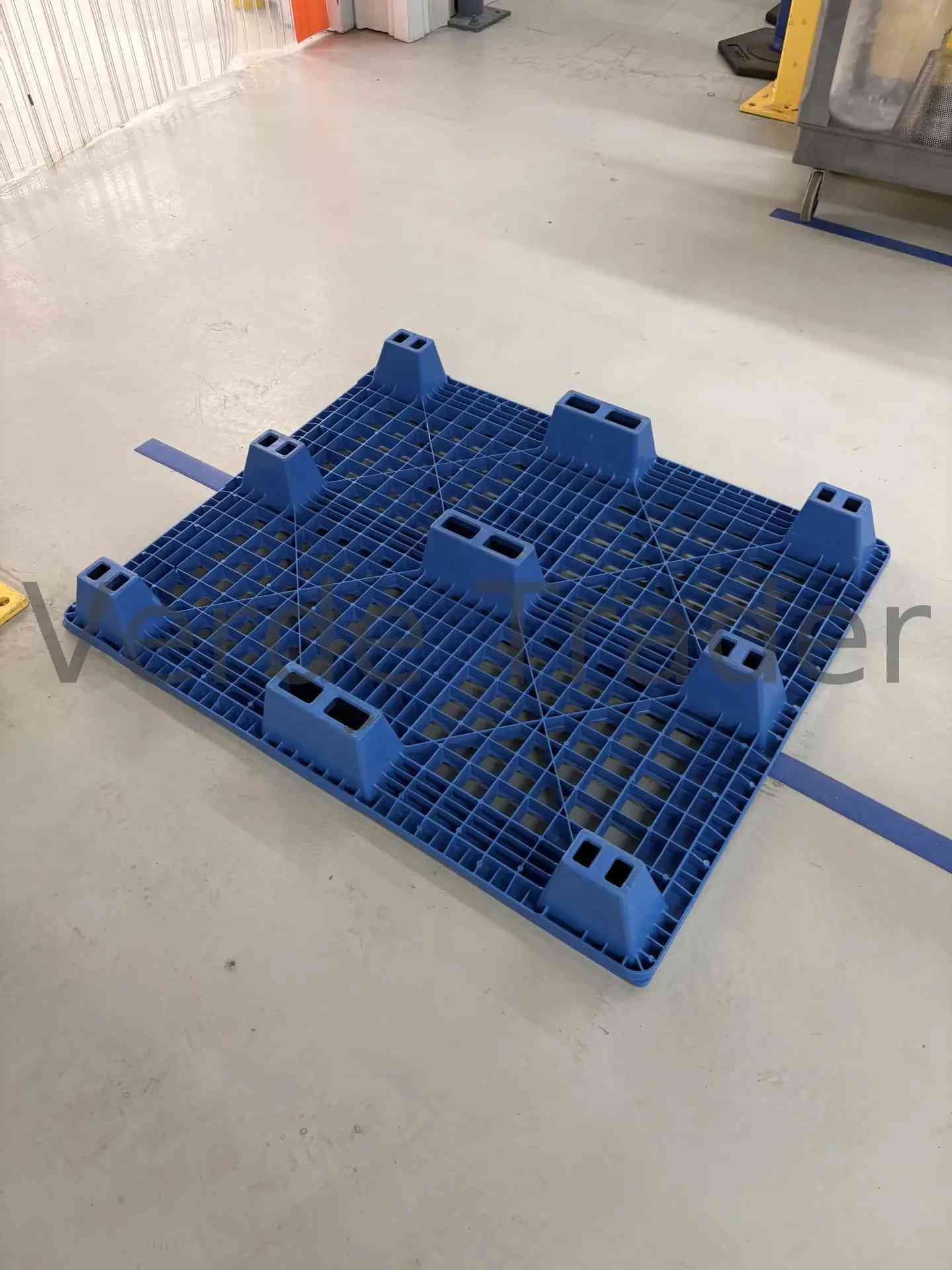
Ribbed leg construction on a lightweight nestable pallet
The tradeoff is load capacity. A lighter export pallet isn't built to span a beam rack under a heavy static load the way a rackable warehouse pallet is - it's built to survive one outbound trip carrying a defined payload, then either get discarded, recycled, or occasionally returned empty at a fraction of the freight cost of a heavier pallet.
Sizes and specs used in international shipping
There is no single universal export pallet size. Unlike wood, where the Euro pallet (1200 x 800 mm) and the U.S. GMA pallet (48 x 40 in.) dominate by convention, plastic pallet sizing varies by manufacturer, industry, and destination market. The footprints below are common nestable, export-oriented models currently in production.
Footprint and stack height both matter once a pallet has to fit a container doorway.
Source: Monoflo International nestable pallet spec sheets, current production line.
Because there's no fixed standard, the footprint on an export pallet is a specification decision, not an assumption. Confirm it against the destination country's handling equipment and, if the pallet is going into a container, against the container's internal width before committing to a size.
Pallet height and container fit
Footprint decides whether a pallet fits a container's floor. Height decides whether the load fits through the door and stacks the way you planned once it's inside. A standard 20-foot or 40-foot dry container has an internal height of roughly 90 inches at the door opening, and every inch of pallet height eats into the load height budget available for product before the container is full.
Lightweight nestable export pallets typically run 4.0 to 5.5 inches tall, on the low end of plastic pallet height ranges generally, which is one of the reasons they show up so often in export lanes: less pallet height means more usable load height per container, and that difference compounds across a full shipment. If a load is double-stacked inside the container, pallet height gets counted twice, once per tier, so confirming the exact figure on the spec sheet matters more on export lanes than domestic ones.
Height also affects forklift and pallet jack access at both ends of the trip. Loading docks and handling equipment vary by country and port, so a pallet's tine entry clearance, not just its overall height, should be confirmed against the equipment at the origin and destination, particularly for lanes where the receiving facility uses different equipment than what loaded the container.
A few inches of pallet height rarely breaks a single shipment. Multiplied across a container's full load and repeated over hundreds of shipments a year, it is a real cost line, which is why export buyers who ship at volume track pallet height as closely as footprint.
For overall height ranges across all plastic pallet types, see our sizes and dimensions guide.
Shipping performance testing
Pallets go through drop, vibration, and compression testing before an exporter trusts them with a full load
Several voluntary standards and test methods can be used to evaluate pallets and palletized shipments before shipping. Two commonly relevant references are ASTM D4169 and ISO 8611. ASTM D4169, Standard Practice for Performance Testing of Shipping Containers and Systems, lays out a laboratory test sequence covering handling, warehouse and vehicle stacking, vibration, and concentrated impact, run in order on the same unit to simulate what it will actually encounter in transit by truck, rail, or sea. It's not specific to pallets, but it's the standard exporters lean on to validate that a palletized load will survive the trip intact.
ISO 8611, in three parts, is the pallet-specific counterpart. It defines test methods for nominal load, maximum working load, and durability comparison across racking, stacking, and general handling conditions. Where D4169 tests the shipment as a whole, ISO 8611 tests the pallet on its own - useful when comparing whether a lighter export-focused pallet still holds up under the load it's actually rated for, rather than the load a heavier rackable pallet of the same footprint could handle.
Neither standard is universally required for international shipping. When a shipment uses regulated wood packaging material, authorities in participating destination countries may inspect it for ISPM-15 treatment and marking compliance. All-plastic pallets are outside the scope of ISPM-15, but other shipment and destination-country requirements may still apply. Performance testing under these standards is a risk-management step exporters take voluntarily to avoid a load failure mid-transit, which is a far more expensive problem than a slightly heavier pallet would have been.
Frequently asked questions about export plastic pallets
Do export plastic pallets need a customs stamp or certificate the way wood pallets do?
No. The IPPC stamp required under ISPM-15 only applies to wood packaging material. Plastic pallets have no equivalent mark or certificate requirement at customs because the regulation they'd otherwise need to comply with doesn't apply to them in the first place.
Are export plastic pallets fumigated before shipping?
No. An all-plastic pallet does not require fumigation under ISPM-15 because the standard applies to regulated wood packaging material. However, fumigation or another treatment could still be required for the cargo itself if a destination country's rules require it.
Can an export plastic pallet make a return trip, or is it built for one-way use only?
Most are built for a single outbound trip, but nothing structurally prevents reuse if the pallet survives the journey undamaged. The economics usually don't favor shipping it back empty, though. Freight on the return leg for a low-value one-way pallet rarely pencils out compared to buying a new one at the destination or recycling the material.
What happens to export plastic pallets once they arrive at their destination?
It depends on the receiving facility. Some are broken down for local recycling since the resin (HDPE or PP) has resale value as regrind. Others get repurposed locally for a different internal trip if they're still structurally sound. Because they're not designed for repair the way wood is, a damaged export pallet is generally retired rather than fixed.
How much weight can an export plastic pallet actually carry, compared to a heavier rackable pallet?
Less. Export pallets are deliberately built lighter, with thinner walls and less structural material, which caps their load capacity below what a solid, injection molded rackable pallet built for warehouse beam racking can handle. The tradeoff is intentional: less material means less shipping weight, and export pallets aren't meant to span a beam rack under a static warehouse load in the first place.
Sources
This page draws from three source types: published testing standards that define how pallets and shipments are validated, peer-reviewed research for the ISPM-15 mechanics and weight data, and manufacturer spec sheets for the export pallet footprints in current production. Verde Trader's own transaction experience informs the practical notes throughout.
Industry standards (what is defined)
- ASTM D4169-23e1. Standard Practice for Performance Testing of Shipping Containers and Systems. Source for the laboratory test sequence (handling, stacking, vibration, concentrated impact) covered in the shipping performance testing section.
- ISO 8611 (Parts 1-3). International standard for flat pallets used in materials handling, covering nominal load, maximum working load, and durability testing. Source for the pallet-specific testing methods described alongside ASTM D4169.
Peer-reviewed research
- Anil et al., Journal of Industrial Ecology (2020). Life cycle assessment comparing wooden and plastic pallets in the U.S. grocery industry. Source for the ISPM-15 treatment mechanics (heat treatment temperature and duration, methyl bromide fumigation) and the decabromine fire retardant note in the ISPM-15 section.
- Pulgar and Oliveira, Springer (2023). Review of production and material types for pallets. Source for the plastic pallet weight ceiling (approximately 34 kg, from roughly 21 kg/m² of polymer input), the "no standard for sizing" finding, and the Euro pallet and GMA wood pallet weight comparisons in the construction and sizing sections.
Manufacturer specifications
- Monoflo International, 48 x 40 Nestable Pallet spec sheet. Source for the 48x40 export footprint and nine-leg nestable construction details in the sizing and construction sections.
- Monoflo International, 48 x 45 Nestable Pallet spec sheet. Source for the 48x45 AIAG footprint used in automotive and manufacturing export.
- Monoflo International, 30 x 42 Nestable Pallet spec sheet. Source for the compact 30x42 footprint used in direct store delivery and tight-clearance loading.
Our sales data (what people actually pay)
- Verde Trader sold-order data. More than 8,000 orders through mid-2026. Practical notes on export pallet condition, buyer use cases, and closed-loop economics on this page draw from our experience buying and selling plastic pallets. For current availability, browse plastic pallets for sale or request a quote.
