

Rackable Plastic Pallets Explained
How rack load ratings, deck design, and reinforcement decide whether a pallet is safe to store in your racking.
Published October 14, 2026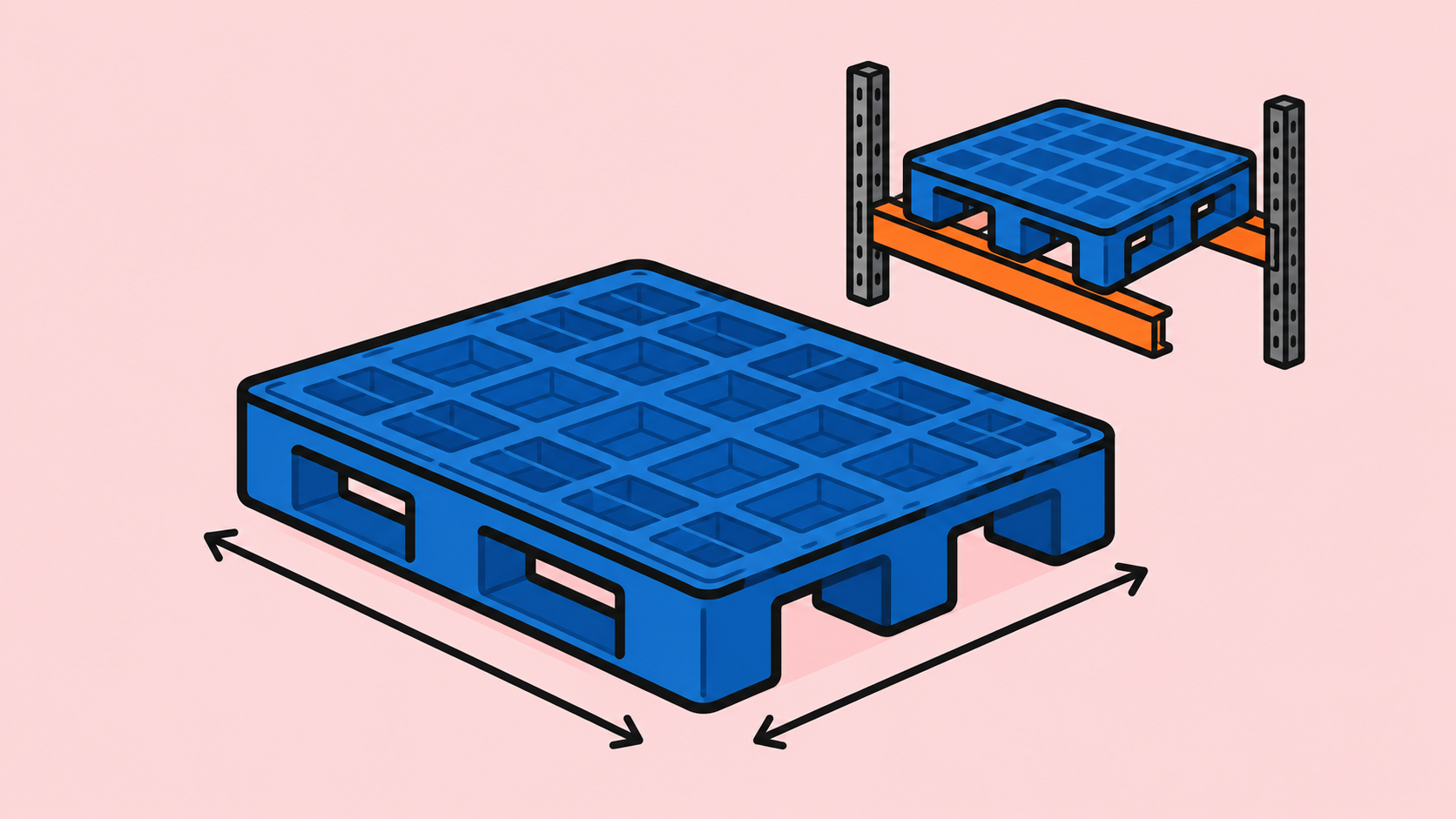
By John Anderson, Owner of Verde Trader
10+ years buying and selling used industrial packaging.
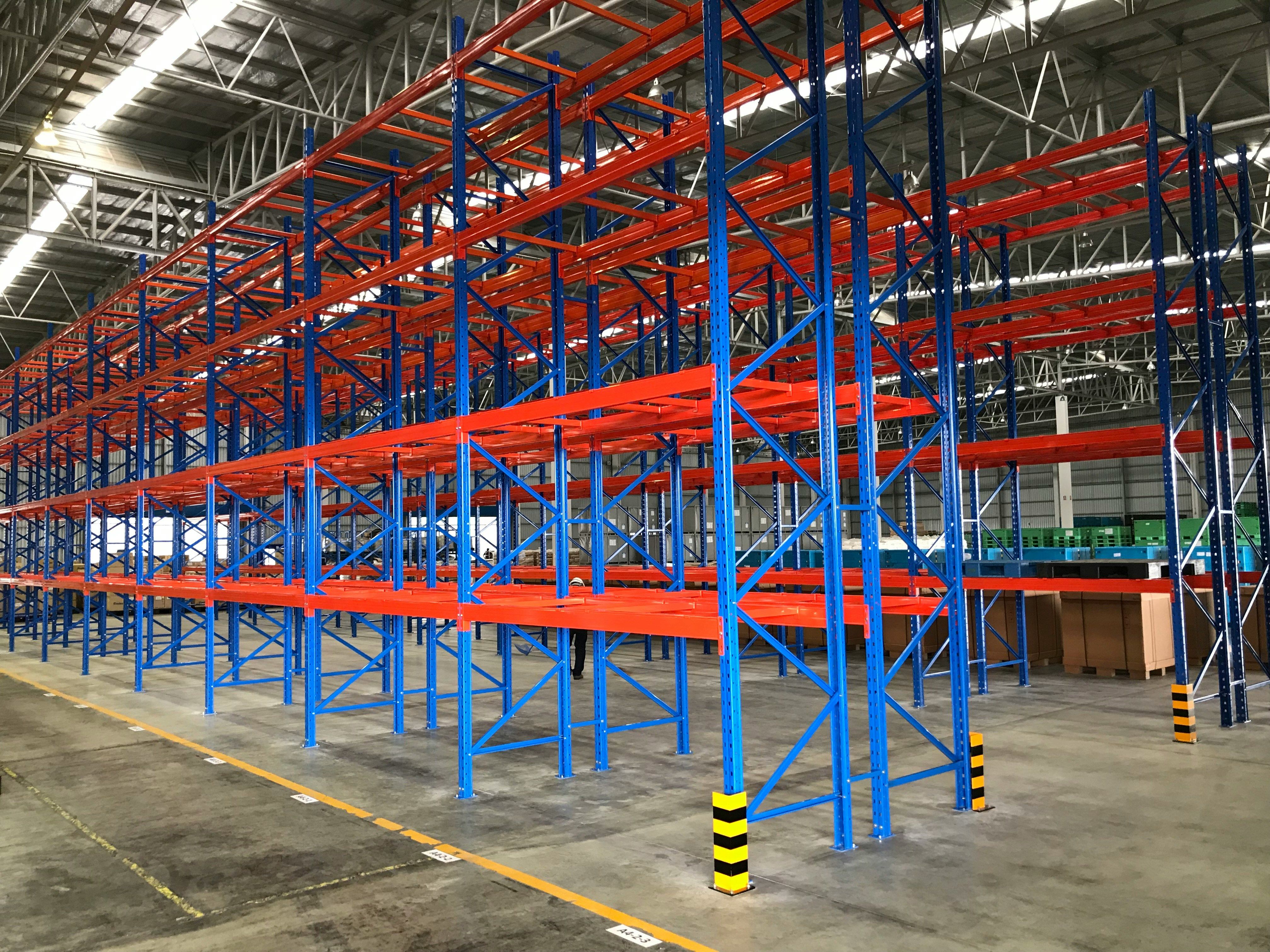
Not every plastic pallet belongs in a rack. When a pallet sits on a flat floor, its full base is supported. When it goes into a selective pallet rack, only two narrow beam rails carry the load, and the pallet has to bridge the unsupported span between them. That single difference - floor support versus edge support - is what separates a rackable pallet from one that is not.
This page explains what structural characteristics make a plastic pallet rackable, how rack load ratings are established through standardized testing, why deck geometry and runner design affect how a pallet behaves under rack conditions, and what reinforcement does to long-term performance. If you want pricing or inventory, browse our rackable plastic pallets for sale.
The short version
- Unsupported racking is the defining condition: a rackable pallet must bridge two beam rails with no support underneath, which is structurally different from floor storage.
- Rack load ratings come from standardized testing: ISO 8611 and ANSI MH1 define how manufacturers establish the rack load number on a spec sheet - it is not estimated.
- Runner design is the key structural variable: continuous full-perimeter or three-runner bases resist the bending forces of unsupported racking; nine-leg and perimeter-foot bases do not.
- Deck geometry determines sag risk: open-deck pallets concentrate load on fewer contact points; solid-top and closed-deck designs distribute it more evenly and reduce midspan deflection.
- Reinforcement and material affect long-term performance: steel rods and structural foam construction reduce creep under sustained rack loads, especially at elevated temperatures.
What makes a pallet rackable
The term "rackable" describes a specific structural condition, not a material or brand. A rackable pallet is designed to carry a rated load while supported only at two edges - the two beam rails of a selective pallet rack. The area between the rails is open air. The pallet is essentially a beam, spanning a gap, with everything riding on its ability to resist bending.
A rackable pallet carries its load while supported only at two edges. The unsupported span in between is what distinguishes racking from floor storage.
This is fundamentally different from floor storage, where the entire base sits on a flat surface and load is distributed across all contact points. On a rack, the only contact points are the two outer runners or edges resting on the beams. The pallet's base must resist the bending moment created by the load between those two support points.
The structural role of the runner
The runner - the longitudinal structural member on the bottom of a plastic pallet - is what does the work in racking. A continuous three-runner base or a solid perimeter runner provides the beam-like rigidity needed to span the gap between rack rails without excessive deflection. Designs that rely on individual legs or corner feet can handle floor stacking well but lack the continuous cross-section needed to resist bending across an open span.
What beam spacing does to the equation
Every rackable pallet is rated for a specific beam spacing, which is the distance from center to center of the two rails carrying it. The wider that spacing, the longer the unsupported span, and the greater the bending stress on the pallet. A pallet rated at 2,000 lbs rack load assumes a particular beam spacing. Put the same pallet on wider rails and the real-world capacity drops, even though the spec sheet number has not changed.
The rack load rating on a spec sheet is only valid at the beam spacing used during testing. Always confirm the beam spacing in your own racking before relying on a published rating.
Rackable pallets are not necessarily stronger overall than other types. A stackable pallet often has a higher static load rating because floor support is uniformly distributed. The rackable pallet earns its designation specifically through its performance under edge-supported, unsupported-span conditions - which is a different test entirely.
How rack load is tested
A rack load rating is not a theoretical estimate. It is the result of a physical test conducted under controlled conditions. Two standards define how that test works: ISO 8611 (internationally) and ANSI MH1 (in the United States). Both specify the same basic method: support the pallet at two points simulating rack beams, apply a distributed load at the center, and measure deflection.
What ISO 8611 requires
ISO 8611 covers flat pallets for materials handling and includes three separate parts addressing test methods, performance requirements, and selection and use. For rack testing, the standard places the pallet on two support rails positioned to simulate the beam spacing of a standard rack system. A uniform load is applied to the deck surface, and deflection is measured at the center of the pallet. The test runs both a short-term load test and a long-term creep test, because plastic - unlike steel - can continue to deflect over time under sustained load.
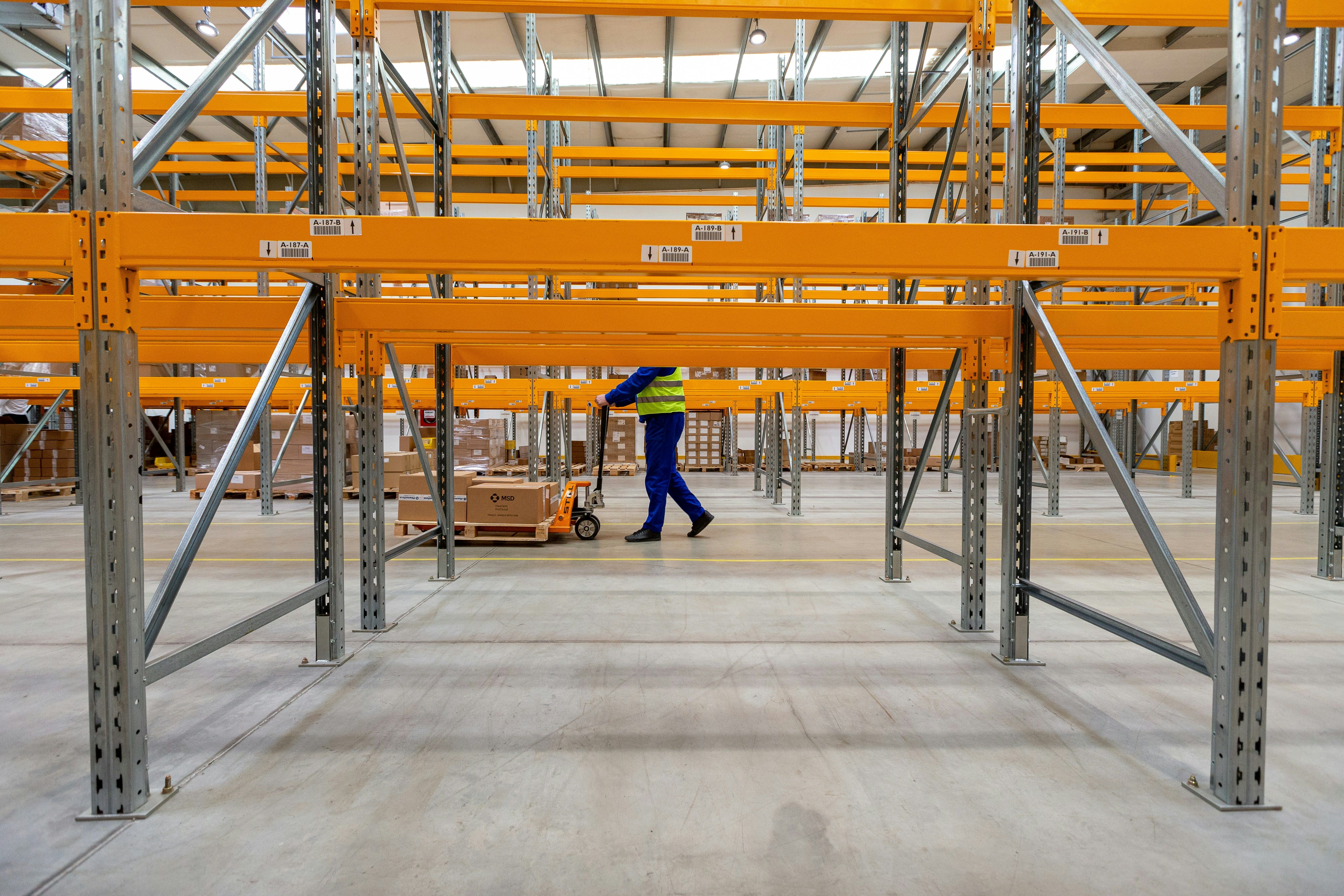
ISO 8611 rack testing supports the pallet on two rails to simulate beam conditions and measures deflection under a known distributed load.
The creep test matters for plastic
Wood deflects under load and largely recovers. Plastic can creep - meaning it continues to deflect slowly under a constant load even after the initial loading. ISO 8611 addresses this with a sustained load test that runs over a defined period, measuring how much additional deflection occurs. This is why a plastic pallet's long-term rack load rating can be lower than its short-term rating, and why the spec sheet number may specify both.
Why ratings are model-specific
Because the test measures actual physical behavior - deflection of a specific geometry at a specific beam spacing - the result is model-specific and beam-spacing-specific. Two pallets from the same manufacturer at the same price point can have meaningfully different rack load ratings if their runner profiles and deck geometries differ. This is why the spec sheet, not a general product category, is the right reference for any racking application.
For typical rack load ranges across pallet styles, see our plastic pallet weight capacity guide, which covers the full range of dynamic, static, and rack load ratings.
Source: ISO 8611 (Parts 1-3); ANSI MH1-2021.
Why deck geometry causes sag
The top deck of a plastic pallet is not just a surface to put things on. It is a structural element. In racking conditions, the top deck and the runners work together as a composite cross-section that must resist bending. The geometry of that deck - how much material is where - directly affects how the pallet deflects under rack load.
How open decks concentrate load
An open-deck pallet has gaps between deckboards or a grid pattern in the top surface. The load from the product above travels down through the contact points - the deckboards or grid ribs - to the runners. Because the load path is concentrated at fewer, narrower contact points, the bending stress per unit area in the deck and runners is higher than in a solid-top design carrying the same total weight. The midspan - the area furthest from the two rack beams - is where this shows up as visible sag first.
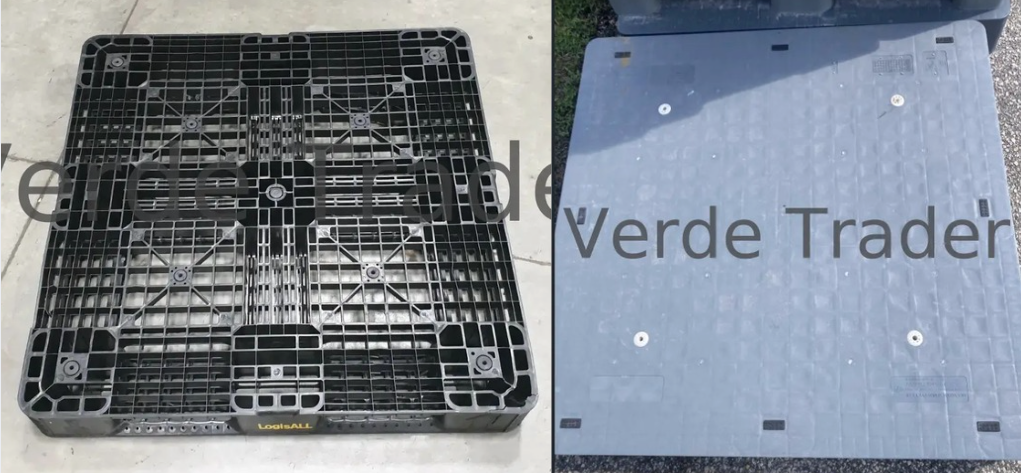
Open-deck pallets channel load through fewer contact points. Solid-top designs spread that load more evenly, which reduces midspan deflection under rack conditions.
What solid top and closed deck designs do differently
A solid-top deck presents a continuous flat surface. Load distributes across the entire top face and transfers to the runners uniformly. The closed-deck design - solid on top, with a formed underside - adds section depth, which increases the moment of inertia of the overall cross-section. A higher moment of inertia means more resistance to bending for the same amount of material. This is the same geometric principle that makes an I-beam stiffer than a solid rectangular bar of equivalent weight.
Runner count and continuity
The number of runners and whether they run continuously from edge to edge also matter. A three-runner design with full-length runners creates a consistent load path from the deck down to the beam rails. A six-runner or nine-leg design may carry the same static load on a flat floor, but the shorter, interrupted load paths of a leg-style base provide less resistance to the midspan bending specific to racking. The Virginia Tech Center for Packaging and Unit Load Design has documented how deck stiffness and runner geometry interact under real warehouse load conditions, which explains why identical products on different pallet configurations produce different deflection results.
Sag in a rack does not always mean failure - but it can cause product damage, interfere with forklift entry, or create an uneven base for the load above. Any visible, permanent deflection after unloading is a sign the pallet was overloaded relative to its rack rating.
For guidance on which deck style fits your operation, see the rackable plastic pallets guide on Verde Trader.
Reinforcement and materials
Two construction choices significantly affect how a plastic pallet performs under sustained rack load: whether steel rods are embedded in the runners, and which polymer the pallet is molded from. Both decisions are about managing creep - the slow, ongoing deflection that plastic undergoes when held under constant stress over time.
Steel rod reinforcement
Some rackable plastic pallets are manufactured with steel rods running longitudinally through the runners. Steel has a much higher stiffness (modulus of elasticity) than either polypropylene or high-density polyethylene. When a steel rod is embedded in a runner, the composite cross-section resists bending more effectively than plastic alone, and the steel controls creep because it does not cold-flow under sustained stress the way polymer chains do. The result is a pallet that can carry higher rack loads for longer periods without exceeding acceptable deflection limits.
Steel rods embedded in the runners act as a composite beam, giving the pallet significantly higher resistance to bending and creep under sustained rack load.
Structural foam molding
Structural foam molding is a process that injects a blowing agent into the plastic melt during molding, producing a pallet with a dense outer skin and a lower-density foam core. This is not insulation foam - the material is still rigid plastic. The benefit is a higher strength-to-weight ratio than solid injection molding because the foamed core acts like the web of an I-beam: it separates the dense outer skins, increasing section depth without adding proportional weight. For racking applications, structural foam pallets tend to have better long-term rack load performance than solid-injection pallets of similar weight, because the geometry compensates for the slightly lower density of the core.
HDPE versus polypropylene under rack conditions
Most rackable plastic pallets are molded from high-density polyethylene (HDPE) or polypropylene (PP). Both are suitable for racking, but they behave differently at temperature extremes. HDPE remains relatively tough in cold environments and is the more common choice for food and beverage racking where pallets may move between refrigerated and ambient spaces. Polypropylene has a higher flexural modulus at room temperature, meaning it is stiffer under normal conditions, but it becomes brittle at low temperatures. For cold storage or freezer racking, HDPE is generally preferred. For ambient warehouse racking where stiffness at room temperature is the priority, PP can perform well. Either way, the key is that the rack load rating on the spec sheet was established at a specific temperature - if your operating environment is significantly different, verify the rating applies.
Source: ISO 8611 (Parts 1-3); ANSI MH1-2021; manufacturer specifications from sources cited below.
Rackable vs. nestable vs. stackable
All three pallet types carry load and work with standard forklifts and pallet jacks. The difference is in where and how they carry it - and that difference is structural, not cosmetic.
Why nestable pallets are not rackable
A nestable plastic pallet is designed so that empty pallets stack inside each other - the legs or feet of one pallet drop into the spaces of the one below, a design that requires individual contact points rather than continuous runners. Individual legs can support load on a flat floor, but they cannot bridge an open span. Place a nestable pallet on rack beams and the midspan between the legs has no support structure to resist bending, making it unsuitable for racking.
Why stackable pallets are not rackable
Stackable plastic pallets are engineered for high static load ratings - the load that can sit on them while they are stacked on a floor. Their base designs prioritize column stacking strength, with the structure oriented to transfer load vertically from one pallet's corners or perimeter to the one below. This vertical load path is excellent for floor stacking but does not translate to the horizontal bending resistance required for racking. A stackable pallet on rack beams will typically sag more than a rackable pallet of similar weight, even if its static rating is higher.
When each type makes sense
If your operation uses both racking and floor staging in different areas, a rackable pallet works in both environments. The reverse is not true. For a full look at available inventory across all three types, browse all plastic pallets on Verde Trader.
Planning rack slot height around your pallets
Everything above covers how a rackable pallet behaves once it's on the beams. Before it gets there, the pallet's own height has to fit the vertical space between one beam level and the next. That number is different from beam spacing (the horizontal distance a rackable pallet bridges) and it is easy to overlook until a loaded pallet does not clear the beam above it.
The math is straightforward: pallet height, plus the tallest expected load height, plus a clearance margin, has to be less than the vertical distance to the next beam level up. Most warehouses build in at least 4 to 6 inches of clearance above the load, beyond the pallet and product height, to account for load variation and to give a forklift operator room to place the pallet without scraping the beam above. Rackable plastic pallets typically run 5.5 to 6.5 inches tall, which is the number to start that calculation with, not the load height alone.
Pallet height also determines the tine entry clearance a forklift needs at the bottom, and the mast lift height required to place a loaded pallet at your highest rack level. If you are reconfiguring racking or adding a new pallet type to an existing system, confirm both numbers, the entry clearance underneath and the vertical clearance above, against your specific forklift and rack beam layout before ordering pallets at volume.
Beam spacing (horizontal) and rack slot height (vertical) are two separate numbers, and both come from the same pallet. A rack rating tells you the pallet can bridge the beams. It does not tell you it will physically fit in the slot. Confirm both before committing to a layout.
For overall height ranges across all plastic pallet types, see our sizes and dimensions guide.
Frequently asked questions about rackable plastic pallets
What does "unsupported racking" actually mean?
Unsupported racking means the pallet sits on two beam rails with nothing supporting the area between them. Only the outer edges of the pallet make contact with the rack. The pallet has to bridge that open span by itself, which creates a bending force in the runners and deck. This is different from floor storage, where the entire base area is supported. The term "unsupported" describes the condition the pallet faces, not a weakness in the system - it is the standard operating condition for any pallet rack.
How is a rack load rating actually established?
Manufacturers establish rack load ratings through physical testing defined by ISO 8611 and ANSI MH1. The pallet is placed on two support rails set at a specified beam spacing, a distributed load is applied to the deck surface, and deflection is measured. The test includes both a short-term load test and a long-term creep test, because plastic continues to deflect slowly under sustained load in a way that wood does not. The rack load rating on a spec sheet is the load at which deflection stays within the acceptable limit at the tested beam spacing - not an estimate.
Does a solid top deck perform better in racking than an open deck?
Generally yes, for rack conditions specifically. A solid top deck distributes load across the full deck surface before it transfers to the runners, rather than concentrating it at deckboard contact points. This more even distribution reduces peak bending stress in the runners at midspan. Closed-deck designs also add section depth, which increases the cross-section's resistance to bending. That said, open-deck pallets can be fully rackable - the runner design matters more than the deck surface in most cases. The spec sheet rack rating accounts for the actual tested geometry, so always use the published number for the specific model rather than assuming based on deck style alone.
What happens if a plastic pallet's rack load rating is exceeded?
Two things can happen depending on the severity. At loads modestly above the rating, the pallet will deflect more than the acceptable limit - the deck and runners sag visibly at midspan. If the excess load is removed and the deflection is permanent rather than elastic, the pallet has taken a set and its future rack load capacity is reduced. At significantly higher loads, the pallet can fail structurally - the runners crack or the deck buckles - causing the load to drop. Either outcome is a safety and product damage risk. Rack load ratings exist specifically to prevent this. Operating at or below the rating with the correct beam spacing is the only safe approach.
Do steel rod reinforced pallets have higher rack ratings than unreinforced ones?
Yes, typically. Steel has a modulus of elasticity roughly 30 times higher than polypropylene or HDPE, meaning it resists bending far more effectively for the same cross-sectional area. When steel rods are embedded in the runners, the composite cross-section resists the bending forces of unsupported racking much more effectively than plastic alone. The bigger practical benefit for racking is creep resistance - steel does not cold-flow under sustained load, so a steel-reinforced pallet's rack performance degrades less over time than an unreinforced plastic pallet carrying the same load. For operations that store loaded pallets in racks for extended periods, reinforced construction is worth the higher unit cost.
Why does creep under sustained load matter more for rackable pallets than other types?
Creep is the tendency of plastic to slowly deform under a load held over time, and it matters more for rackable pallets because they're the only type that spans an open beam gap - any gradual sag shows up as visible deflection in the unsupported span rather than being caught by a solid floor underneath. Elevated temperatures accelerate creep in both HDPE and PP, so a rackable pallet holding a steady load in a hot warehouse or near a heat source can deflect more over time than the same pallet would at room temperature, even without any change in the actual weight on it. Nestable and stackable pallets experience the same material softening, but since they sit on a supported surface, gradual deflection isn't a structural concern the way it is on an open rack span. For how temperature affects load capacity generally across all plastic pallet types, see our load capacity guide.
Sources
This page draws on two types of sources: published standards that define how rack load is tested and what rackable means structurally, and peer-reviewed research on plastic pallet materials and performance. All sources below appear in the Plastic Pallets research library maintained by Verde Trader.
Industry standards (what is defined)
- ISO 8611 (Parts 1-3) - Pallets for materials handling: flat pallets. The international standard covering pallet test methods, performance requirements, and selection criteria. Parts 1 and 2 define the bending and rack load test procedures directly cited throughout this page, including the two-rail support method and deflection limits.
- ANSI MH1-2021 - Pallets, slip sheets, and other bases for unit loads. The U.S. standard for pallet performance requirements. Defines load capacity testing methodology including the rack load test, and establishes the terminology used by North American manufacturers on spec sheets.
- ASTM D1185-98a(2025) - Test methods for pallets and related structures. Covers test methods for pallets used in warehousing and shipping, including stiffness and load-carrying capacity under racking conditions.
- Virginia Tech Center for Packaging and Unit Load Design - Investigating the effect of pallet deckboard stiffness. Research on how deck stiffness interacts with load distribution and deflection - the academic basis for the deck geometry discussion on this page.
Peer-reviewed research
- Godley, M.H.R. (1997). Plastic design of pallet rack beams. Thin-Walled Structures, 29(1-4), 175-188. Elsevier. Structural analysis of pallet racking beam behavior under load, including the role of beam-column connector stiffness. The foundational engineering reference for understanding how racking structures behave under pallet loads.
- Koci, V. (2019). Comparisons of environmental impacts between wood and plastic transport pallets. Environment International. Elsevier. Life cycle assessment comparing wood and plastic pallets. Includes material data for polypropylene and HDPE pallets relevant to the materials section on this page.
- Khan, M.M.H. et al. (2021). Environmental impacts of wooden, plastic, and wood-polymer composite pallets: a life cycle assessment approach. International Journal of Life Cycle Assessment. Springer Nature. Comparative LCA including material and performance data for injection-molded plastic pallets relevant to the construction and materials discussion.
- Weththasinghe, K.K. et al. (2022). Carbon footprint of wood and plastic as packaging materials - an Australian case of pallets. Journal of Cleaner Production. Elsevier. Includes manufacturing process data for plastic pallets, covering molding methods and material inputs used to contextualize the structural foam and injection molding discussion.
- Anil et al. (2020). Life cycle assessment comparison of wooden and plastic pallets in the grocery industry. Journal of Industrial Ecology. Wiley. LCA study including material specifications and use-phase performance data for plastic pallets in active supply chain environments.
Manufacturer specifications
- Monoflo International 48x40 Rackable Pallet spec sheet. Published rack load rating, beam spacing assumptions, and construction details for a standard rackable injection-molded plastic pallet.
- Rehrig Pacific 40x48 Rackable Pallet spec sheet. Manufacturer spec including rack load rating and construction details used to illustrate the reinforcement discussion.
- Rehrig Pacific 40x48 GMA Rackable 2400 Pallet spec sheet. High-capacity rackable pallet spec, cited for the upper range of rack load performance in commercially available plastic pallets.
- Monoflo International Nestable and Rackable Pallet spec sheet. Comparative spec sheet showing both nestable and rackable designs from the same manufacturer - useful for understanding how base geometry differs between the two types.
