| Dynamic load | 2,200 to
Where a 5-runner pallet works depends on the model. The fits below come from what makers say on their pages for 5-runner models, so read them as common uses rather than guarantees for any one pallet.

Settings where a 5-runner pallet fits
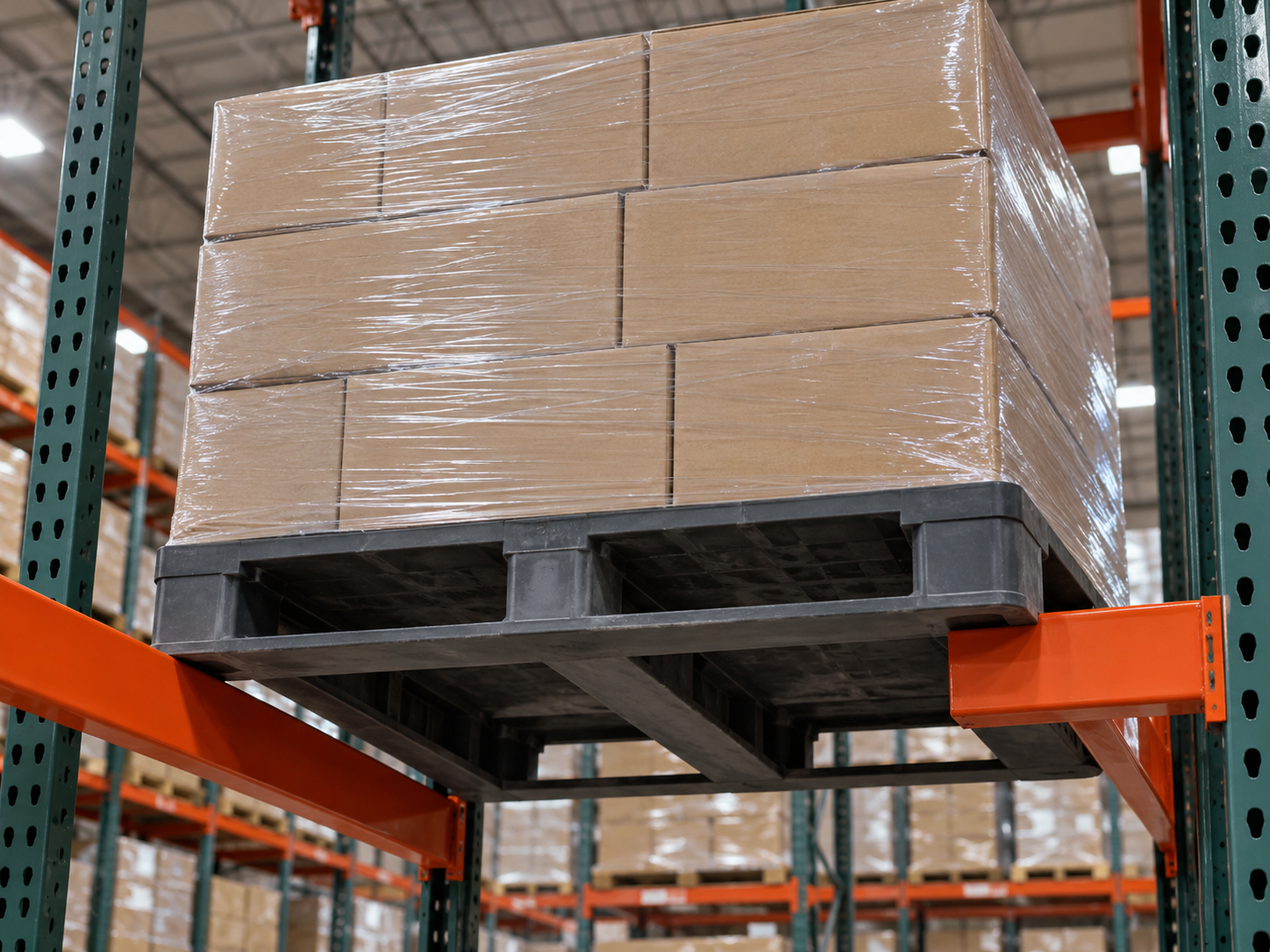
Racked storage
All but one of the models checked list a rack rating, and several makers describe their models for use in high racks. For how rack ratings are read, see our guide to rackable pallets.
Conveyors and automated handling
Several makers list roller conveyors for some models, and some models are described for automated high-rack warehouses or automated processes.
Loads from light to heavy
Makers position these models across a wide span. Some pages describe lightweight to medium loads or industries that do not need heavy-duty pallets, while others describe big bags, bagged goods and heavy loads.
Hygiene-sensitive work
Some models are described for hygiene-sensitive work, with closed-deck models among them. Pages use wording that runs from semi-hygienic to food, pharmaceutical and chemical industries, and several mention easy cleaning.
Pools and closed loops
Some makers describe models for closed loops, pools and distribution, and some for high-rotation use. Some pages also list export.
Uses are what makers list for some of their models in the 1200 x 1000 mm (about 47 x 39 in) and 48 x 40 in sizes. They are not a rating for every 5-runner pallet.
Several makers list the same model for both high racks and conveyors, so one pallet can cover a loop that includes both.

Most of the shortfalls come down to what a listing leaves out and how its ratings are set.
Ratings are printed figures, and most pages do not say how a rating was tested. Figures from different makers are therefore not a like-for-like comparison, even when the models look alike.
Limits to weigh
Entry is often not stated
Makers state 4-way entry for half of the models checked. Most of the rest state nothing, and one maker's wording about rack and conveyor use can be read more than one way. None of the pages for the 48 x 40 in models checked states an entry type.
Rack is the lowest rating
In every model checked that lists a rack rating, it is the lowest of the three ratings or ties for lowest. It runs from about a third of the dynamic rating up to the same figure, and from about 8 to 31 percent of the static rating.
Conveyor and rack use is not always listed
Some models are described for non-automated processes, and some for industries that do not need high racking capability. Some pages state no use at all.
Empties take room
Makers list about 390 to 570 pallets per full trailer, depending on the model and trailer type. Nestable designs pack empties more tightly, as our guide to nestable plastic pallets explains.
Counts and ratios come from the 24 full-size models checked: 20 in 1200 x 1000 mm (about 47 x 39 in) and 4 in 48 x 40 in. Trailer counts come from the pages that list them, and individual models vary.
Entry, test conditions and conveyor or rack use are three points a 5-runner page can leave unsaid.

The usual buying checks, such as reading the three load ratings, deck style and food-grade needs, are in our guide to what to check before you buy plastic pallets. A 5-runner pallet adds a few of its own.
The checks below cover what the 5-runner label leaves open. Where a seller can put the answers on a spec sheet or in writing, keep them with the order.
Checklist for a 5-runner pallet
1
Underside and runner count
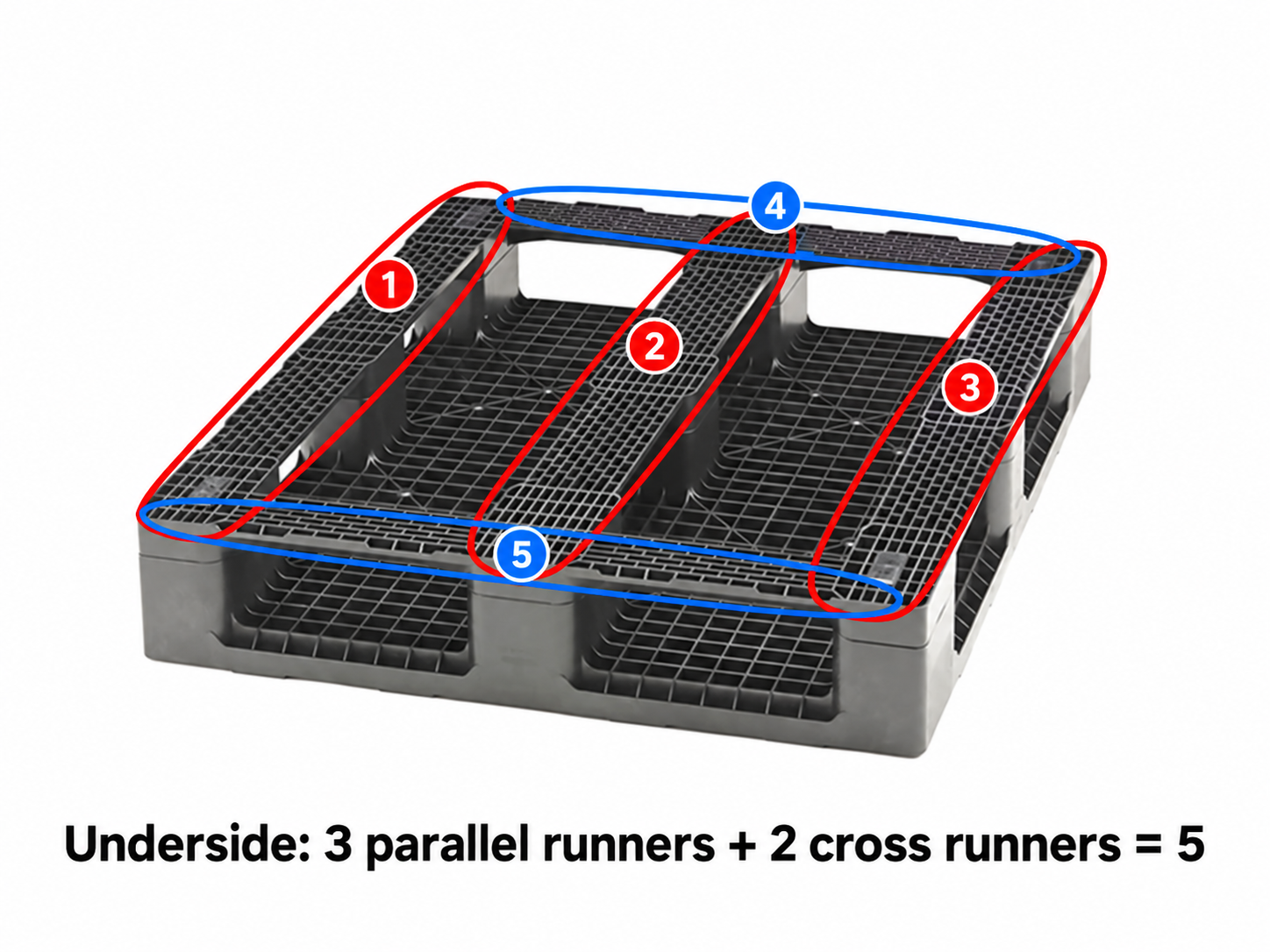
Ask for an underside photo or a sample, and count the runners. Some makers sell the same pallet with 3 or 5 runners, so the count on the listing is worth confirming against the photo.
2
Exact model, size and version
Get the model name or article number. Then confirm the footprint, which is either 1200 x 1000 mm (about 47 x 39 in) or 48 x 40 in, and whether the version has added profiles or rods. Ratings belong to one version, and a version with added profiles or rods can list a higher rack rating and a higher weight.
3
Entry
Ask which sides of the pallet can be entered and by which equipment. If the listing does not say, treat entry as unconfirmed.
4
Rack support
If the pallets will go into racking, ask how the pallet sits on the beams when the rack rating applies and compare that with your racks. A rack rating is not printed for every model, so do not assume one.
5
Equipment fit
If the pallets will run on conveyors or in automated storage, ask the seller to confirm that exact model for that use.
Several maker pages mark their load figures with an asterisk but print no footnote, so a rating can reach you without the conditions behind it.
Frequently asked questions about 5 runner plastic palletsHow do I read a model code such as OD-5R or CD-5R?Some makers build the model code from the deck and the runner count. In those catalogs, OD means an open deck, CD means a closed deck, and a number followed by R gives the runners, so OD-5R is an open deck with five runners and CD-5R is a closed deck with five runners. Not every maker uses this pattern, so read a code against the maker's own model page. Do 5-runner plastic pallets have anti-slip decks or rims?Some models do. Listings describe anti-slip features such as rubber inserts, grommets, plugs or strips on the deck, and rims that help hold a load or keep empty pallets in place when stacked. Some of these are options that are added or retrofitted, so it depends on the version. Are 5-runner pallets designed to handle fork contact?Several makers describe features meant for forklift handling, such as rounded corners or chamfered edges on both sides of the runners. These are described in words on the model's page rather than rated, so there is no figure to compare. Are 5-runner pallets made from recycled plastic?Some makers describe their 5-runner models as reusable and made from recycled plastic, and some say the pallets are recycled at the end of their life. Material and recycled content vary by model, and a page that does not state the material does not say either way. What conditions do load ratings assume?Where a maker prints its test conditions, ratings assume an evenly distributed load at about 68 F (20 C). The static rating assumes the pallet on flat ground, and the dynamic rating assumes it carried on a forklift. The rack rating assumes the pallet resting on two supports for more than 100 hours, and the same note says results can vary with the loading method, the temperature and the storage time. For how the three ratings differ, see our guide to how much weight plastic pallets can hold.
This page draws on manufacturer product pages and spec sheets, one test standard and one pallet pool guide. Ranges cover full-size models only, in 1200 x 1000 mm (about 47 x 39 in) and 48 x 40 in. Kilogram figures are converted to pounds and rounded. Counts and ratios, such as how many models state 4-way entry, are tallied from the pages below. Pages were accessed October 2026.
Industry standards and research (what is defined)
Manufacturer specifications
- Cabka: Eco i5 OD-5R; Eco i5.1 OD-5R; Eco i5.2 OD-5R; Eco i7.1 OD-5R; Endur i7 OD-5R; Endur i7 CD-5R; Endur i9 OD-5R; Endur i9.1 OD-5R. 5-runner models and their same-page 3-runner versions in 1200 x 1000 mm: weight, entry, loads and some use wording. Entry is printed once per page, and some tables carry an asterisk with no footnote text.
- Craemer: E3-5 data sheet; E3-5 news page; CR3-5; CR4-5; D3-5; TC3-5; TC3-5 flyer. Weight, loads, "in racking" figures, use wording and, for E3-5 and TC3-5, 4-way entry. The CR3-5, CR4-5 and D3-5 pages state no entry. CR4-5 is 48 x 40 in. The data sheet and flyer print test conditions, and some product pages mark load tables with a footnote that is not shown.
- Tosca: PPP5 1210 spec sheet; DIC/MP3 1210 page. Weight, loads and use wording. Entry reads "2-ways in rack and 2 ways on a conveyor belt", which does not name 4-way. No test conditions are printed.
- Greystone: WDP 48x40 5-runner. 48 x 40 in, weight in pounds, and static, dynamic and rack ratings with and without three rods. States no entry and no use, and prints rack as N/A for the version without rods.
- Other bases in the comparison table: the 2-runner, 3-runner, 4-runner, 6-runner and nine-legged figures are carried over from our 4-runner guide, which lists the pages behind them. They were not re-derived for this page.
Terminology and background
- iGPS: Plastic Pallets: Your Definitive Guide. Three-runner and nine-legged pallets being technically skids, notched runners for 4-way entry and solid for 2-way, six-runner pallets also called cruciform or picture frame with two sets of three runners, nine legs letting pallets nest. General guidance, and it does not mention 5-runner pallets.
No standard or pool guide checked defines the term 5-runner, and none of the maker pages reviewed says where the five runners sit. Ratings are as printed, and only some documents print the conditions they were tested under.
Written by the Verde Trader operations team. We buy and sell used plastic pallets and have handled more than 8,000 orders through mid-2026.
Data source
Verde Trader sales records
For current pricing, request a quote
|