

What Is A 3 Runner Plastic Pallet
How it is built, how it compares, and what to check before you buy
Published October 19, 2026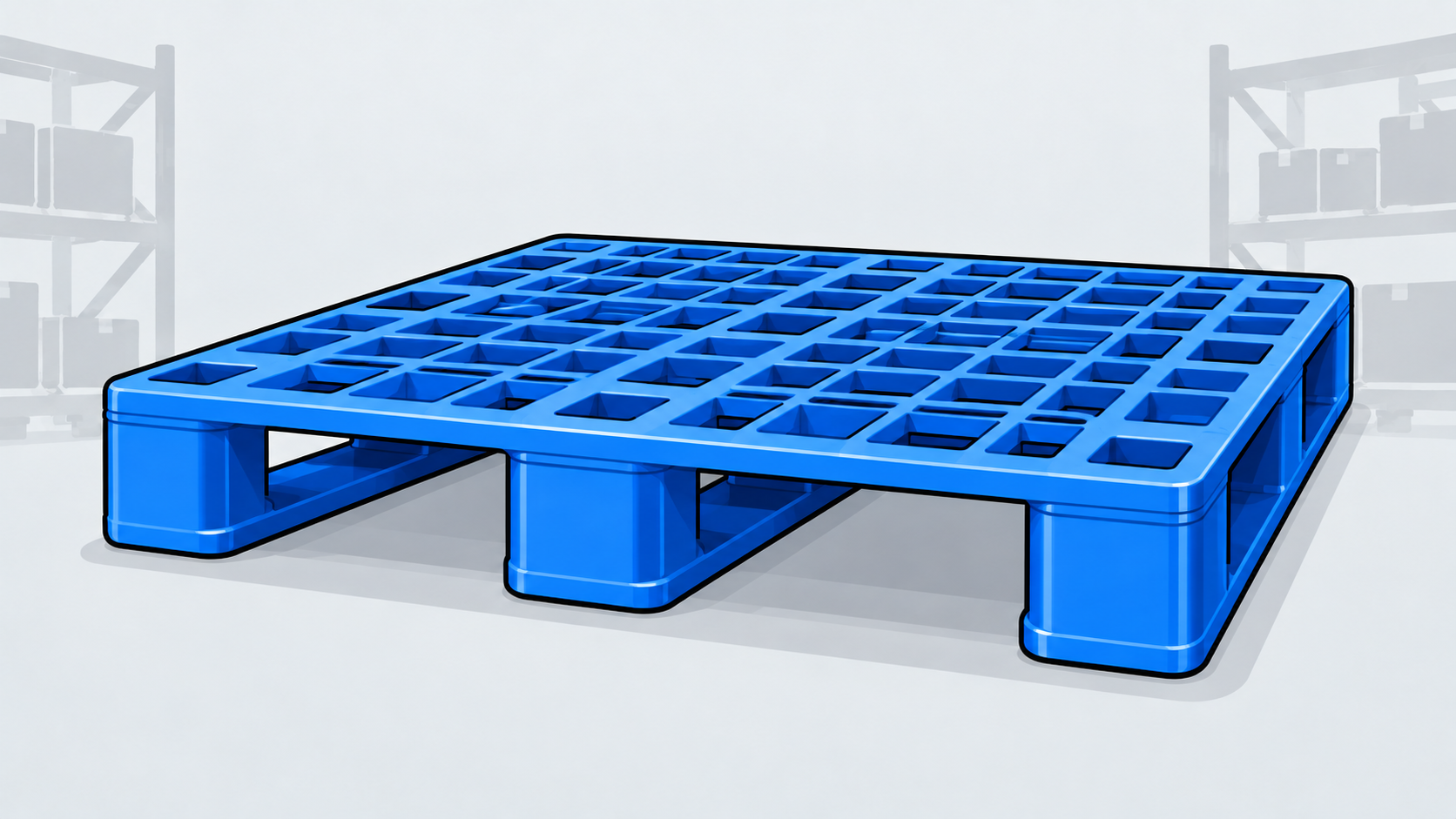
By John Anderson, Owner of Verde Trader
10+ years buying and selling used industrial packaging.
A 3-runner plastic pallet has three long, parallel runners under the top deck and no bottom deck. A 2-runner plastic pallet has two, and a 3-runner base adds a third. Whether forks can enter from two sides or all four depends on the model, because the runners can be notched or left solid.
I have spent more than 10 years buying and selling used industrial packaging, so I read a pallet listing the way a buyer does. This page explains how a 3-runner pallet is built, how it compares with other plastic pallet bases, and what to confirm before you buy one.
The short version
- Build: Three parallel runners under the top deck and no bottom deck. Many are one-piece moldings.
- Entry: Varies by model. Some are notched for 4-way entry, some are 2-way only, and several listings do not say.
- Typical range: Manufacturer listings show dynamic loads of about 2,000 to 6,000 lb, static loads of about 5,000 to 30,000 lb, and weights of about 24 to 52 lb.
- Rating note: Where a rack rating is listed it runs about 1,650 to 3,100 lb, and some models list none, so confirm it before racking any 3-runner pallet.
- Best fit: Routes where you know how forks and pallet jacks will approach, and loads that stay within the listed dynamic and static ratings.
Source: Product pages and spec sheets from ORBIS, Cabka, Craemer, Naeco Packaging and Greystone, and iGPS plastic pallet guides, accessed October 2026. Kilogram figures are converted to pounds and rounded. Ranges cover the models checked, not every 3-runner pallet.
How a 3-runner plastic pallet is built
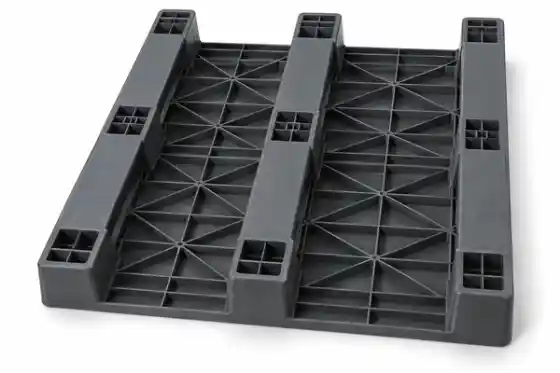
A 3-runner pallet has three parts that matter: a top deck, three runners underneath it, and the resin it is molded from. The deck carries the load. The runners lift the deck off the floor and leave room for forks to get underneath.
A 3-runner pallet is easy to mistake for a 2-runner plastic pallet that has an optional middle foot. In that 2-runner design the middle foot is extra support under the deck, not a third runner, and entry stays 2-way. In the other direction, manufacturer listings for a 3-runner pallet count all three as runners, and whether forks can enter from two sides or four depends on the model.
Manufacturers mold these pallets from HDPE or polypropylene, often recycled, and many make them in one piece, so the deck and runners are not separate parts that get assembled. Some models add reinforcement members, which can change the ratings between versions of the same pallet. For how base design affects ratings in general, see our guide to how much weight plastic pallets can hold.
Source: Product pages, spec sheets and brochures from ORBIS (Odyssey 3-Runner), Cabka (Eco i5, Eco i5.2, Eco US4, Type H1 and Hygienic i7.1), Craemer (CR3, CS, D, L, SL1 and Non-Stop series), Naeco Packaging (Flat 1210-C3 and Logic Pro 1210-G3) and Greystone (nestable 3-runner), accessed October 2026. Ranges cover full-size 3-runner models only, not half-size models or 5-runner versions. Kilogram figures are converted to pounds and rounded. Rack ratings are listed for some models only, rack figures printed without a unit are left out, and where a maker prints two rack figures for different support conditions (ORBIS), the lower one is used. All ratings are manufacturer-listed values and vary by model.
Terminology note: iGPS describes three-runner pallets as "technically skids due to the lack of a bottom deck." ASTM D1185, the pallet test standard, also uses the word skid in its scope. So a listing that says skid, runner pallet, or 3-runner pallet may describe the same kind of base, and the base description is the line to read.
How a 3-runner base compares with other bases
The base under a pallet largely decides how forks and pallet jacks can reach it, and whether it can nest or be racked. The table below sets the 3-runner base next to three other plastic pallet bases a buyer might be weighing, using the way manufacturers and iGPS describe them. It compares designs and does not rank them.
Swipe sideways to compare the other designs.
Source: iGPS, Plastic Pallets: Your Definitive Guide, and The 4-Way vs. the 2-Way Pallet; Rehrig Pacific spec sheets (44 x 56 high deck, 44 x 56 low deck and 40 x 48 rackable); Cabka product pages (Eco i5, Eco US4 and Hygienic i7.1); Craemer pallet brochure (April 2025). All accessed October 2026. Base descriptions and entry types are as each source states them. Individual models vary.
The closest neighbor is the 2-runner base, which has two runners instead of three and 2-way entry. We cover it in our guide to the 2-runner plastic pallet. Nine-legged pallets nest when empty, which saves space on returns, but the sources checked list no rack rating for them. For how nesting works, see our guide to nestable plastic pallets. For pallets built for racking, see rackable pallets explained.
A 4-way label can still mean different things. iGPS describes notched runner designs as partial 4-way: forklifts can enter from all sides, but pallet jacks are often limited to two. So a 4-way listing does not always mean every tool can enter from every side.
Where a 3-runner pallet works
Makers describe their 3-runner models for a handful of settings, and the four below come up across many listings. They show where the design fits, not that every 3-runner pallet suits each one, so check the exact model.
The simple base can also make a 3-runner pallet an inexpensive, durable choice. For what plastic pallets sell for, see our guide to how much plastic pallets are worth.
Food suitability depends on the exact model and material. Some models are listed for non-food or industrial use only, even when the same maker offers a food-grade version, so check the listing for the model you are considering.
Where a 3-runner pallet falls short
The downsides come from two places: entry, which varies by model, and ratings, which are easy to misread. The limits below apply to many 3-runner pallets, so check each one against the model you are considering.
The three ratings measure different things and sit far apart on most listings. The table shows how they relate across the full-size 3-runner models checked.
Shares are worked out from the listed ratings of the full-size 3-runner models checked that give the ratings in question. Individual models vary.
Listed ratings are the manufacturer's own figures, and test conditions are not always stated. Temperature, loading method and storage time can all change what a pallet carries, so compare ratings across makers with care.
What to check before you buy
For the general checklist, such as reading the three load ratings, deck style, and food-grade needs, see our guide to what to check before you buy plastic pallets. The checks below are the ones that matter most for a 3-runner base.
Source: Craemer pallet brochure (April 2025); iGPS guides on 4-way vs. 2-way entry and static vs. dynamic loads; Cabka and ORBIS product pages; Molina, Horvath and West, Applied Sciences 2021, 11(7), 3029; ISO 8611-1:2025, flat pallet test methods (published February 2025). Web pages accessed October 2026.
Try a few before you commit. ISO 8611-1:2025, the standard test methods for new flat pallets, notes that load-capacity tests "do not replace the value of conducting field tests." A small trial on your own route and racks is one way to do that.
Frequently asked questions about 3 runner plastic pallets
Is a 3-runner plastic pallet stronger than a 2-runner pallet?
Not automatically. Capacity depends on the material, the reinforcement and the overall design, not on runner count alone, and ratings vary widely from model to model within both types. Compare the static, dynamic and rack ratings on the spec sheet for each exact model instead. Check out our blog on how much weight all plastic pallets can hold to compare.
Can loaded 3-runner plastic pallets be stacked?
Only if the maker lists that model as stackable, so do not assume it from the shape. The static rating is the one that applies while a pallet sits still under a stack, so compare it with the full weight above the bottom pallet. If the spec sheet gives no stacking guidance, ask the maker before building stacks.
Are 3-runner plastic pallets nestable?
Some are designed to nest when empty, which saves space on return trips, and the listing will say so. A 3-runner pallet is not nestable by default, so do not assume it nests unless the listing says it does.
Are 3-runner plastic pallets made from recycled plastic?
Several makers list 3-runner models made from recycled plastic as well as virgin material, and the spec sheet should say which one a given model uses. Recycled content alone does not tell you what a pallet can carry, so judge it by the same listed ratings as any other pallet.
What affects the price of a 3-runner plastic pallet?
Size, material, load ratings and reinforcement, whether the pallet is new or used, its condition, and the order quantity all move the price. For current ranges, see our pricing guide, or request a quote for the exact model you need.
Sources
This page draws on published industry standards and research, manufacturer product pages and spec sheets, and plastic pallet guides from iGPS. They answer different questions, so we keep them separate. Where a source describes one model, or pallets in general, rather than every 3-runner pallet, the page says so. Web pages were accessed in October 2026.
Industry standards and research (what is defined)
- ISO 8611-1:2025: Pallets for materials handling, flat pallets, part 1: test methods. Source for the note that load-capacity tests do not replace field tests, and background on how flat pallets are tested. This is the current edition, published in February 2025.
- ASTM D1185: Standard test methods for pallets and related structures employed in materials handling and shipping. Its scope also uses the word skid, which supports the terminology note in the construction section. Background for how pallet load ratings are tested.
- Molina, Horvath and West: Development of a Friction-Driven Finite Element Model to Simulate the Load Bridging Effect of Unit Loads Stored in Warehouse Racks (Applied Sciences, 2021, 11(7), 3029). Source for the point that how a unit load is built and how its pallet is supported in racking affect how the pallet performs. It studies unit loads in racks in general, not 3-runner or plastic pallets specifically.
Manufacturer specifications
- ORBIS: 4048 Odyssey 3-Runner pallet spec sheet. Source for its 48 x 40 x 6 in size, 51 lb weight, and static, dynamic and rack ratings. ORBIS also prints a higher 6,000 lb rack figure for a different support condition. This page uses the 3,000 lb figure, which ORBIS describes as unsupported rack capacity. The ORBIS product page gives the same load figures.
- Cabka product pages: Eco i5 (OD-3R), Eco i5.2 (OD-3R), Eco US4 (OD-3R), Type H1 recycled (OD-3R) and Hygienic i7.1 recycled (CD-3R). Source for sizes, weights, entry types and ratings, for the 3-runner and 5-runner versions sold under the same model names, and for the non-food listing of the recycled Hygienic i7.1.
- Craemer: Pallet brochure (April 2025). Source for the one-piece 3-runner models, the 3-runner and 5-runner versions of the same pallet, the nestable nine-legged pallet, which models Craemer lists for automated processes, and how Craemer defines static, dynamic and racking loads. The Craemer CR3 product page lists the CR3 variants with their weights and ratings, and its suitability for roller conveyors and automated edge rack warehouses.
- Naeco Packaging data sheets: FLAT 1210-C3 and LOGIC PRO 1210-G3, as published in Naeco's catalog on DirectIndustry. Source for sizes, weights, ratings and the one-piece recycled-material construction.
- Greystone: Nestable 3 Runner product page. Source for its 48 x 40 x 6.25 in size, 24 lb weight, and 5,000 lb static and 2,000 lb dynamic ratings. The rack rating is listed as N/A. The page sits under Greystone's Nestable & Export Pallets category and says nothing more about export use.
- Rehrig Pacific product pages: 44 x 56 High Deck, 44 x 56 Low Deck and 40 x 48 Rackable. Source for the picture-frame and cruciform base description and the 4-way entry given by tapered edges, used in the base comparison.
Terminology and background
- iGPS: Plastic Pallets: Your Definitive Guide. Source for the runner terminology, including 3-runner pallets being technically skids, the notched and solid runner options and their entry types, and the descriptions of other bases. It also says 3-runner pallets are inexpensive and durable, but that 2-way entry can leave a pallet hard to retrieve. Where the guide's comparison table and its text differ, this page follows the text. The one exception is the nine-legged entry type, which comes from the table and is attributed to iGPS.
- iGPS: The 4-Way vs. the 2-Way Pallet: How to Choose a Pallet Type. Source for partial 4-way designs with notched runners, where forklifts can enter from all sides but pallet jacks are often limited to two, and for the handling trade-offs of 2-way pallets. It describes 4-way and 2-way pallets in general, not 3-runner pallets specifically.
- iGPS: Static Load Vs. Dynamic Load: Demystifying Pallet Load Ratings. Source for the definitions of static, dynamic and rack load ratings and how they relate.
