

What is a 2-runner plastic pallet?
How it is built, where it fits, and what to check before you buy
Published October 14, 2026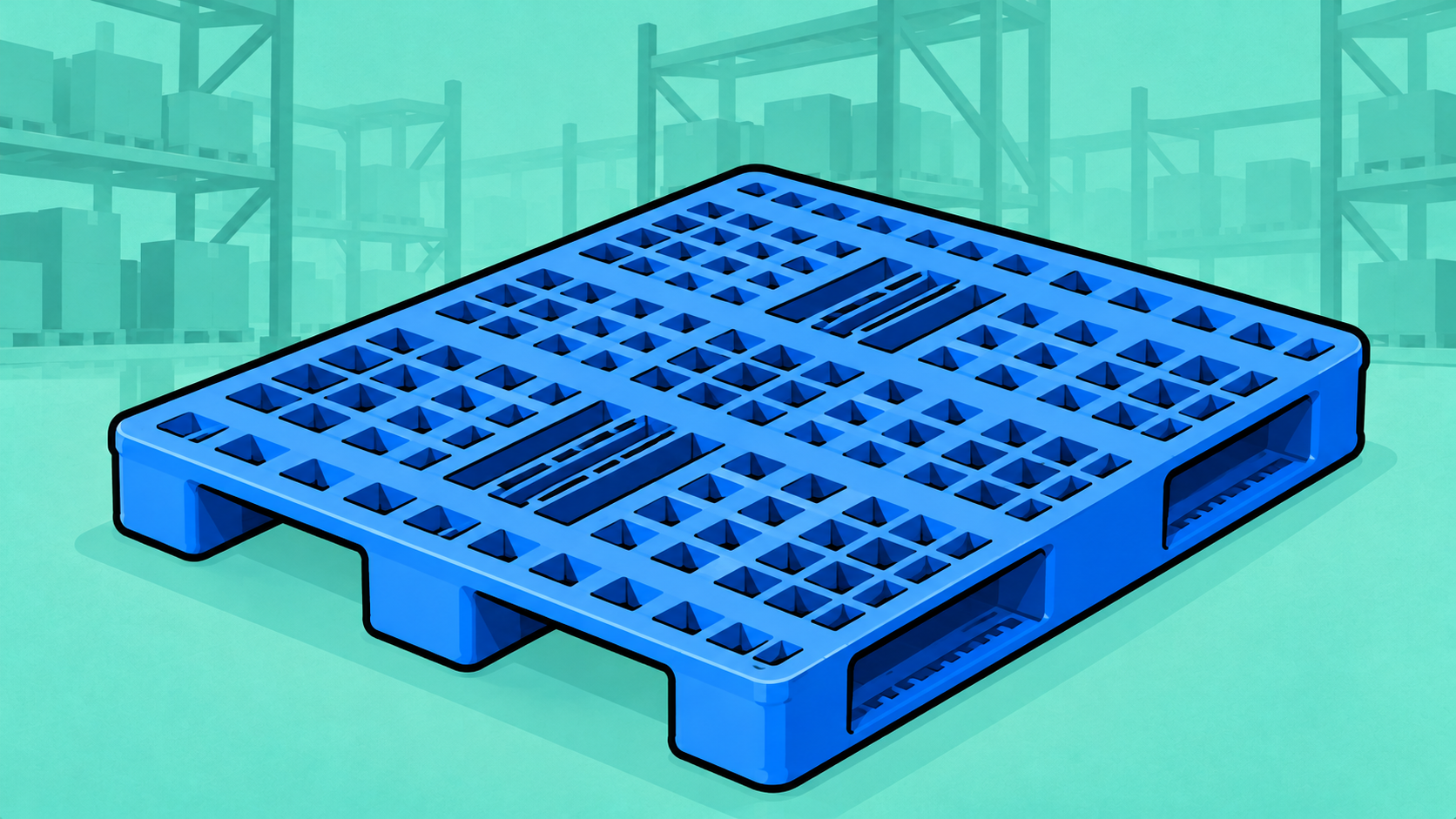
By John Anderson, Owner of Verde Trader
10+ years buying and selling used industrial packaging.
A 2-runner plastic pallet has two long, parallel runners under the deck instead of the feet, corner blocks, or three-runner base found on many other plastic pallets. Because the runners run in one direction, forklifts and pallet jacks can only enter from two opposite sides, which makes it a 2-way entry design.
I have spent more than 10 years buying and selling used industrial packaging, so I look at pallets the way a buyer does: how they are built, how they are handled, and what they are rated to carry. This page explains what a 2-runner pallet is, how it compares with other bases, and what to confirm before you buy one.
The short version
- Build: Two parallel runners under the deck.
- Entry: 2-way. Forks and pallet jacks enter from two opposite sides only.
- Typical example: One manufacturer's 40x24 model weighs 36 lb and is listed at 3,500 lb dynamic and 12,000 lb static.
- Rack rating: The same model is listed at only 800 lb in a rack, so confirm the rack rating before racking any 2-runner pallet.
- Best fit: Fixed routes where equipment approaches from the same sides every time.
How a 2-runner plastic pallet is built
A 2-runner pallet has three parts that matter: a top deck, two runners underneath it, and the resin it is molded from. The deck carries the load. The runners lift the deck off the floor and leave room for forks to get underneath.
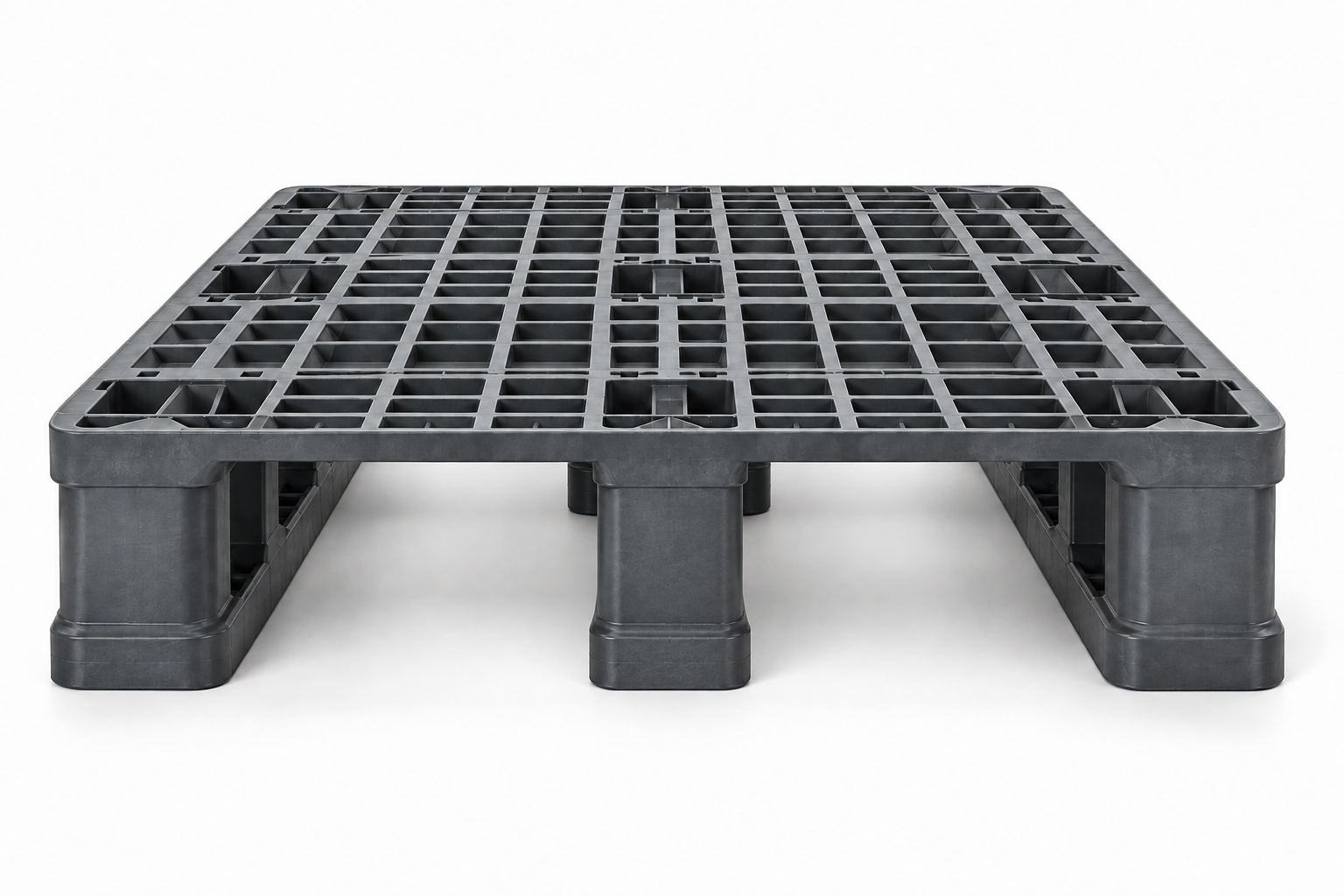
Some 2-runner pallets also have an optional middle foot between the two runners, so the underside can look like a 3-runner pallet at a glance. The middle foot is extra support under the deck, not a third runner. In the example, the top deck is open and the bottom base is listed as "2 Runner - Unidirectional Long Side." In plain terms, that is two runners that all run in the same direction. Because forks slide in along that direction, the pallet can only be entered from two opposite sides, which is 2-way entry.
It is a one-piece HDPE molding, so the deck and runners are not separate parts that get assembled. For how deck style and base design affect ratings in general, see our guide to how much weight plastic pallets can hold.
Source: Nelson Company, NPP-4024-2R-Display product page, accessed October 2026. The manufacturer describes its technical data as guideline values that may vary with intended use, features, raw materials, and environment.
Terminology note: iGPS describes three-runner pallets as "technically skids due to the lack of a bottom deck." If a listing says skid, runner pallet, or 2-runner pallet, check the base description and the underside photo to confirm what you are getting.
How a 2-runner base compares with other bases
Runner layout largely decides how forklifts and pallet jacks can approach a pallet. The table below sets the 2-runner base next to other plastic pallet bases a buyer might be weighing, using the way each source describes them. It compares designs and does not rank them.
Swipe sideways to compare the other designs.
Source: Nelson Company, NPP-4024-2R-Display product page (accessed October 2026); iGPS, Plastic Pallets: Your Definitive Guide. Base descriptions and entry types are as each source states them. Individual models vary.
Nine-legged pallets use legs instead of runners, which is what lets empty units drop into one another. For how nesting works, see our guide to nestable plastic pallets.
Entry type depends on the specific model. iGPS notes that three-runner pallets can be notched for 4-way entry or left solid for 2-way entry only, so confirm which version you are looking at on the spec sheet.
Where a 2-runner pallet works
The clearest guidance on uses comes from how a manufacturer lists the uses of its 2-runner model and from how iGPS describes 2-way pallets in general. The common thread is a known route: pallets that get picked up from the same sides every time.
Source: Nelson Company, NPP-4024-2R-Display product page (accessed October 2026); iGPS, "The 4-Way vs. the 2-Way Pallet: How to Choose a Pallet Type" (February 2026). Uses are as Nelson lists them for this one model and are not a rating for every 2-runner pallet.
There is also a cost angle. iGPS says 2-way pallets are simpler to manufacture, which keeps prices lower compared with block-style designs.
These uses come from one manufacturer's listing for one pallet model. Another 2-runner pallet may be rated or approved differently, so check the spec sheet for the exact model, especially for food or pharmaceutical use.
Where a 2-runner pallet falls short
Most of the downsides trace back to the two-sided entry. iGPS lists them for 2-way pallets in general, and the Nelson example adds one that shows up in its load ratings.
The ratings add a second limit. A forklift rating does not carry over to a rack. On the Nelson example, the rack rating is 800 lb, less than a quarter of its 3,500 lb dynamic rating. A 2,000 lb load, for example, is within the dynamic rating but well over the rack rating.
Source: iGPS, "The 4-Way vs. the 2-Way Pallet: How to Choose a Pallet Type" (February 2026); Nelson Company, NPP-4024-2R-Display product page (accessed October 2026). The iGPS points describe 2-way pallets in general. The ratings are those Nelson lists for this one model.
A footprint does not tell you the base. Rehrig Pacific lists its 24 x 40 half pallet, about the same footprint as the Nelson example, with 4-way entry (Rehrig Pacific product page, accessed October 2026). Confirm the base style from the spec sheet or an underside photo, not from the dimensions.
What to check before you buy
A 2-runner pallet adds a few checks to the usual buying list. For the usual ones, such as reading the three load ratings, deck style, and food-grade needs, see our guide to what to check before you buy plastic pallets. The checks below are the ones that matter most for a 2-runner base.
Source: Nelson Company, "Capacity Ratings for Plastic Pallets" (updated September 2026); "Racking: Is your Pallet Material up for the Job?" (updated September 2026); "Are published load ratings accurate?"; and the NPP-4024-2R-Display product page (accessed October 2026). The 800 lb rack figure is for that one model.
Ratings are a starting point, not a guarantee. In one Nelson rack test, two 48 x 40 pallets with published ratings of 2,200 lb and 1,000 lb showed "no practical difference" in rack strength under a 1,000 lb banded film roll.
Frequently asked questions about 2 runner plastic pallets
Can a pallet jack move a 2-runner plastic pallet?
Yes, from either of its two open sides. A 2-way pallet lets forklifts or pallet jacks enter from two opposite sides only. What matters most is entry clearance, the gap between the floor and the underside of the top deck. A pallet can be tall overall and still have an opening that a manual jack’s forks cannot slide into cleanly. Check before you buy.
Is a 2-way pallet stronger than a 4-way pallet?
Sometimes. Solid runners that run the full length of the pallet add strength across the base, and a 2-way pallet’s weight capacity can exceed that of a pallet with notched runners. That comparison is with notched designs, not with every 4-way pallet, and ratings vary by model. Compare the listed dynamic, static, and rack figures instead of assuming either way.
What do dynamic, static, and rack load ratings mean?
Static load is what a pallet can hold when it is not moving, such as when it sits in a stack. Dynamic load is the most it can carry while a forklift or pallet jack is moving it. Rack load is what it can hold while spanning the open gap between rack beams. Static is usually the highest of the three and rack the lowest, so match each rating to how you will actually use the pallet.
How are plastic pallet load ratings tested?
Makers set ratings using a mix of calculations and lab or field testing, and there is no single method every one of them follows. Standard test methods exist, such as ASTM D1185, which covers the performance of pallets, including plastic ones, through static stiffness and strength tests and dynamic tests of structural reliability. If a rating matters for your use, ask the maker how it was determined and under what conditions.
Where do I find the load rating for a used pallet, and what if there is no rack rating?
Start with the manufacturer’s spec sheet for that model, since capacities are typically issued by the maker. Age, material, and condition can all affect how much a pallet carries, so a used pallet may not match its published figure. Pallets designed for racking normally list a rack rating, so if the spec sheet has none, do not assume the pallet is rackable. Ask the seller before it goes on beams.
Sources
This page draws on one published industry standard and on manufacturer product pages and technical guidance. They answer different questions, so we keep them separate. Where a source describes one model, or 2-way pallets in general, rather than every 2-runner pallet, the page says so.
Industry standards (what is defined)
- ASTM D1185: Standard test methods for pallets and related structures employed in materials handling and shipping. Covers the performance of pallets, including plastic pallets, through static stiffness and strength tests and dynamic tests of structural reliability. Background for how the load ratings discussed on this page are tested.
Manufacturer specifications
- Nelson Company: NPP-4024-2R-Display plastic pallet (accessed October 2026). The named 2-runner model used as the example on this page. Source for its 40 x 24 x 6 in size, base description, 2-way entry, weight, dynamic, static, and rack loads, and the uses the manufacturer lists. Nelson describes its technical data as guideline values.
- Rehrig Pacific: 24 x 40 half pallet (accessed October 2026). A pallet with about the same footprint as the Nelson example and 4-way entry. Used to show that a pallet's dimensions do not identify its base style.
Terminology and background
- iGPS: Plastic Pallets: Your Definitive Guide. Source for the runner terminology, including three-runner pallets being technically skids, the notched and solid entry options, and the base comparison.
- iGPS: The 4-Way vs. the 2-Way Pallet: How to Choose a Pallet Type. Source for how 2-way pallets are used and what they trade off: fixed routes, handling, storage layout, trailer loading, automation, and upfront cost. It describes 2-way pallets in general, not 2-runner pallets specifically.
- iGPS: Static Load Vs. Dynamic Load: Demystifying Pallet Load Ratings. Source for the definitions of static, dynamic, and rack load ratings and for how age, material, and condition affect capacity.
- Nelson Company: Capacity Ratings for Plastic Pallets. Explains static, dynamic, and racking capacities, how ratings are set, and the assumption of an even load. Source for the load and rating checks.
- Nelson Company: Racking: Is your Pallet Material up for the Job? Covers heat, creep, and the temperature at which labs test pallets. Source for the temperature check.
- Nelson Company: Are published load ratings accurate? Describes a rack test of two 48 x 40 pallets in which direction changed the result and published ratings did not predict rack strength. Source for the rack direction check.
