

What is a 6 runner plastic pallet?
What six runners mean, how the base compares, and what to confirm before you buy
Published October 26, 2026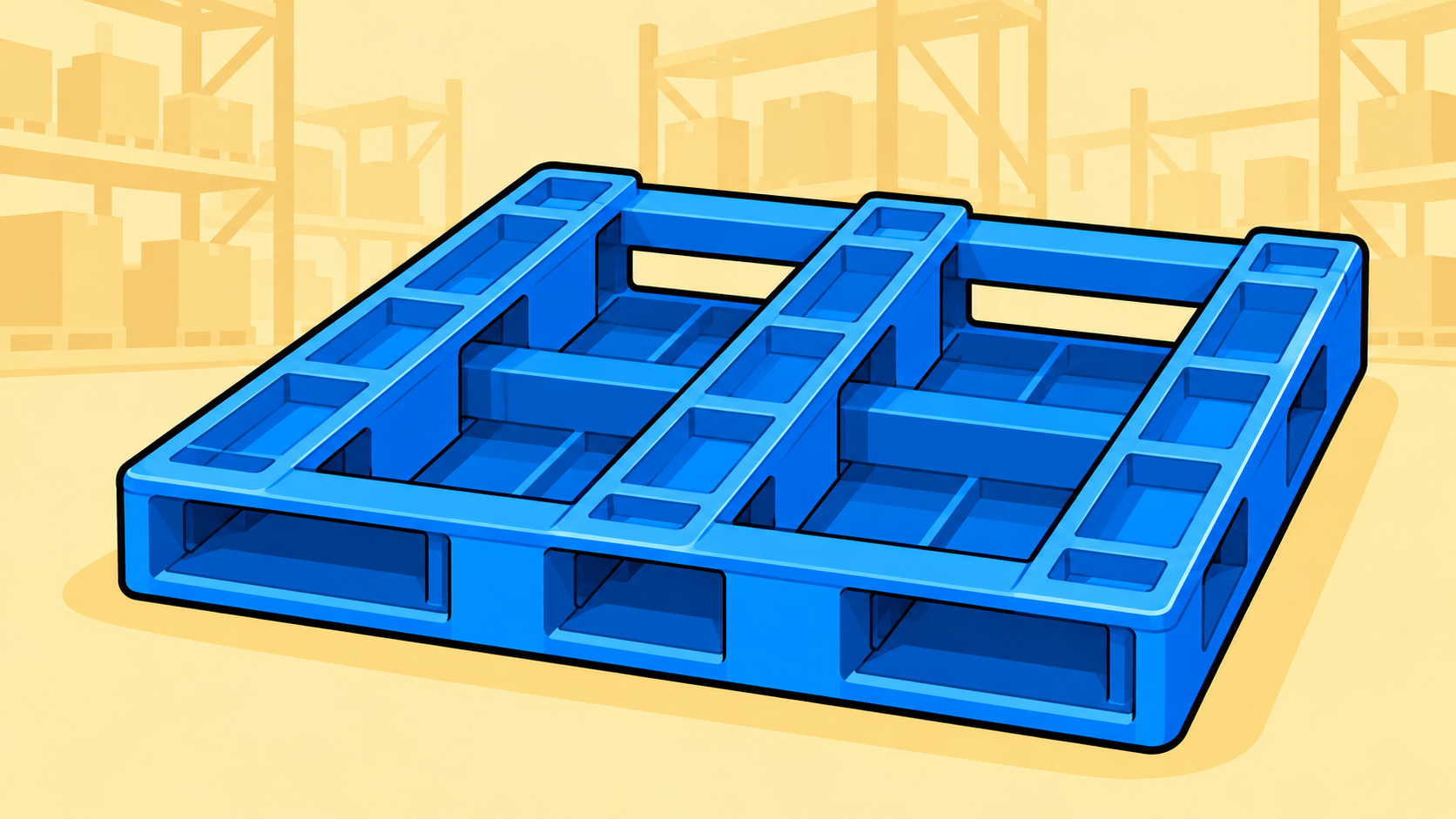
By John Anderson, Owner of Verde Trader
10+ years buying and selling used industrial packaging.
A 6-runner plastic pallet has six runners under the deck. The number is only a count, so on its own it does not tell you how the runners are laid out, which sides can be entered, or what the pallet is rated to carry. Runner count and 4-way entry are separate questions. For the neighboring base, see our guide to 5-runner pallets.
I have spent more than 10 years buying and selling used industrial packaging, so I look at pallets the way a buyer does: how they are built, how they are handled, and what they are rated to carry. This page explains how a 6-runner base is built, how it compares with 2-runner, 3-runner, 4-runner and 5-runner bases, and what to confirm before you buy one.
The short version
- Build: A pallet with six runners under the deck, made in open-deck and closed-deck versions across several sizes. Makers print the runner count, but the pages reviewed describe the arrangement differently when they describe it at all, so no single layout is confirmed.
- Entry: Varies by model. Many listings show 4-way entry and some do not say.
- Typical range: Covers several sizes from about 1100 x 1100 mm up to 1400 x 1400 mm, including the 1200 x 1000 mm and 48 x 40 in sizes used in the sibling guides. Weight about 25 to 66 lb, dynamic 2,200 to 5,500 lb, static 6,200 to 17,600 lb.
- Rating note: Rack ratings are a fraction of static ratings in most models checked: about 600 to 3,300 lb. One open-deck model prints a rack rating equal to its dynamic rating, which is unusual in this set.
- Best fit: Loads that a specific model's printed dynamic, static and rack ratings cover, including rack storage on models rated for it. Those ratings and the entry type decide the fit more than the runner count does.
How a 6-runner plastic pallet is built
Every plastic pallet has a top deck, a base that lifts the deck off the floor, and the resin it is molded from. On a 6-runner pallet, the base is the part the name describes: six runners instead of four or five.
Among the 6-runner pages I checked, the runner count is the one thing makers agree on. How those six runners are arranged is not: the few pages that describe it at all give different pictures (parallel rows, a perimeter frame, a perimeter with a center brace), and the largest maker in this set never describes the layout on its product pages. Both open-deck and closed-deck versions exist, across several footprints.
No standard defines the layout, so the ranges below come from makers' own listings. For how deck style and base design affect ratings in general, see our guide to how much weight plastic pallets can hold.
Figures cover the two sizes used in the sibling guides. Other sizes exist, from about 1100 x 1100 mm up to 1400 x 1400 mm; see the key information above for their full range. Rack figures use the lowest value printed for each model. Ratings vary by model and load conditions.
A 6-runner name is a runner count, not a layout spec. The pages that describe the arrangement at all do not agree with each other, and the largest maker in this set does not describe it, so do not assume a specific runner pattern from the name alone.
How a 6-runner base compares with other bases
The runner count is shorthand for how a base is built, and it changes how a pallet is entered, nested and racked. The table sets 6-runner pallets next to the other full-size bases a buyer might be weighing. It compares designs and does not rank them. For how racking works, see our guide to rackable pallets.
Swipe sideways to compare the other designs.
Full-size models only: 48 x 40 in, except the 2-runner figures, which are for 1200 x 1000 mm (about 47 x 39 in) models. Rack figures use the lowest value printed for each model. *The 6-runner static range reflects the models verified for this guide; other guides on this site currently show a higher published figure for 6-runner pallets that could not be independently confirmed. Ranges come from the models checked, and individual models vary.
Against a 5-runner pallet, the two overlap on weight and dynamic load, and the published static range for 5-runner models runs higher than what we could verify for 6-runner models. Check the printed rating for the exact model rather than assuming the extra runner adds capacity. Our 5-runner guide covers that base.
Against a 4-runner pallet, the ranges overlap heavily on both sides, since 4-runner covers two different base designs (nestable and picture-frame) with very different ratings. Our 4-runner guide covers that split.
A higher runner count does not by itself mean a higher rating. Check the printed dynamic, static and rack ratings for the exact model you are considering, not just the runner count.
Where a 6-runner pallet works
The fits below come from what makers list for the 6-runner models checked, so read them as common uses rather than guarantees for any one pallet.
Uses are drawn from what makers list for the models checked. They are not a rating for every 6-runner pallet.
In the models checked, switching from open to closed deck within the same product line usually leaves the printed load ratings the same or very close. Deck style looks like mostly an environment choice, not a capacity upgrade, within this set.
Where a 6-runner pallet falls short
Most of the shortfalls come down to what a 6-runner listing does, and does not, state. The name is a runner count, and little else about the pallet follows from it.
One closed-deck model in this set lists a static rating of about 17,600 lb, well above the next-highest model checked (about 15,400 lb) and well below the 30,000 lb figure published elsewhere on this site for 6-runner pallets. Neither figure could be independently confirmed here, so treat any 6-runner static rating as something to confirm with the maker directly, not something to assume from a published range.
Figures come from the models checked for this guide. Rack figures use the lowest value printed for each model, and individual models vary.
These limits are where two pallets with the same label differ most: layout, entry, rack rating and build material. The 6-runner name tells you none of the four.
What to check before you buy
A 6-runner pallet adds a few checks to the usual buying list. For the usual ones, such as reading the three load ratings, deck style and food-grade needs, see our guide to what to check before you buy plastic pallets.
The checks below cover what the 6-runner label leaves open. Where a seller can put the answers on a spec sheet or in writing, keep them with the order, because two pallets sold under the same label can differ on every point.
One maker's own spec sheet for a 6-runner model lists two different rack figures in two different sections of the same page. Ask which number the seller stands behind before you order.
Frequently asked questions about 6 runner plastic pallets
Is a 6-runner pallet the same as a picture-frame or cruciform pallet?
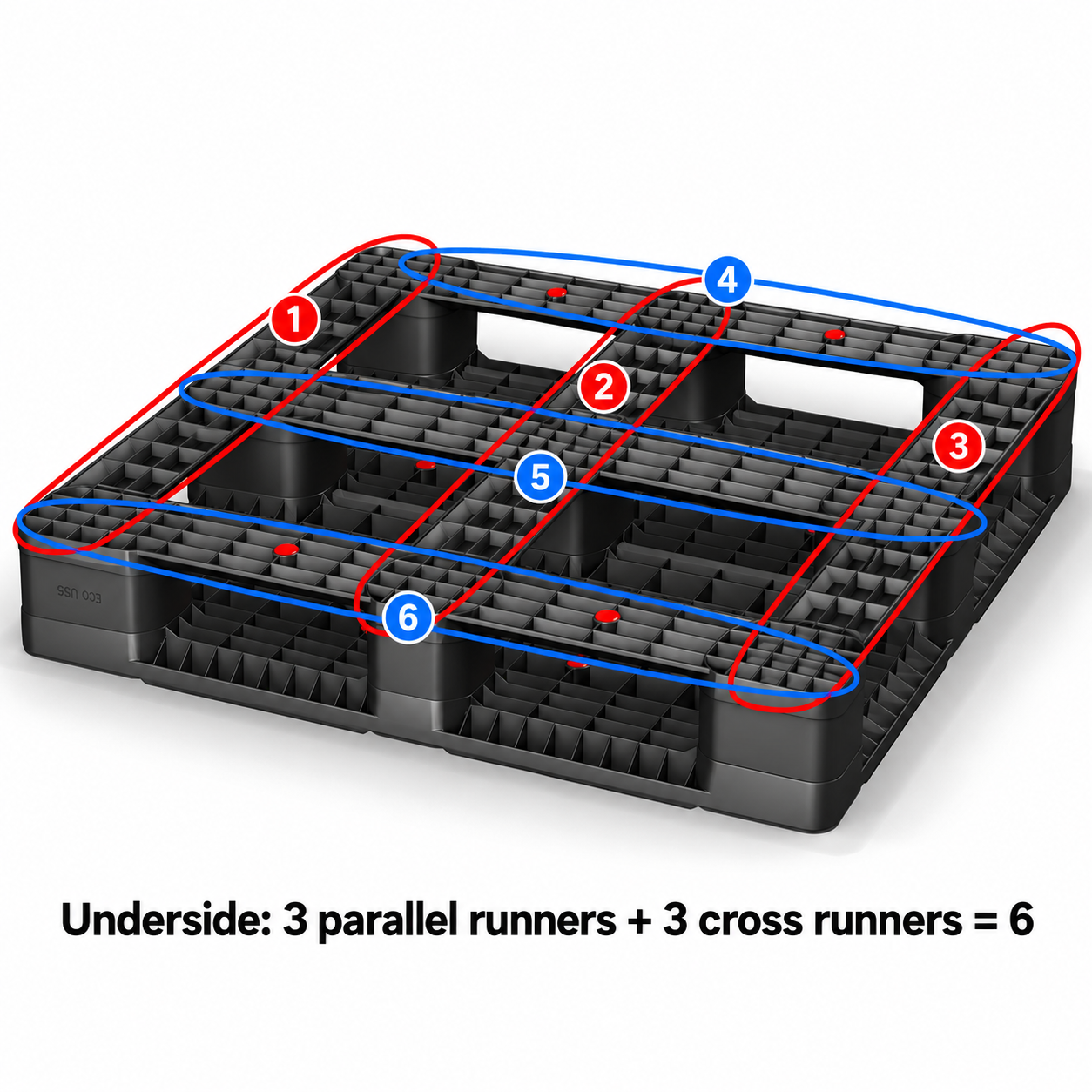
Sometimes, but not always. One source in our research describes 6-runner pallets as built from two sets of three runners crossing each other, which is the picture-frame or cruciform shape. Other sources describe six parallel runners, or six runners around the perimeter, and the largest manufacturer we checked does not describe the layout at all. Ask for an underside photo before assuming either shape.
Why don’t sources agree on how a 6-runner pallet is built?
The term describes a runner count, not a construction standard. No test standard we found defines a 6-runner design, so each seller or guide describes the layout its own way, and the pages that address it at all disagree with each other.
Is a 6-runner pallet stronger than a 5-runner pallet?
Not necessarily. In the models we checked, published ratings for 5-runner pallets run as high as, or higher than, anything we could confirm for 6-runner pallets. Runner count is not a reliable proxy for strength; check the printed dynamic, static and rack ratings for the exact model.
Can I rack a 6-runner pallet?
Many models print a rack rating, but the figures vary widely and don’t follow a consistent pattern against the dynamic rating in this set. Get the rack figure for your exact model in writing before you rack a load. See our guide to rackable plastic pallets.
Sources
This page draws on two test standards, manufacturer spec pages and one pallet-terminology site. Kilogram and tonne figures are converted to pounds and rounded. Where a page prints more than one figure for the same rating, the lower figure is used. Manufacturer pages were accessed October 2026.
Industry standards and research (what is defined)
- ISO 8611-1:2025: Pallets for materials handling, flat pallets, Part 1: Test methods. Test methods for flat pallets. It does not mention runner counts or base designs. With ASTM D1185, the source for the statement that no standard defines a six-runner layout.
- ASTM D1185: Standard test methods for pallets and related structures employed in materials handling and shipping. Static and dynamic test methods (current listing D1185-98a(2025)). Its scope names skids, bases, platforms and bins. A test method, not a design definition.
Manufacturer specifications
- Cabka: Endur i7 OD-6R; Endur i7 CD-6R; BPP i9 OD-6R; Eco US5 OD-6R, OD-6R-M, CD-6R and CD-6R-M; Nest US5.1 OD-6R; Nest US5.1 CD-6R; Endur S7 OD-6R; Endur S7 CD-6R; Nest C5.2 OD-6R and CD-6R; Nest C5 OD-6R and CD-6R; Nest S5 CD-6R; Eco C5 OD-6R. Weight, material, deck style, entry where stated, and loads for 17 models across eight families, in 1200 x 1000 mm, 48 x 40 in, 1200 x 1200 mm, 1140 x 1140 mm and 1100 x 1100 mm. None of these pages describes the runner layout. The Endur i7 CD-6R page's description text says "OD-6R" once while its title and table say CD-6R, read as a copy-paste error. The BPP i9 OD-6R page prints a rack rating equal to its dynamic rating. The Nest S5 CD-6R page prints a static rating about twice its nearest sibling, flagged in this guide rather than excluded. The Nest C5 CD-6R page does not separately state a closed-deck weight, so the open-deck figure is carried over.
- Naeco: EXPERT 1210-O6. Describes "six full perimeter runners," a fourth, distinct layout description. Load figures for this exact model are blank on the page, so this source is used for layout and entry only, not for the numeric ranges in this guide.
- Enlightening Pallet (cnplasticpallet.com): 1210TW-D Six Skids. Nine size and weight rows under one product page. Built from HDPE reinforced with embedded steel bars rather than plastic alone, and loads are printed in tonnes, converted here. Two rows list the same 110 x 110 x 15 cm dimensions with different weights, and the page does not explain the difference.
- Transoplast (manufacturer vs. reseller status unclear from the site): 1140M6RR. Describes "six runners, positioned all around the pallet and cross-braced in the centre," a fifth, distinct layout description. The page's own rack rating differs between its spec table (350 kg) and its properties section (250 kg); the lower figure is used.
Terminology and background
- iGPS: Plastic Pallets: Your Definitive Guide. Describes 6-runner pallets as also called cruciform or picture frame, built from two sets of three runners crossing each other. One of the conflicting layout descriptions found; general guidance, not specific to any model in this guide.
- Racklify: Beyond the standard: how the six-runner pallet handles your heaviest loads. Describes six continuous, longitudinal runners, typically evenly spaced across the pallet's length. A third, distinct layout description; general guidance, not specific to any model in this guide.
No standard or source checked defines the term 6-runner, and the sources that describe the runner layout at all do not agree with each other. The 30,000 lb static figure shown for 6-runner pallets elsewhere on this site was not found on any manufacturer page reviewed for this guide; the static range above reflects only the models checked here.
