

Types of Corrugated Bulk Containers
Gaylord box, bulk cargo container, pallet box, octabin - one guide that sorts out every name and every type.
Published October 21, 2026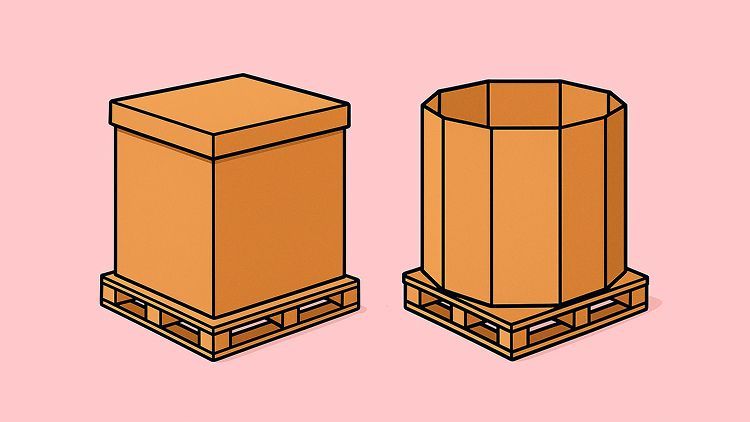
By John Anderson, Owner of Verde Trader
10+ years buying and selling used industrial packaging across the U.S.
The industrial packaging world uses at least half a dozen names for the same family of containers. You may hear "Gaylord box," "bulk bin," "pallet box," or "octabin" depending on who you are talking to and what they are buying. In this article, we focus on corrugated bulk containers: pallet-sized boxes made from corrugated fiberboard. Terms like "Gaylord box," "bulk bin," "pallet box," and "octabin" often overlap in commercial use, although "bulk bin" and "pallet box" can also refer to plastic, wood, or metal containers outside the corrugated category.
This article is a classification guide, not a basic definition page. I am going to cover the terminology, show you the major styles, and give you enough context to pick the right container for your application. If you are new to corrugated bulk containers and want the full backstory on Gaylord boxes specifically, start with the What Is a Gaylord Box? article and come back here when you are ready to compare types.
- Industry term: Corrugated bulk container. Most common U.S. commercial name: Gaylord box - a genericized brand name from Gaylord Container Corporation.
- Main styles: Rectangular Gaylord boxes, octabins, produce bins, and laminated bulk bins.
- Wall count: Double-wall, triple-wall, or laminated multi-ply - a major driver of capacity and cost, alongside board grade, bottom construction, dimensions, moisture exposure, and handling conditions.
- Octabins: Wider corner panels distribute internal pressure and reduce sidewall bulge, making them commonly used for flowable and granular loads.
- Minimums: Used corrugated bulk containers available in pallet minimums starting at 25 to 50 units.
Photo by Guilherme Mendes / Unsplash
What Is a Corrugated Bulk Container?
A corrugated bulk container is a pallet-sized box made from corrugated fiberboard and designed to store or transport bulk materials. It sits on a standard pallet - typically a 48 x 40 inch footprint - and is handled by forklift or pallet jack. Most designs have an open top for loading and a flat or reinforced bottom to carry heavy loads.
The board construction is defined by ASTM D4727/D4727M, which covers board grades, flute types, and wall combinations from single-wall through triple-wall. The number of corrugated medium layers, commonly called the wall count, strongly influences how much weight a container can hold and how much crush resistance it has under stacking loads, but final performance also depends on board grade, flute combination, bottom style, dimensions, moisture exposure, and handling conditions. Gaylords and bulk bins are typically double-wall or triple-wall; laminated multi-ply bins are used for the heaviest industrial applications, with some manufacturers producing containers up to sextuple-wall laminated construction.
In practice, "corrugated bulk container" is the term you will find in ASTM standards and packaging specifications. On the commercial side, most U.S. buyers use a different name entirely - which brings up the most common question in this space.
Are Corrugated Bulk Containers the Same as Gaylord Boxes?
Yes. A Gaylord box is a corrugated bulk container. "Gaylord" is a genericized brand name that traces back to Gaylord Container Corporation - a history documented in Wikipedia's article on Gaylord Container Corporation and confirmed by the Fibre Box Association Glossary. The name became so widely used in the U.S. that it now functions as the dominant commercial term for the entire product category, but it is not a spec. Two products both called "Gaylord boxes" can have completely different wall counts, board grades, and weight capacities.
Because "Gaylord" is a brand name and not a spec, always pair it with the real construction when writing a purchase order - for example, "triple-wall, 48x40 footprint, RSC bottom." The name alone does not tell you wall count, capacity, or board grade.
If you are choosing between an octagonal Gaylord and an octabin for a specific load, see our Gaylord vs. octabin decision guide. The sections below use "corrugated bulk container" as the umbrella term and note where specific commercial names apply.
Corrugated bulk container terminology explained
The same container shows up in purchase orders, spec sheets, and warehouse conversations under many different names. The Wikipedia article on bulk boxes and the Fibre Box Association Glossary are the two most useful references for sorting out what each term actually means. Here is how the terminology breaks down.
Sources: FBA Glossary (Fibre Box Association), Wikipedia - Bulk box, Wikipedia - Gaylord Container Corporation, ASTM D4727/D4727M, Smurfit Westrock - Gaylord Boxes and Octabin, Cascades - Bulk Bins, International Paper - Bulk Packaging.

Photo by Towfiqu barbhuiya / Unsplash
Types of corrugated bulk containers
Within the corrugated bulk container family there are several distinct styles. The differences come down to shape, wall construction, and intended load type.
Rectangular Gaylord Boxes
The standard rectangular design is the most common corrugated bulk container in the U.S. These run on a 48 x 40 inch or 45 x 45 inch pallet footprint with heights that vary by application. Styles include RSC (regular slotted container), half-slotted, and sleeve-plus-tray-plus-cap - all documented in ASTM D5118/D5118M and the Fibre Box Handbook. Wall count ranges from double-wall up through laminated multi-ply. See the Gaylord box overview for a full breakdown of this style.
Triple-Wall and Laminated Bulk Bins
Triple-wall construction - governed by ASTM D5168 - uses three corrugated medium layers separated by four flat liner sheets, producing a rigid board for heavy industrial loads. Tri-Wall originated triple-wall board and remains a leading producer. Laminated bins take this further: International Paper's laminated bulk bins reach up to 3,000 lb capacity, roughly 40% more compression strength than box-in-tube designs at the same footprint. Greif offers double- and triple-laminated Gaylord-style bins in custom sizes. DS Smith's Tecnicarton division manufactures octabins up to sextuple-wall laminated construction for the most demanding bulk applications. For the heaviest industrial loads, Verde Trader carries HPT-41 laminated bulk bins with up to 2,000 lb capacity.
Octabins
An octabin is an eight-sided corrugated bulk container consisting of an octagonal sleeve, a bottom tray, a top cap, and typically a liner. The wider corner panels distribute internal pressure more evenly than a four-corner rectangular design - a feature documented in patents US6783058B2 and US6588651B2 (International Paper) - which reduces sidewall bulge when the container is filled with loose, flowable, or granular material. This behavior is confirmed by open-access research in PubMed Central (PMC8124728) on octabin stacking behavior. Octabins fit 48 x 40 inch or EU 1200 x 1000 mm and 1140 x 1140 mm pallets and hold approximately 1,000 to 1,250+ kg depending on wall construction, which ranges from double-wall through sextuple-wall laminated.
Produce Bins
Produce bins are corrugated bulk containers engineered for fresh fruit and vegetables, including pumpkins and watermelons. They are vented for airflow, treated for moisture resistance, and sized to the Fibre Box Association Corrugated Common Footprint standard. NC State Extension's postharvest engineering guide (Chapter 9) covers the standard constructions in detail. Packaging Corporation of America's produce line covers ventilated bulk bins on the FBA Common Footprint. These containers run from single-wall cartons up to pallet-sized 48 x 40 inch bulk bins and are almost always single-use.
Sources: ASTM D5168 (triple-wall), ASTM D4727/D4727M (board grades), ASTM D5118/D5118M (box styles), Fibre Box Handbook, International Paper - Laminated Bulk Bins (3,000 lb / 40% compression uplift), DS Smith Tecnicarton (sextuple-wall), Patents US6783058B2 and US6588651B2 (octabin corner-panel design), PMC8124728 (octabin stacking behavior), PCA - Produce, NC State Extension Ch. 9, FBA Common Footprint Standard.
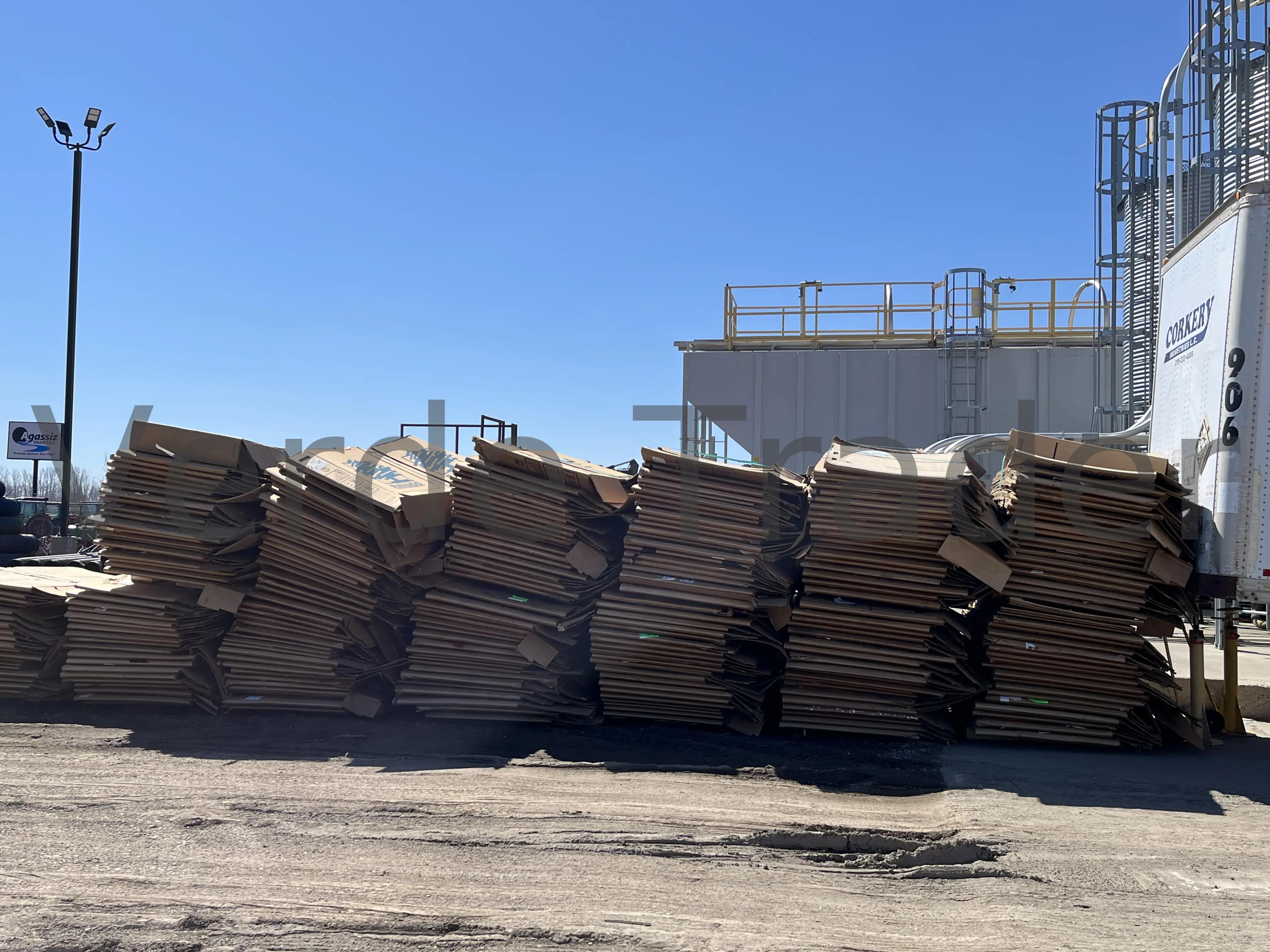
Photo by Verde Trader
Corrugated bulk containers move through nearly every sector that handles bulk materials - from plastic resin and agricultural produce to recycling, manufacturing, and food processing.
Common uses for corrugated bulk containers
Corrugated bulk containers move through nearly every sector that deals with bulk materials. Here are the applications I see most frequently on the buy and sell side.
Plastic resin and scrap. Octabins and rectangular Gaylord boxes are the standard containers for pelletized resin, regrind, and plastic scrap. International Paper's food-grade bulk page documents the octagonal-versus-rectangular tradeoff for flowable materials - the octagonal shape reduces the sidewall bulge that occurs when loose material shifts and pushes outward against flat walls during transit.
Recycling and waste collection. Single-use and multi-use Gaylord boxes are used at material recovery facilities to collect sorted paper, plastic, metal, and glass before baling or further processing. The Product Care Association's Gaylord collection box assembly guide covers the standard setup for recycling collection programs in Canada and the U.S.
Agriculture. Produce bins handle fresh fruits and vegetables in-field and in transit. NC State Extension's postharvest engineering guide (Chapter 9) covers corrugated bulk bin construction for fresh produce including venting, moisture treatment, and stacking tab requirements. Dry agricultural commodities - seed, grain, dried beans - move in rectangular Gaylords and octabins.
Manufacturing and parts storage. Automotive and industrial manufacturers use Gaylord boxes and laminated bulk bins to move stampings, castings, fasteners, and finished components between facilities. Triple-wall and laminated construction handles the density and sharp edges of metal parts that would damage lighter-wall containers.
Food processing. Ingredients, bulk spices, dried goods, and frozen products move in corrugated bulk containers. International Paper's laminated bulk bins and totes are used where both moisture resistance and high stacking weight are required at the same time.
Warehouse storage and distribution. Corrugated bulk containers are used as temporary storage bins in distribution centers for loose parts, overflow inventory, and returned goods. ASTM D5639/D5639M provides the formal framework for matching container construction to warehouse load and handling conditions.
Photo by Verde Trader
How to choose the right corrugated bulk container
The right container depends on what you are putting in it and how it is going to be handled. ASTM D5639/D5639M - the practice for selecting corrugated fiberboard materials and box construction based on performance requirements - is the formal framework for this decision. Here are the five factors that matter most in practice.
Weight of the Load
More wall layers mean more edge crush resistance (ECT) and higher stacking strength (BCT). The McKee formula - published in 1963 and still the industry standard - predicts BCT from ECT, board caliper, and box perimeter. A double-wall container handles light to moderate loads; triple-wall (ASTM D5168) handles heavy industrial loads; laminated multi-ply construction handles the densest materials, with International Paper's laminated totes rated up to approximately 3,000 lb. For a full guide to matching wall count to load requirements, see why wall count matters when choosing Gaylord boxes. For load ratings by wall type, see our Gaylord box weight capacity guide.
Capacity ranges shown are representative examples, not universal ratings. Actual capacity varies by board grade, wall construction, bottom style, dimensions, condition, moisture exposure, and manufacturer specifications.
Bottom Style
The bottom construction affects effective load capacity as much as the wall count. An RSC (regular slotted container) bottom with overlapping flaps is less rigid than a Bliss-style or solid bottom design. ASTM D5118/D5118M covers the fabrication requirements for different bottom styles. Research on Bliss-style box compression published in the Journal of Applied Packaging Research (de la Fuente, 2011) confirms that bottom style significantly affects BCT at the same wall count. Always check the bottom construction when evaluating used containers.
Shape: Rectangular or Octagonal
Rectangular Gaylord boxes stack on standard pallet racking and fit standard conveyor widths. Octabins are engineered for flowable materials. Patents US6783058B2 and US6588651B2 describe how the wider corner panels of an octabin distribute internal pressure more evenly than four-corner rectangular walls, reducing the sidewall bulge that causes rectangular containers to fail with loose, shifting loads. International Paper's food-grade bulk page covers this tradeoff directly with rectangular-versus-octagonal tote comparisons. For a full side-by-side comparison, see our Gaylord vs. octabin guide.
Moisture Exposure
Standard corrugated loses significant strength when exposed to humidity. Research published in BioResources (NC State) and MDPI Applied Sciences (2024) documents the effect of humidity and temperature on corrugated board mechanical properties - ECT and stiffness drop measurably in humid conditions. If your application involves condensation, outdoor storage, or wet processing, you need a moisture-resistant coating or a laminated container rated for those conditions.
New vs. Used
Used corrugated bulk containers cost significantly less than new. For applications where the container will be used once or twice before recycling, used is almost always the right call economically. For food-contact, pharmaceutical, or high-value applications where contamination or certification matters, new may be required. See used Gaylord boxes for current availability. For current market rates across wall counts and conditions, see our Gaylord box pricing guide. For standard dimensions by footprint and height, see our dimensions guide.
Where to buy used corrugated bulk containers
Verde Trader sells used corrugated bulk containers - Gaylord boxes, octabins, and bulk bins - in pallet and truckload quantities. All containers are inspected before listing. Minimum order is typically one pallet (25 to 100 units depending on style and size).
Browse by container type:
- Used Gaylord Boxes - rectangular corrugated bulk containers in double-wall through laminated construction
- Used Octabins - eight-sided bulk containers for resin, seed, and flowables
- All Bulk Boxes - full inventory of corrugated bulk containers currently available
Need a specific size or wall count? Request a quote and we will find what you need from current or upcoming inventory.
Have surplus containers to move? Get a quote to sell your Gaylord boxes, or recycle them for free.
Frequently asked questions about corrugated bulk containers
What is a corrugated bulk container?
A corrugated bulk container is a pallet-sized box made from corrugated fiberboard, used for storing or shipping bulk materials. It sits on a standard pallet and is loaded from the top. In the U.S., the same product is commonly called a Gaylord box - a genericized brand name from Gaylord Container Corporation. The Fibre Box Association Glossary and ASTM D4727/D4727M are the primary references for construction terminology.
Are corrugated bulk containers the same as Gaylord boxes?
Yes. "Corrugated bulk container" is the ASTM standard term. "Gaylord box" is the dominant U.S. commercial name - a genericized brand name tracing back to Gaylord Container Corporation, documented in Wikipedia's article on Gaylord Container Corporation and the FBA Glossary. The two terms refer to the same product family. Because "Gaylord" is not a spec, always pair it with wall count and dimensions when ordering.
What is the difference between a Gaylord box and an octabin?
A Gaylord box is a rectangular four-sided corrugated bulk container. An octabin is an eight-sided version. Patents US6783058B2 and US6588651B2 document how wider corner panels distribute internal pressure more evenly across the walls, reducing the sidewall bulge that occurs with loose, flowable, or granular materials. Research in PubMed Central (PMC8124728) confirms this under vertical stacking loads. Octabins also fit EU 1200x1000mm pallets in addition to the standard 48x40 inch footprint.
How much weight can a corrugated bulk container hold?
Capacity depends on wall count, board grade, and bottom construction. Triple-wall containers governed by ASTM D5168 handle heavy industrial loads; laminated multi-ply bins are rated up to approximately 3,000 lbs. The bottom design matters as much as the walls - a solid or Bliss-style bottom holds more than an RSC overlapping-flap bottom at the same wall count, as documented in research on bottom construction performance.
What sizes do corrugated bulk containers come in?
The two most common U.S. footprints are 48x40 inches and 45x45 inches. Octabins also fit EU 1200x1000mm and 1140x1140mm pallets. Heights vary by application and wall count. See the Gaylord box dimensions guide for a full breakdown.
Are corrugated bulk containers recyclable?
Yes. Corrugated fiberboard is one of the most widely recycled materials in the U.S. The Corrugated Packaging Alliance 2020 Life Cycle Assessment documents approximately a 50% reduction in greenhouse gas emissions per ton of corrugated product between 2006 and 2020, driven largely by high recovery rates. Used containers too degraded for reuse are often accepted by paper recycling facilities and cardboard balers, though acceptance can vary if boxes are waxed, coated, lined, wet, or contaminated.
Can corrugated bulk containers be reused?
Yes, in many applications. Higher wall count and laminated containers hold up better across multiple uses than lighter-wall designs. Moisture exposure is the primary factor that limits reuse cycles - research in BioResources and MDPI Applied Sciences (2024) documents how humidity reduces ECT and stiffness in corrugated board. Used containers in good, dry condition are available from Verde Trader for applications where additional uses are needed before recycling.
Are corrugated bulk containers sold in bulk only?
At Verde Trader, yes. We sell in pallet minimums - typically 25 to 100 units per pallet depending on size and style - and in full truckloads. Single-unit sales are not something we do. If you need smaller quantities, local packaging distributors sometimes carry them individually, though at significantly higher per-unit cost.
Sources
Every fact on this page traces back to at least one published standard, peer-reviewed study, patent, manufacturer specification, or industry reference.
Industry standards and primary research
- ASTM D4727/D4727M. Specification for corrugated and solid fiberboard sheet stock. Defines board grades, flute types, and wall combinations - the foundation for all wall-count references on this page.
- ASTM D5168. Standard practice for the fabrication and closure of triple-wall corrugated fiberboard containers.
- ASTM D5118/D5118M. Practice for the fabrication and closure of corrugated fiberboard boxes. Covers box styles (RSC, HSC, Bliss, sleeve-tray-cap) and bottom construction requirements.
- ASTM D5639/D5639M. Practice for selecting corrugated fiberboard materials and box construction based on performance requirements.
- Fibre Box Handbook and FBA Glossary (Fibre Box Association). Industry reference covering box styles, flutes, carrier rules, and authoritative terminology definitions.
- Patent US6783058B2 and US6588651B2 (International Paper). Octabin design patents documenting how wider corner panels distribute internal pressure and reduce sidewall bulge.
- PMC8124728 - Mechanical Behavior Modeling of Containers and Octabins Under Vertical Stacking Loads. Peer-reviewed research on octabin compression and stacking behavior.
- BioResources (NC State) - Cornaggia et al. 2023 and MDPI Applied Sciences 2024. Two open-access studies on the influence of humidity and temperature on corrugated board ECT and stiffness.
- Journal of Applied Packaging Research - de la Fuente 2011 (RIT). Study on Bliss-style box compression strength and the effect of bottom style on BCT.
- Corrugated Packaging Alliance / NCASI - 2020 LCA of U.S. Average Corrugated Product. Cradle-to-grave life cycle assessment documenting approximately a 50% GHG reduction from 2006 to 2020.
- NC State Extension - Postharvest Engineering for Fresh Fruits and Vegetables, Chapter 9. Produce packaging guide covering corrugated bulk bin construction, venting, moisture treatment, and stacking tabs.
Manufacturer and trade association references
- International Paper - Laminated Bulk Bins and Totes. Product specifications for laminated bins up to approximately 3,000 lb.
- DS Smith Tecnicarton - Bulk Packaging. Laminated octabins from double-wall through sextuple-wall construction.
- Smurfit Westrock - Gaylord Boxes and Octabin (ComboPAC). Gaylord and octabin product definitions and product range.
- Cascades - Corrugated Bulk Bins. Multi-wall and octagonal bulk bin range.
- Packaging Corporation of America - Produce Packaging. Ventilated produce bulk bins on the FBA Common Footprint.
- Greif - Bulk Laminated Bins. Double- and triple-laminated Gaylord-style bins in custom sizes.
- Tri-Wall - Products. Heavy-duty corrugated product range. Tri-Wall originated triple-wall board.
- Wikipedia - Bulk box. Terminology, construction overview, and history.
- Wikipedia - Gaylord Container Corporation. Origin and history of the "Gaylord" brand name and its genericization.
Our sales data
- Verde Trader sold-order data. More than 8,000 corrugated bulk container orders through mid-2026, across all major wall constructions, footprints, shapes, and U.S. regions. Archived and dead-deal orders are excluded.
