

Gaylord Box Weight Capacity Guide
How much weight can a Gaylord box actually hold?
Published August 5, 2026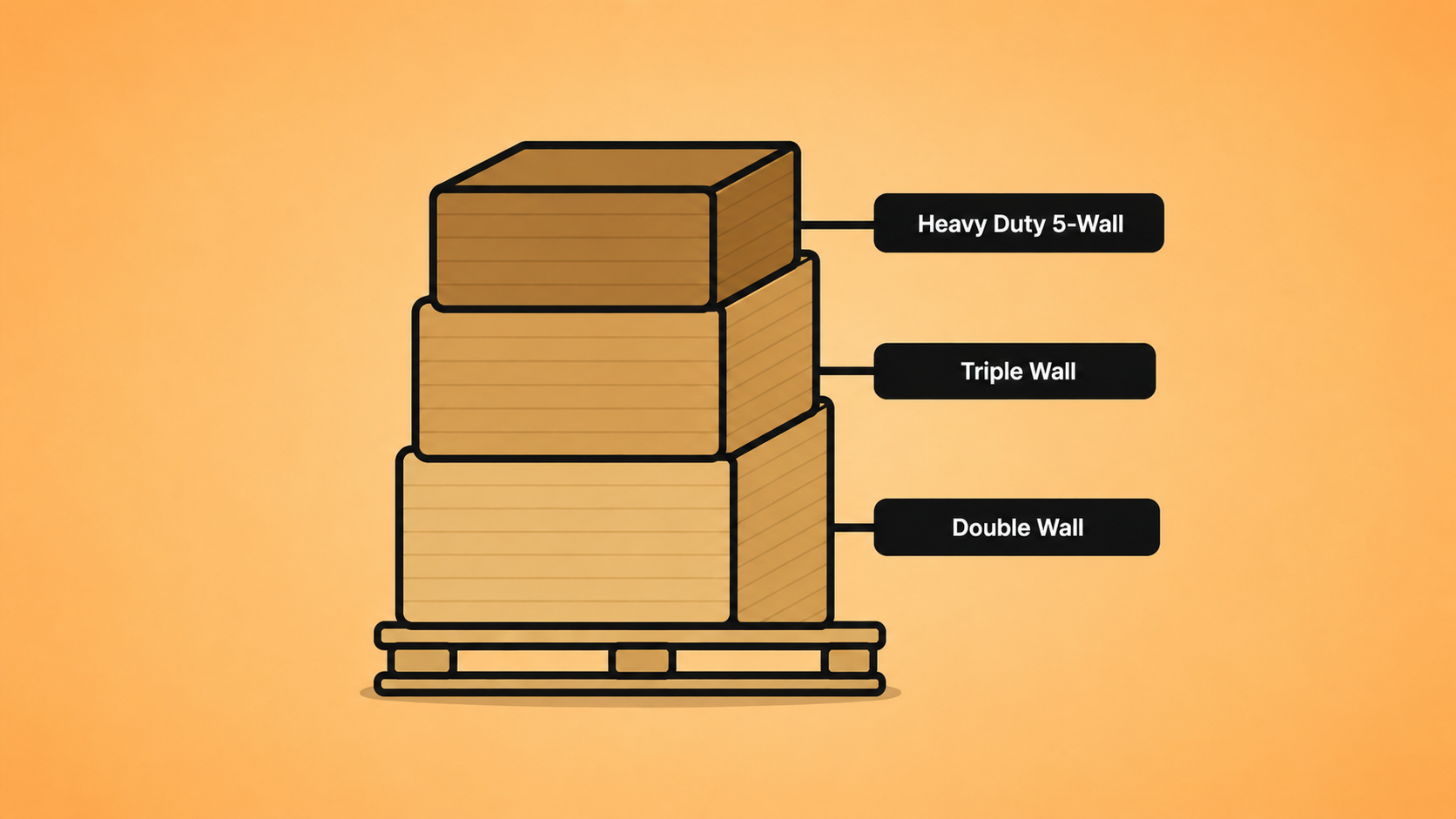
By John Anderson, Owner of Verde Trader
10+ years buying and selling used industrial packaging. The numbers here come from more than 1,000 Gaylord box orders in our own system.
For a Gaylord box, there isn't just only one weight limit. How much the box can hold depends on how many walls the box has, the grade of the board, the dimensions, and what conditions it's going into. A standard triple-wall Gaylord is usually rated to hold around 1,100 lbs. That's the most common stocked spec, per ASTM D5168 and the Uline triple-wall catalog. Heavier wall constructions carry higher ratings, but the number on the box or in the spec sheet is always the one that decides the capacity.
We sell Gaylord boxes every day. The number one thing buyers get wrong is assuming that they're all the same. They're not. Wall count is the biggest driver of capacity, but it's not the only one. Here's everything you need to match the right box to your load.
Key takeaways
- There is no universal weight rating. Capacity depends on wall count, board grade, dimensions, and conditions.
- 2-wall Gaylord boxes are lighter-duty bulk containers. Actual capacity depends on board grade, dimensions, bottom style, condition, and the printed manufacturer rating. Triple-wall (3-wall) is the most common for most industrial bulk applications, with the standard stocked spec rated at 1,100 lbs per ASTM D5168. Heavier wall constructions have higher ratings.
- Triple-wall is the most common construction for general industrial use.
- Moisture, stacking, and product type can all pull effective capacity below the rated limit.

Photo by Tim Mossholder / Unsplash
Gaylord box weight capacity by wall type
Wall count is the most reliable place to start. As ASTM D4727/D4727M defines, each additional corrugated medium layer adds rigidity and compressive strength. The figures below come from published ASTM standards and the Uline triple-wall spec sheet - for single-, double-, and triple-wall. For 4-wall and above, ASTM D4727 doesn't define specific limits. That's set by the manufacturer. Not sure which wall count fits your load? See why wall count matters when choosing Gaylord boxes.
ASTM D4727 covers single-, double-, and triple-wall. For 4-wall and above, capacity is set by the manufacturer - not this standard.
Factors that affect Gaylord box weight capacity
While wall count is the starting point, there are a lot of other variables that determine what a Gaylord can actually handle in your operation, and knowing them helps you avoid overloading a box or spending more money than you need to.

Photo by Alexander von Schulz / Unsplash
- Board grade and flute profile. Two boxes with the same wall count can hold very different weights depending on the board grade. Higher-grade liner and medium stock make for a stiffer, stronger box. When comparing boxes from different sources, ask for the ECT rating - Edge Crush Test, measured per TAPPI T 811, and the primary strength spec for modern corrugated containers.
- Box dimensions. A taller box is less resistant to top-load compression than a shorter one at the same wall count. The McKee formula (McKee, Gander, and Wachuta, 1963) estimates box compression strength from ECT, board thickness, and box perimeter. All three of those change with dimensions - so a different footprint or height gives you a different compression strength even at the same wall count. If the box is significantly taller than it is wide, check the compression rating before loading it to capacity. See our Gaylord box dimensions guide for standard footprints and heights.
- Pallet design and support. A box is only as strong as what's underneath it. Research from Virginia Tech's Unit Load Design program shows that pallet deckboard stiffness directly affects box compression strength. Full deck support spreads the load evenly. An undersized or partial-deck pallet concentrates stress - and the box fails sooner.
- Product density and fill pattern. Loose, uniform products like pellets or grain spread weight evenly across the floor. Irregular or sharp products create pressure points that can buckle the sidewalls well below the rated capacity. ASTM D5639 addresses this directly - it guides selection based on performance requirements, not just weight. For flowable or bulgy loads, octagon-shaped bins distribute internal pressure more evenly than rectangular boxes.
- Moisture and humidity exposure. Corrugated board loses compressive strength when it gets wet. Research in BioResources (2023) and MDPI Applied Sciences (2024) shows that elevated humidity measurably reduces ECT and stiffness. If the box is going into a humid warehouse or outdoors, step up one wall count.
- Stacking requirements. When boxes are stacked, the bottom box carries everything above it - not just its own contents. ASTM D4169 establishes the performance test sequences and safety-factor methodology for validating containers under stacking loads. Add up the total column load and make sure the bottom box is rated for it, with a buffer built in.
Photo by Tania Melnyczuk / Unsplash
Gaylord box wall count by industry
Different industries use Gaylord boxes for very different loads. The table below shows the wall construction we see most in each application - based on what buyers actually order from Verde Trader. ASTM D5639 guides matching wall count to performance requirements. These patterns are what that looks like in practice.
Metal scrap and dense irregular materials are where wall count most often needs to step up. ASTM D5639 covers performance-based selection for products that concentrate stress - for those loads, confirm the rated capacity on the spec sheet rather than relying on wall count alone.

Photo by Kelli McClintock / Unsplash
How to choose the right Gaylord box for your load
Work through these steps in order and you'll land on the right box.
Step 1 - Know your load weight
Weigh a full load, or estimate from product density and box volume. Add a safety buffer. That number is your target minimum capacity.
Step 2 - Assess your product type
Uniform, free-flowing products like pellets, grain, or powder spread load evenly. Sharp, heavy, or irregular products - metal parts, castings - concentrate stress on the box floor and walls. ASTM D5639 guides selection based on performance requirements, not just weight. For demanding products, step up at least one wall count beyond what the weight alone would suggest — for the heaviest industrial loads, consider a heavy-duty laminated bin like the HPT-41.
Step 3 - Factor in stacking
If boxes are going to be stacked, multiply the number of boxes in a column by the weight of one full box. The bottom box has to carry all of it. ASTM D4169 establishes the safety factors and test sequences for validating containers under stacking conditions - build in a buffer for long-term storage.
Step 4 - Evaluate moisture risk
Is the box going outdoors, into a humid warehouse, or near condensation? If yes, step up one wall count. Research in BioResources (2023) and MDPI Applied Sciences (2024) documents that elevated humidity measurably reduces ECT strength - the primary rating for corrugated bulk containers.
Step 5 - Confirm the rated capacity
Every corrugated container has a manufacturer's rated capacity - it's on the box or in the spec sheet. ASTM D5168 and ASTM D4727 define the test requirements behind those ratings. Always confirm the printed rating matches your load before use. For current pricing by wall count, see our Gaylord box pricing guide.
Related: Triple Wall Gaylord Boxes - specs, sizes, and inventory for 3-wall corrugated bulk containers.
Related: Used Gaylord Boxes - browse available inventory by wall count, size, and location.
Have boxes to move? Get a quote to sell, or recycle them for free.
Frequently asked questions about Gaylord box weight capacity
How much weight can a Gaylord box hold?
It depends on wall count and board grade. ASTM D4727 sets the max fill weight for double-wall boxes at 180 lbs on a standard 48x40 footprint. ASTM D5168 defines the triple-wall Class CG standard at 1,100 lbs with an ECT-90 rating - that's the most widely stocked Gaylord spec. For 4-wall and above, capacity varies by manufacturer and board grade. Confirm with the spec sheet or the rating on the box.
Can a Gaylord box hold more than 1,100 lbs?
Yes. The 1,100 lb Class CG triple-wall spec in ASTM D5168 is the most common stocked configuration, but ASTM D4727 defines higher-grade fiberboard with higher capacity limits. For loads above the triple-wall rating, a 4-wall or heavier construction is the right call - confirm the rated capacity with the manufacturer's spec sheet before use.
Can a Gaylord hold metal scrap?
Yes, but wall count and product type have to be matched carefully. Metal scrap is dense and irregular - it concentrates stress on the box floor and walls beyond what the fill weight alone suggests. ASTM D5639 guides selection based on performance requirements, not just weight. Step up at least one wall count from what the weight would indicate, and confirm the rated capacity with the spec sheet before loading.
How much weight can a triple-wall Gaylord hold?
The standard triple-wall Class CG spec in ASTM D5168 sets rated capacity at 1,100 lbs with an ECT-90 rating on a 48x40 footprint. That's the most widely stocked configuration. Higher board grades within the triple-wall class carry higher ratings - confirm with the spec sheet on the box.
What is the difference between ECT and Mullen ratings?
ECT - Edge Crush Test, measured per TAPPI T 811 - measures how much top-to-bottom compression a box can take before the walls buckle. That's the relevant number for stacking and top-load applications, and it's how modern Gaylord boxes are specified under ASTM D5168 and D4727. Mullen is a burst test - it measures how much pressure it takes to puncture the board, which matters more for rough handling and transit. The Fibre Box Association's 2008 ECT Guide covers the shift from Mullen-based to ECT-based carrier rules in detail.
Do Gaylord box dimensions affect weight capacity?
Yes. The McKee formula (McKee, Gander, and Wachuta, 1963) estimates box compression strength from ECT, board thickness, and box perimeter. All three of those change with dimensions - so a different footprint or height gives you a different compression strength, even at the same wall count and board grade. The capacity ratings in ASTM D5168 and D4727 assume standard dimensions. A box with a significantly different footprint or height may carry a different effective capacity. Confirm with the spec sheet.
Sources
The capacity ranges and guidance on this page rest on two legs: published ASTM standards that define how corrugated board is graded and containers are tested, and Verde Trader's own sold-order records that show what buyers actually specify for real load applications. They answer different questions, so we keep them separate.
Industry standards (what is defined)
- ASTM D4727/D4727M. Defines board grades, wall construction classes, and minimum strength requirements for single-, double-, and triple-wall corrugated sheet stock. The size-and-weight tables in this standard are the authoritative source for fill capacity limits by wall count referenced on this page.
- ASTM D5168. The primary fabrication standard for triple-wall containers. Covers flute arrangement, facing weights, ECT minimums, and maximum box weight. The 1,100 lb Class CG triple-wall specification cited on this page is drawn from this standard.
- ASTM D5639/D5639M. Guides how wall count and board grade are matched to load requirements - the foundational reference for the selection guidance in the How to Choose section.
- ASTM D642. The box compression test (BCT) method. The stacking and top-load compression claims on this page derive from this test protocol.
- TAPPI T 811. The edge crush test method. ECT is the primary strength specification for modern Gaylord boxes and the input used in the McKee formula to estimate finished-box compression strength.
- ASTM D4169. Establishes safety factors and test sequences for validating container performance under stacking, vibration, and distribution conditions. Relevant to the safety-buffer guidance in the selection steps.
- Fibre Box Handbook (Fibre Box Association). Industry reference covering box styles, flute profiles, carrier rules, and strength requirements. Background context for construction grades and the ECT-vs-Mullen discussion throughout this page.
Peer-reviewed research
- McKee, Gander, and Wachuta (1963) - Compressive Strength Formula for Corrugated Boxes. The original paper introducing the McKee formula. Public domain and underlies most ECT-based capacity specifications in the industry.
- Cornaggia et al. (2023) - Influence of Humidity and Temperature on Mechanical Properties of Corrugated Board (BioResources, NC State). Documents how elevated humidity reduces board stiffness and compressive strength.
- MDPI Applied Sciences (2024) - Impact of Temperature and Humidity on Key Mechanical Properties of Corrugated Board. Companion experimental study confirming ECT strength degradation across climate conditions.
Manufacturer specifications
- Uline - 1,100 lb Triple-Wall Boxes spec sheet. Stock triple-wall dimensions and rated capacity (1,100 lb / ECT-90). Used as a practical reference point for the standard triple-wall Gaylord specification cited throughout this page.
Our sales data (what buyers actually order)
- Verde Trader sold-order data. More than 1,000 Gaylord box orders closed between December 2025 and May 2026, across all major wall constructions, footprints, heights, and industries. The industry application ranges, wall-count patterns, and buyer behavior observations on this page come from these records. Archived and dead-deal orders are excluded.
