

What is a 6-legged plastic pallet?
What six legs mean, how the base compares, and what to confirm before you buy
Published October 26, 2026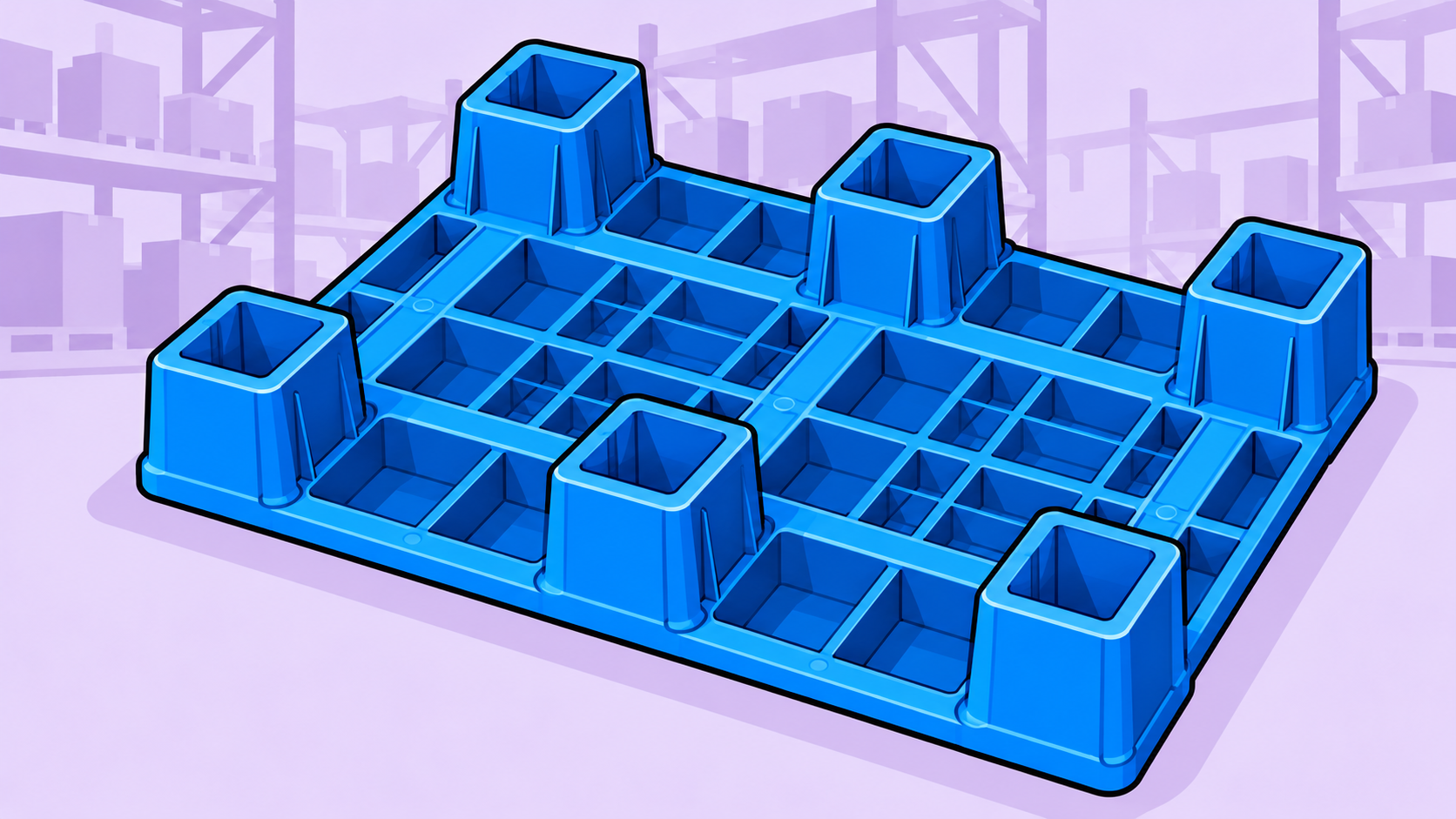
By John Anderson, Owner of Verde Trader
10+ years buying and selling used industrial packaging.
A 6-legged plastic pallet is built on six legs instead of runners. The number is only a count, so on its own it does not tell you how the legs are arranged, which sides can be entered, or what the pallet is rated to carry. For a related base design, see our guide to 6-runner pallets.
I have spent more than 10 years buying and selling used industrial packaging, so I look at pallets the way a buyer does: how they are built, how they are handled, and what they are rated to carry. This page explains how a 6-legged base is built, how it compares with other bases, and what to confirm before you buy one.
The short version
- Build: A pallet with six legs instead of runners. The three maker listings verified for this guide are all built on the same 800 x 600 mm footprint, and none describe how the six legs are arranged.
- Entry: Stated on only one of the three models checked (4-way); the other two do not say.
- Typical range: Covers the models found, all about 800 x 600 mm (about 31 x 24 in). Weight about 6 to 7 lb. Dynamic load about 800 to 1,100 lb and static load about 1,500 to 2,200 lb, each from 2 of the 3 models.
- Rating note: None of the three models checked list a rack rating. One listing prints two load figures without saying which is static and which is dynamic, so it is left out of both ranges above.
- Best fit: Loads within a specific model's printed static and dynamic ratings. None of the models checked are rated for racking, so treat rack storage as unconfirmed rather than assumed.
How a 6-legged plastic pallet is built
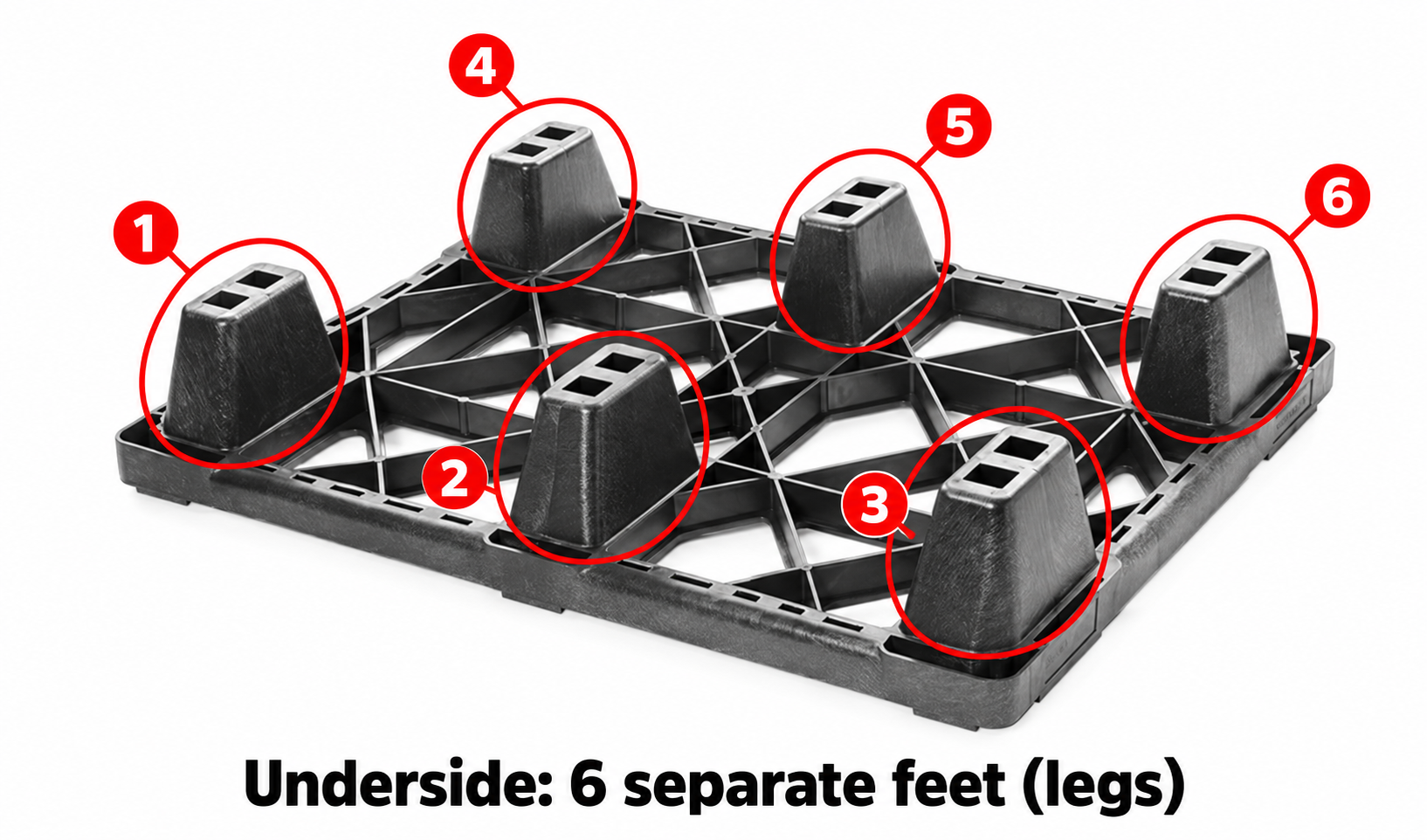
Every plastic pallet has a top deck, a base that lifts the deck off the floor, and the resin it is molded from. On a 6-legged pallet, the base is the part the name describes: six legs instead of runners.
Among the 6-legged listings I checked, the leg count is the one thing the three makers agree on. None of them describe how the six legs are arranged. All three list the same 800 x 600 mm footprint, though the printed height ranges from 130 to about 140 mm across listings, and one page gives two different heights for the same model (140 mm in its spec table, 143 mm in its description).
No standard defines the leg layout, so the figures below come from the three makers' own listings. For how deck style and base design affect ratings in general, see our guide to how much weight plastic pallets can hold.
Figures cover the three models verified for this guide. The dynamic and static load rows use 2 of the 3 models; the third prints two load figures without saying which is static and which is dynamic, so it is excluded from both rows. Ratings vary by model.
A 6-legged name is a leg count, not a layout spec. None of the three listings checked describe how the six legs are arranged, and none print a rack rating, so do not assume a specific layout or rack-readiness from the name alone.
How a 6-legged base compares with other bases
Leg and runner counts are both shorthand for how a base is built, and the base shapes how a pallet is entered, stored and racked. The table sets the 6-legged base beside the runner-count bases and the nine-legged base. It describes each design and does not rank them.
Swipe sideways to compare the other designs.
Full-size models only: 48 x 40 in, except the 2-runner figures, which are for 1200 x 1000 mm (about 47 x 39 in) models. *The 6-runner static range reflects the models verified for this guide; other guides on this site currently show a higher published figure for 6-runner pallets that could not be independently confirmed. †The 6-legged figures are for a much smaller export/half-pallet footprint (800 x 600 mm, about 31 x 24 in), not a full-size pallet, and its dynamic and static ranges use 2 of the 3 models checked; the third prints an unlabeled combined load figure. Rack figures use the lowest value printed for each model. Ranges come from the models checked, and individual models vary.
Against a nine-legged pallet, the two share a legged base instead of runners, but the nine-legged figures above are for a full-size pallet while the 6-legged models checked are a smaller export footprint. Leg count tells you how the base is built, not how the two compare on capacity.
Against the runner-count bases, every one of those uses a full-size 48 x 40 in or similar footprint; the 6-legged models checked are built for a roughly 800 x 600 mm export pallet instead. The figures in this table are not adjusted for that size difference, so read the 6-legged column as its own category rather than a smaller version of the others.
A 6-legged pallet is not a smaller nine-legged pallet. The two share a legged base, but nothing in the listings checked ties their load ratings together, and the 6-legged models are a different size class entirely.
Where a 6-legged pallet works
The fits below come from what the three makers list for the models checked, so read them as common uses rather than guarantees for any one pallet.
Uses are drawn from what the three makers list for the models checked. They are not a rating for every 6-legged pallet.
One of the three listings checked states outright that this pallet is not suitable for stocking in rack, and none of the three print a rack rating. Treat racking as unconfirmed for this base unless the exact model's page says otherwise.
Where a 6-legged pallet falls short
Most of the shortfalls come down to what a 6-legged listing does, and does not, state. The name is a leg count, and little else about the pallet follows from it.
One listing in this set gives two different heights for the same model (140 mm in its spec table, 143 mm in its description), and another gives two different colors for the same model (anthracite on the order form, black in the description). Neither inconsistency could be resolved here, so confirm the printed spec with the maker directly rather than taking either page at face value.
Figures come from the three models checked for this guide. Individual models vary.
None of the three listings checked are confirmed as manufacturer-direct pages: two are reseller or marketplace listings, and the third's own manufacturer-vs-reseller status is unclear. Treat the load figures above as a starting point to verify, not a guarantee, before you buy.
What to check before you buy
A 6-legged pallet adds a few checks to the usual buying list. For the usual ones, such as reading the three load ratings, deck style and food-grade needs, see our guide to what to check before you buy plastic pallets.
The checks below cover what the 6-legged label leaves open. Where a seller can put the answers on a spec sheet or in writing, keep them with the order, because the three listings checked for this guide disagree with each other on several points.
One listing in this set gives two different heights for the same model on the same page, 140 mm in its spec table and 143 mm in its description. Ask which figure the seller stands behind before you order.
Frequently asked questions about 6 legged plastic pallets
Is a 6-legged plastic pallet the same size as a nine-legged pallet?
No. The nine-legged pallets published on this site are full-size, about 48 x 40 in. Every 6-legged model found for this guide is a smaller export or half-pallet, about 800 x 600 mm (about 31 x 24 in). The two share a legged base but are not the same size class.
How is a 6-legged pallet different from a 6-runner pallet?
The base itself. A 6-runner pallet is built on six runners under the deck, while a 6-legged pallet is built on six separate legs. The two names describe different base designs even though both use the number six.
Can I rack a 6-legged pallet?
Not based on anything found for this guide. None of the three models checked list a rack rating, and one states outright that it is not suitable for stocking in rack. Treat racking as unconfirmed unless the seller states it in writing.
Does 6-legged mean 4-way entry?
Not necessarily. Only one of the three models checked states an entry type, and it's 4-way. The other two don't say. Entry and leg count are separate questions, so confirm entry for the exact model.
How much weight can a 6-legged pallet hold?
It depends on the model, and the figures checked here are modest. Two of the three models checked print separate ratings: about 1,500 to 2,200 lb static and about 800 to 1,100 lb dynamic. The third prints a combined 350 kg and 800 kg figure without saying which is which, so it's excluded from those ranges.
Sources
This page draws on two manufacturer-direct product pages for 6-legged plastic pallets. Kilogram figures are converted to pounds and rounded. Pages were accessed October 2026.
Manufacturer specifications
- Cabka: Nest H3 (OD-6F). Dimensions, leg count, static and dynamic load, entry, and weight for its two material variants (PE mix and PP mix). No rack rating is given. The page does not describe how the six feet are arranged.
No standard, pool guide or terminology site checked defines the term six-legged, and neither maker page reviewed says how the six legs are arranged. A check of pallet-terminology sites that carry entries for nine-leg pallets turned up no equivalent entry for six-leg pallets.
