

Are used fiber drums safe?
What actually determines it, and when hazmat rules change the answer.
Published October 21, 2026
By John Anderson, Owner of Verde Trader
10+ years buying and selling used industrial packaging.
People ask this before almost every fiber drum order: is a used one actually safe, or is that a risk I'm taking on to save some money. The honest answer is it depends on three things - the condition of the drum body, what it held before, and what you're planning to put in it next. None of those show up on a price tag, so here's how to check each one yourself.
I sell used fiber drums every day, so this is written from the inspection side of the business, not a lab.
The short version
- Dry, non-hazardous reuse: safe in most cases if the body is dry, intact, and free of delamination.
- Water damage: the biggest red flag. Fiber drums are only built to resist delamination under normal transport conditions, not repeated wetting.
- Previous contents: matter more than age. A drum that held chemicals shouldn't go on to food or anything absorbent.
- Shipping hazmat in a used drum: is a much narrower case than general reuse, and comes with its own DOT/UN requirements.
What makes a fiber drum a "1G" drum in the first place
Every fiber drum built for regulated shipping starts life with the identification code 1G. Under federal packaging standards, that code comes with specific construction rules: the body has to be multiple plies of heavy paper or fiberboard, glued or laminated firmly together, and the whole assembly has to be water-resistant enough not to delaminate under normal transport conditions.
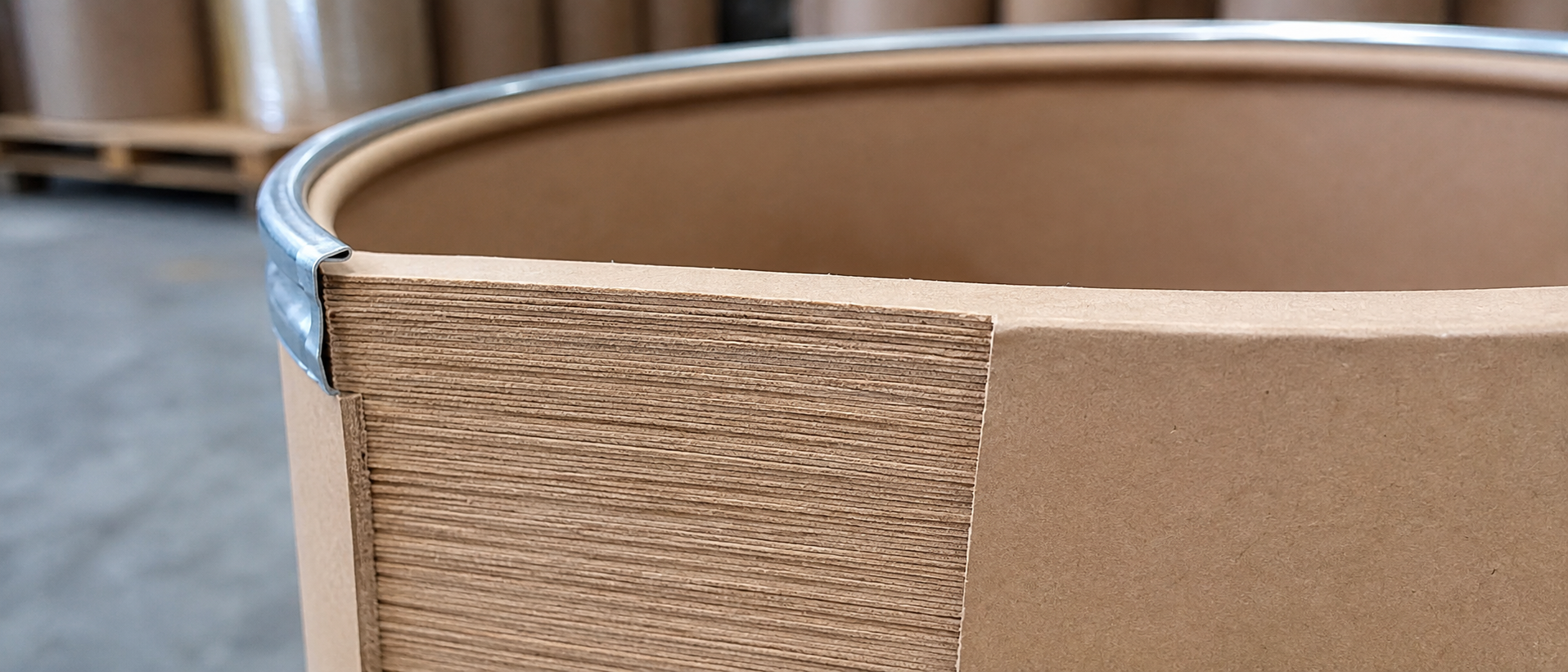
Cross-section of a fiber drum wall showing multiple laminated paperboard plies
The heads (the top and bottom) can be wood, fiberboard, metal, plywood, or plastic, and the whole drum is capped at a fixed size, since the standard sets a hard ceiling on both volume and weight.
Those figures are the maximum limits allowed by the federal 1G fiber-drum specification, not the rated capacity of every fiber drum. An individual drum’s permitted capacity and gross mass depend on its tested design and markings.
How fiber drums get tested before they're ever certified
Before a fiber drum design can carry a UN specification mark, the manufacturer must successfully complete the performance tests applicable to that packaging and its intended contents. These may include drop, stacking, leakproofness, hydrostatic-pressure, and vibration testing, but not every test applies to every fiber drum design. The stacking test in particular is meant to prove the drum can hold up under the weight of drums stacked on top of it during transport and storage, which is exactly the failure mode people worry about with a used drum.
Independent tests used alongside the federal ones
Outside the strict hazmat certification process, the packaging industry leans on its own standardized tests to benchmark shipping container durability more generally.
- Compression and stacking. ASTM D642 measures compressive resistance, and TAPPI T804 is the fiberboard-specific compression test.
- Drop and impact. ASTM D5276 covers free-fall drop testing of loaded containers.
- Vibration. ASTM D999 simulates the shaking a container takes over the road or in a warehouse.
- Full system performance. ASTM D4169 and ISTA Procedure 1A test the container as a whole system rather than one failure mode at a time.
None of these tests get rerun on an individual used drum before it's resold. They describe what the design was proven to handle when new, which is the standard a used drum is being measured against, not a guarantee it still meets.
What actually changes once a drum has been used
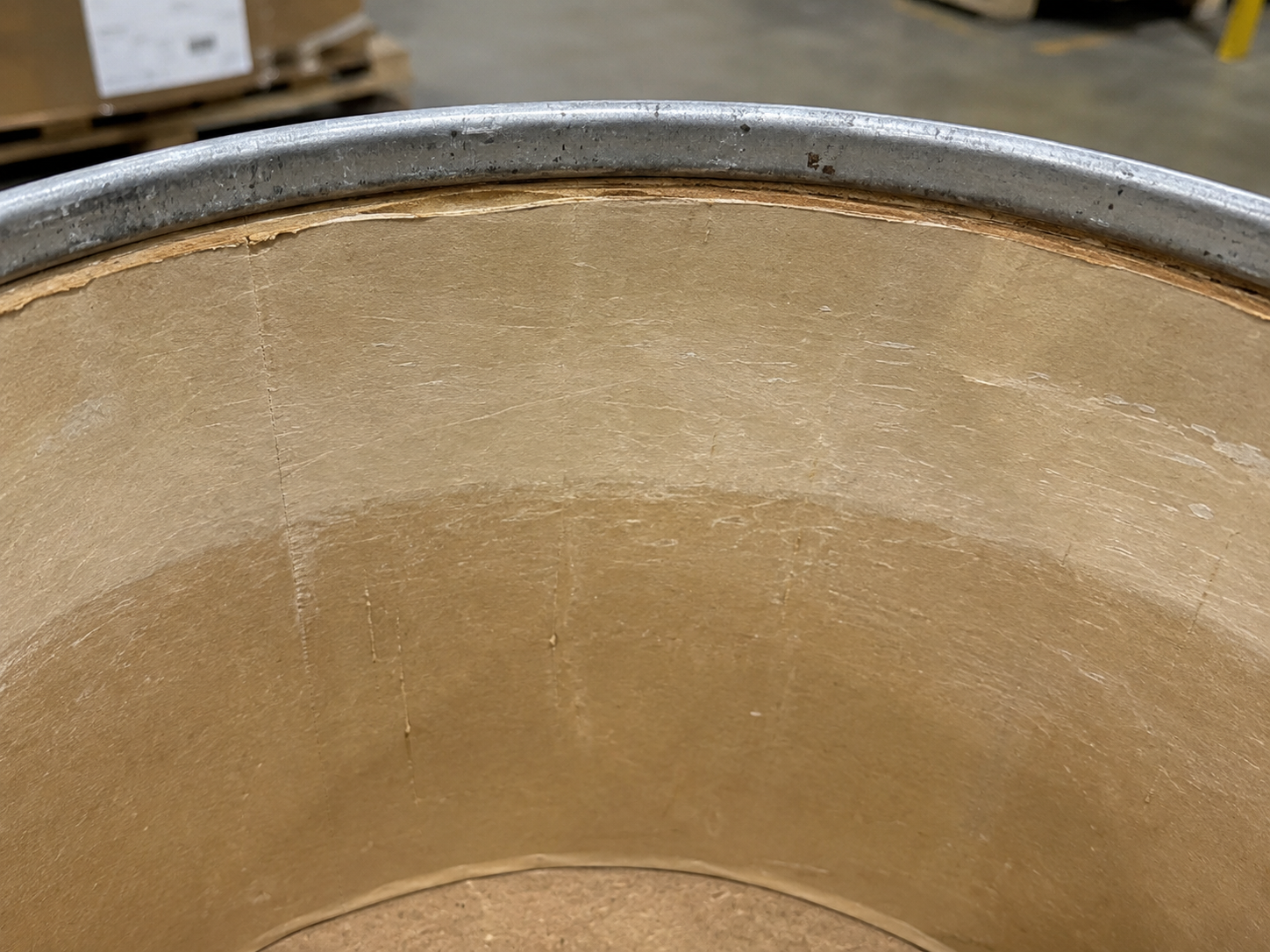
Two things change between a new fiber drum and a used one, and only one of them is obvious from the outside.
The first is moisture. Standard fiber drums are built with a water-resistant barrier layer, but that layer is designed to survive normal transport, not sitting outside or getting soaked repeatedly. Once the paperboard plies absorb water, the glue bond between layers weakens, and that's the delamination the construction standard is trying to prevent in the first place.
The second is what was inside it. Fiber drum liners, whether that's a plain kraft interior, a foil or plastic barrier layer, or a fitted plastic bag, are chosen to match whatever the drum originally held. If that was a chemical, an adhesive, or anything that can bind to or migrate into the liner, that residue doesn't necessarily come out with a normal cleaning, and a patent for a reusable fiber drum design describes this exact problem as the reason a lot of used drums are hard to safely repurpose without stripping and replacing the liner entirely.
That's why "used" and "safe for anything" aren't the same claim. A used fiber drum that held dry plastic pellets is a very different starting point than one that held an industrial solvent, even if both look equally clean from across a warehouse.
A practical checklist for buying a used fiber drum
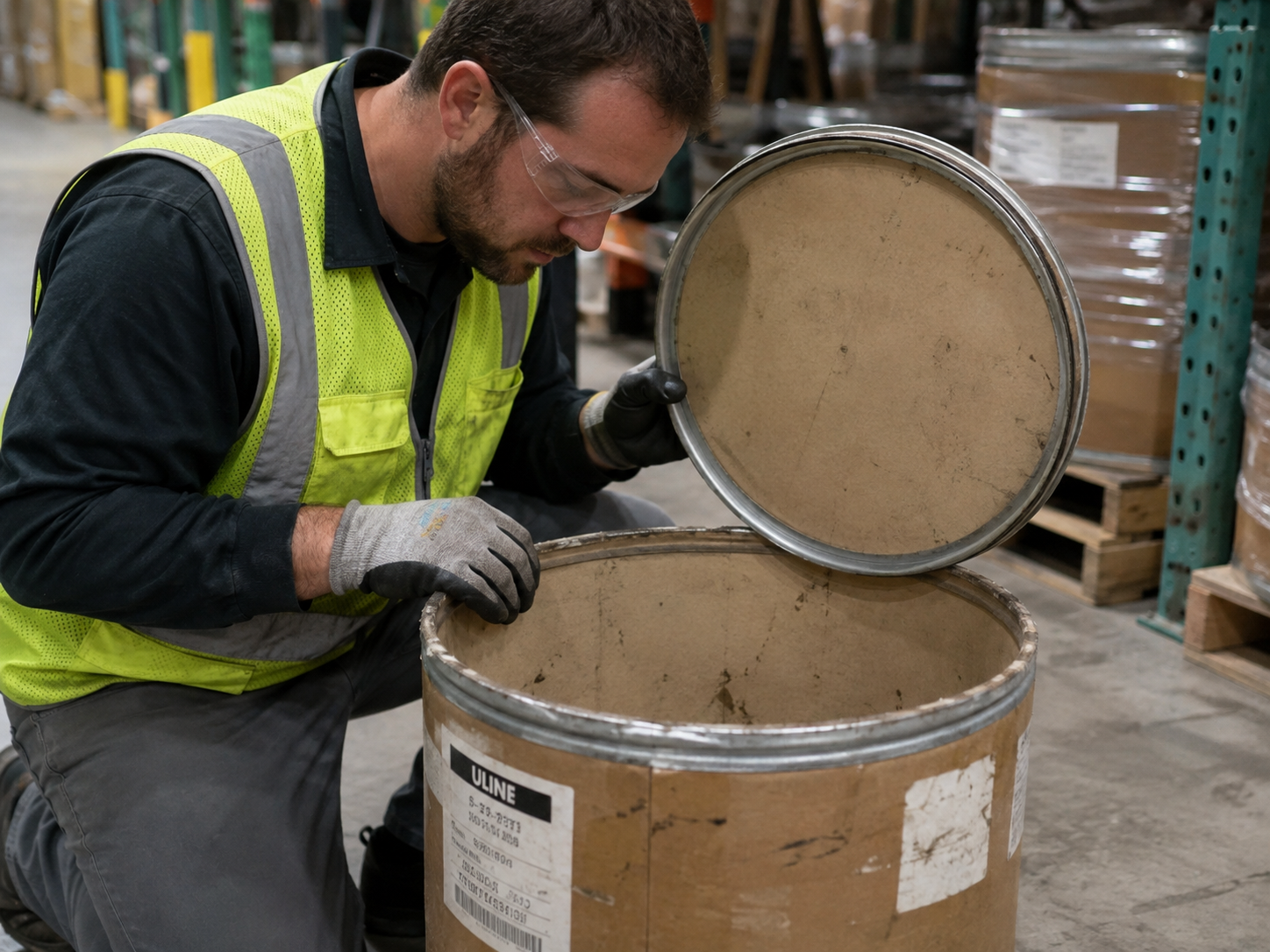
You don't need lab equipment to catch most of the problems that matter. Before you buy or accept a used fiber drum, check for:
- Water stains or soft spots. Discoloration, warping, or a body that feels soft rather than rigid usually means the plies have absorbed moisture.
- Delamination. Look at the seams and the rim for any separation between layers, or plies that have started to peel apart.
- Chime and closure condition. Inspect every metal chime, closure ring, lid, gasket, and other closure component present on the drum. They should be properly seated and free of significant rust, bending, cracking, or other damage.
- Dents and crush marks on the body. A drum that's been crushed or badly dented has already lost some of the stacking strength it was built with.
- Odor and interior residue. Any lingering smell or visible film inside is a sign the previous contents left something behind, even after cleaning.
Passing these checks may indicate that a drum is a candidate for dry, non-hazardous reuse, but visual inspection alone cannot confirm compatibility, cleanliness, load capacity, or suitability for a specific product. Reject drums with moisture damage, delamination, structural damage, unexplained odors, or interior residue.
Hazmat reuse vs. everyday reuse
This is where the answer to "is it safe" splits into two very different questions depending on what you're shipping.
If you're reusing a fiber drum for dry, non-regulated materials, i.e. parts, dry goods, granules, records, general industrial storage, the checklist above is the real test. There's no federal retest requirement standing between you and reuse.
A used fiber drum may be reused for hazardous-material transportation only when the applicable packaging authorization permits that type of packaging and all reuse requirements are satisfied. Before reuse, the packaging must be inspected and must be free from incompatible residue, rupture, or other damage that reduces its structural integrity. Its closures, components, condition, markings, previous contents, and compatibility with the new material must also meet the applicable requirements.
Separate exceptions apply to certain hazardous-waste shipments, including qualifying lab packs and previously used packaging transported under the conditions in 49 CFR §173.12. These exceptions do not provide general authorization to use any fiber drum for hazardous materials.
An original UN marking alone does not prove that a used drum remains authorized or suitable for a new shipment.
Best uses for a used fiber drum
In practice, most of the used fiber drums that change hands on the secondary market end up back in dry, non-hazardous service: plastic resin and pellets, powders, hardware and small parts, recyclable material, and document or records storage. Manufacturers build their standard fiber drum lines around exactly this kind of dry solid content, with liner options like plastic bags or foil barriers added only when the product needs extra moisture or odor protection.
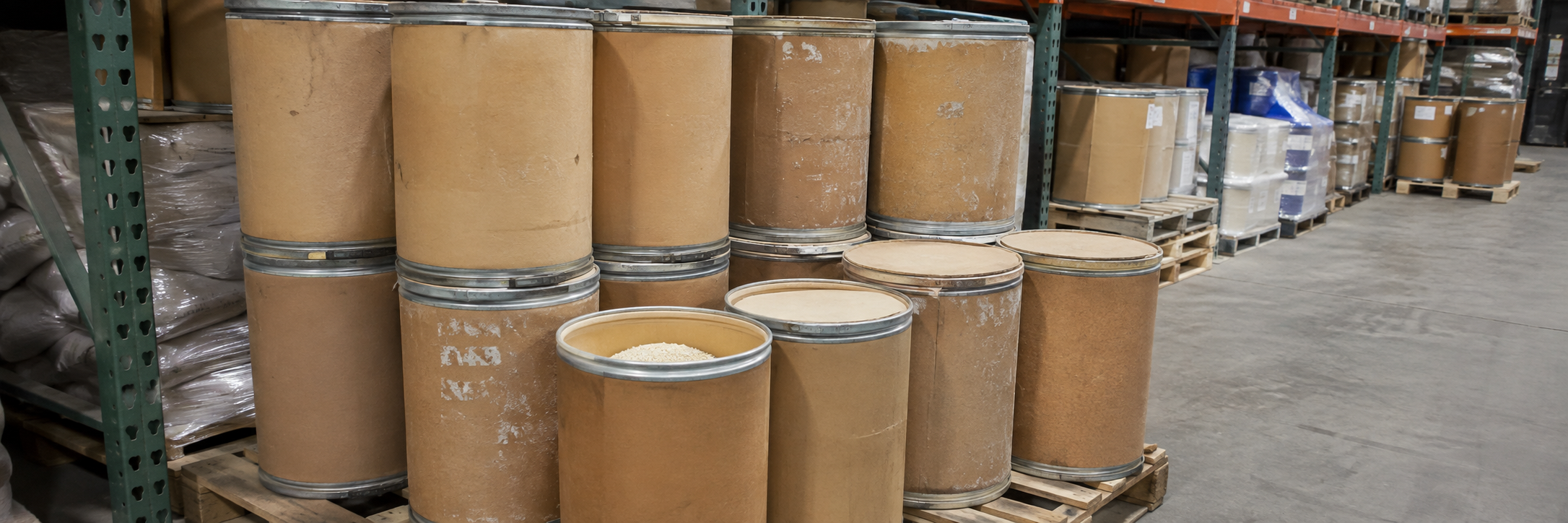
Used fiber drums stacked in a warehouse holding dry industrial goods
Liquids and semi-liquids are the other end of the spectrum. Those depend entirely on an intact interior barrier and sealed base joint, which is exactly the kind of wear you're checking for in the inspection above, so a used drum going back into liquid service deserves the closest look of all.
If a drum doesn't pass that inspection, it's not a loss, see our guide to recycling a fiber drum for what to do with it instead.
Selling or trading in your used fiber drums
If you're on this page because you have used fiber drums to move, not buy, the same factors apply from the other side. We buy and trade for used fiber drums that are dry, structurally sound, and free of contamination from whatever they held before, using the same checklist above.
You don't need to grade them yourself before reaching out. Tell us what you have, roughly how many, and what they held, and we'll tell you what we can offer or trade.
Get a quote on your used fiber drums and we'll walk you through what we're looking for.
Do used fiber drums need to be retested before I reuse them?
Federal hazardous-material packaging tests generally apply to packaging designs and representative samples rather than every individual used drum. For non-regulated reuse, those federal testing requirements generally do not apply. For hazardous-material transportation, the drum must satisfy the applicable reuse, inspection, packaging, closure, and testing requirements; any required testing depends on the packaging and intended contents.
What's the difference between a "used" fiber drum and a "reconditioned" one?
A used drum is sold as-is from its previous life. Reconditioning implies the drum has gone through some level of cleaning, repair, or relining before resale. Always ask a seller which one you're getting, since the inspection checklist matters more for as-is used drums.
Can a used fiber drum be reused for food-grade products?
It depends heavily on the liner type and what the drum held before, and it's specific enough that it deserves its own answer. See our food grade compliance guide before making that call.
Is it safe to store a used fiber drum outdoors?
Only if it was built with a weatherproof barrier and gasketed lid for that purpose. Standard fiber drum construction is water-resistant enough for normal transport, not indefinite exposure to rain, snow, or sun, so check the drum's original spec rather than assuming.
Sources
This page draws on federal packaging standards that define fiber drum construction and testing, industry test standards used alongside them, patent and reference literature on fiber drum design and reuse, and Verde Trader's own sales records.
Industry standards (what is defined)
- 49 CFR § 178.508, Standards for fiber drums. Defines the 1G construction requirements, water-resistance standard, and the capacity/mass limits cited on this page.
- 49 CFR Part 178, Subpart M, Testing of non-bulk packagings and packages. Sets the performance-testing requirements that apply to non-bulk packaging designs, including drop, stacking, leakproofness, hydrostatic-pressure, and vibration tests where applicable.
- 49 CFR § 173.12, Exceptions for shipment of waste materials. The narrow allowance for DOT-specified fiber drums as outer packaging for lab pack waste.
- 49 CFR Part 178 (full). Broader context on marking rules and how fiber drums fit into the 1A/1B/1D/1G/1H packaging code system referenced in the hazmat reuse section.
- EPA RCRA interpretive letter (1990). Clarifies that the fiber drum allowance for lab packs applies to drums meeting the 49 CFR 173.12 specification, not fiber packaging generally.
- ASTM D642. Compressive resistance test for shipping containers, used as an industry benchmark alongside the federal stacking test.
- ASTM D999. Vibration testing standard for shipping containers.
- ASTM D5276. Drop test standard for loaded containers by free fall.
- ASTM D4169. Performance testing standard for shipping containers and systems as a whole.
- TAPPI T804. Compression test standard specific to fiberboard shipping containers.
- ISTA Procedure 1A. Integrity testing standard for packaged products under 150 lb, used as a full-system durability benchmark.
Reference literature and manufacturer specifications
- Kirwan, "Fibre drums" chapter, Paper and Paperboard Packaging Technology (Wiley). Background on fiber drum liner types, moisture barriers, and weatherproofing for outdoor storage.
- Mauser Packaging Solutions, Fiber drums brochure. Manufacturer spec reference for UN-approved fiber drum construction and moisture-protective coatings.
- Greif, Ro-Con fibre drum. Manufacturer spec reference for standard dry-goods fiber drum construction.
Patents
- US 5,137,206, "Reusable Recyclicable Fiber Drum." Describes the contamination and liner-migration problem that makes some used fiber drums difficult to safely repurpose without relining.
Our sales data (what people actually buy)
- Verde Trader sold-order data. Archived and dead-deal orders are excluded.
