

Plastic Drum Sizes & Dimensions Guide
Diameters, heights, and empty weights for plastic drums from 8 to 180 gallons, from someone who sells them every day.
Published October 7, 2026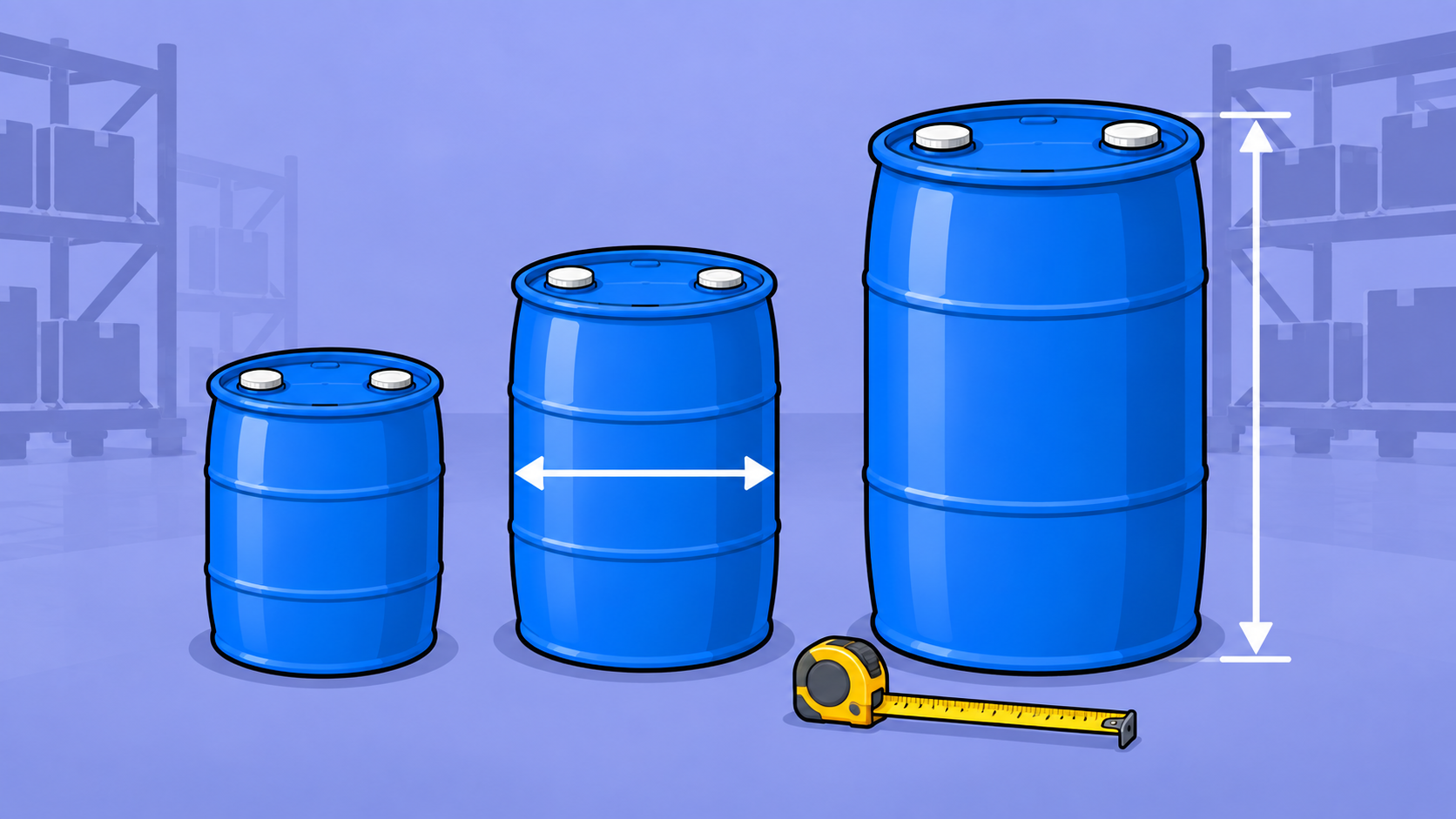
Plastic drum sizes at a glance
- Size range: 8 to 77 gallons (30 to 291 L) for standard tight head and open head drums, plus overpack and salvage drums up to 180 gallons (681 L).
- Most common size: 55 gallons (208 L), about 23" to 24" in diameter and 34" to 39" tall depending on style.
- Two head styles: Tight head drums (UN 1H1) have a fixed lid with small openings. Open head drums (UN 1H2) have a removable lid held by a ring.
- Empty weight: about 5 lb for an 8-gallon drum, 18 to 25 lb for a 55-gallon drum, and 40 to 102 lb for the large overpack drums.
- Federal size maximum: The UN plastic drum specification allows up to 450 L (119 gal) and 400 kg (882 lb) of net mass under 49 CFR 178.509. An individual drum may be rated for less.
Plastic drum size chart
Plastic drums are sold by nominal capacity, but the capacity doesn't fix the shape. Two drums labeled 30 gallon can differ by a couple of inches in diameter depending on whether the lid is fixed or removable, and manufacturers vary wall thickness, ribs, and rings. The chart below lists typical outside dimensions and empty weights for each size, with standard tight head and open head drums first and the larger overpack and salvage drums after.
How the main sizes compare
Drawn to scale from the approximate diameters and heights in the chart below. Shown as front-view silhouettes without lids, rings, or closures.
Approximate figures. Actual dimensions and weights vary by manufacturer, model, and lid style. Source: Mauser Packaging Solutions polyethylene packaging brochure and other published manufacturer specifications.
In the US, drums are sized in gallons and inches. Outside North America they're sized in liters and millimeters, and the two systems don't line up cleanly. A 220 L drum holds about 58 gallons, a little more than a 55 gallon drum, and Mauser's 220 L tight head drum measures 581 mm by 935 mm (about 22.9" by 36.8"), which is close to the 55 gallon footprint. If you're buying across systems, compare the outside diameter and height rather than the capacity label.
The most common size we sell is the 55 gallon drum, and the sections below go through each size range in more detail. If you already know your size, see our 55 gallon plastic drums or 30 gallon plastic drums, or browse all plastic drums.
Small and mid-size plastic drums (8 to 40 gallons)
Drums under 55 gallons run from an 8 gallon drum about 20" tall to a 40 gallon drum as wide as a 55. The size chart above has the main sizes, so this section covers what the numbers mean when you're fitting a drum to a shelf, a rack, or a pallet.
Small drums: 8 to 20 gallons
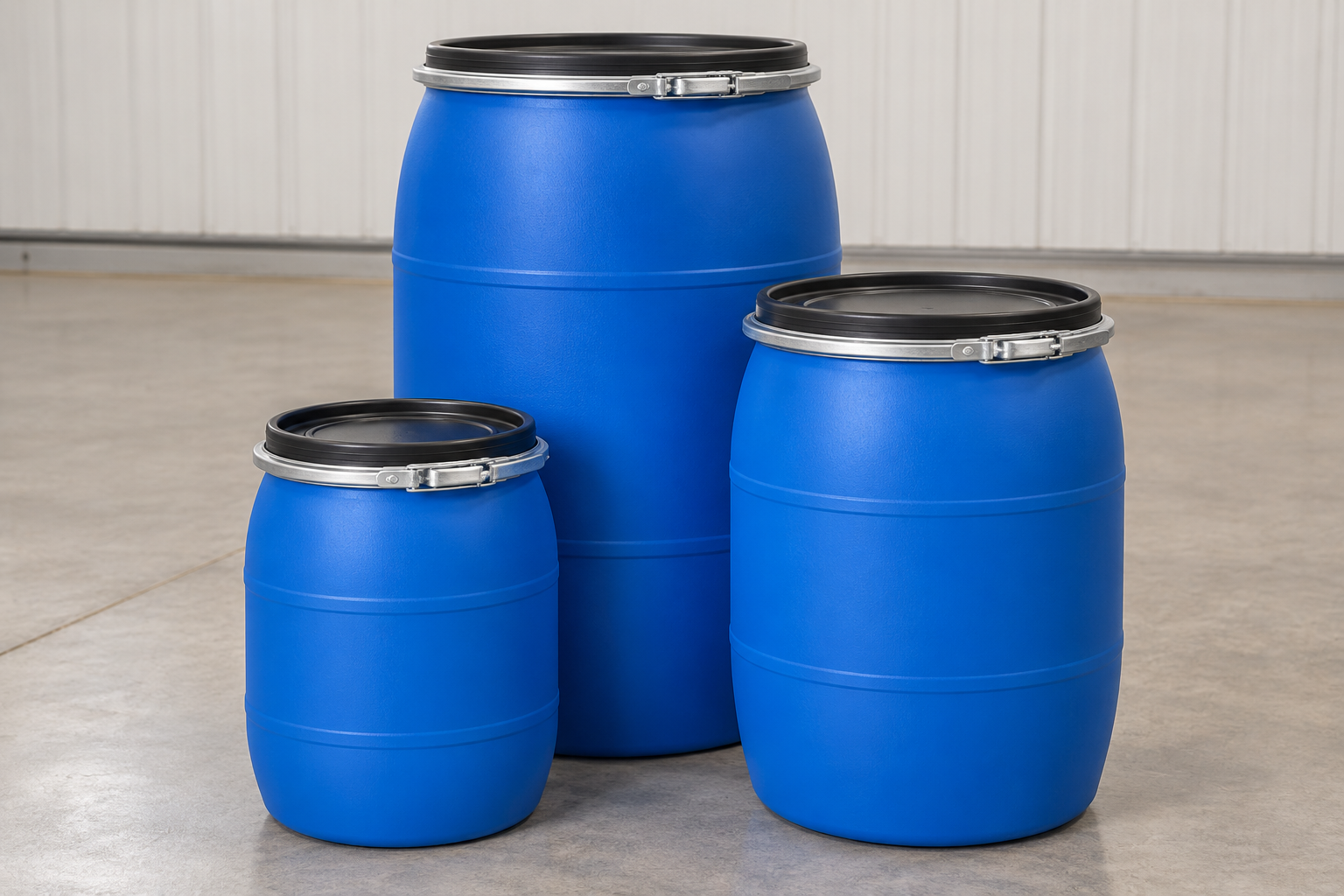
Most small plastic drums are tapered open head drums with a removable lid held on by a lever lock ring. The exceptions are the 15 gallon tight head drum, the 12 gallon drum with a threaded lid, and the 17.7 gallon drum with a screw-on lid. Tapered sides also let empty drums nest inside each other, which saves freight space.
Footprint is where the small sizes get interesting. The 10, 14, 15, and 20 gallon open head drums are all about 15" to 16" wide, so the gallon count changes the height, not the footprint: roughly 18.3" tall for the 10 gallon, 26.5" for the 14 gallon, 27.8" for the 15 gallon, and 30.5" for the 20 gallon. When I'm matching a drum to a shelf or a pallet layer, I check height first.
Mid-size drums: 30 and 40 gallons
The 30 gallon size comes in two shapes that aren't interchangeable. The tight head drum is about 19" wide and 29" tall and weighs 12 to 13 lb. The tapered open head drum is about 21" wide and 28.5" tall and weighs around 18 lb, which makes it roughly 2" wider and 5 to 6 lb heavier for the same capacity. The 15 gallon size shows the same pattern: 14.2" by 26.3" at 7 lb for tight head, against 14.9" by 27.8" at 8.7 lb for open head.
The 40 gallon drum is a tapered open head drum, about 23.8" wide and 31.1" tall. It has the footprint of the taper-sided 55 gallon drum and stands roughly 8" shorter, so it fits a layout built for 55 gallon drums with less height.
How tight head and open head drums differ in openings and closures is covered further down this page. To see what we have in stock now, browse our 30 gallon plastic drums.
55 to 77 gallon plastic drums
The 55 gallon drum is the size most people picture when they say plastic drum, and it's the size we sell most. The label covers more than one shape, though, and the 57 and 77 gallon drums sit right next to it in footprint.
What the 55 gallon label covers
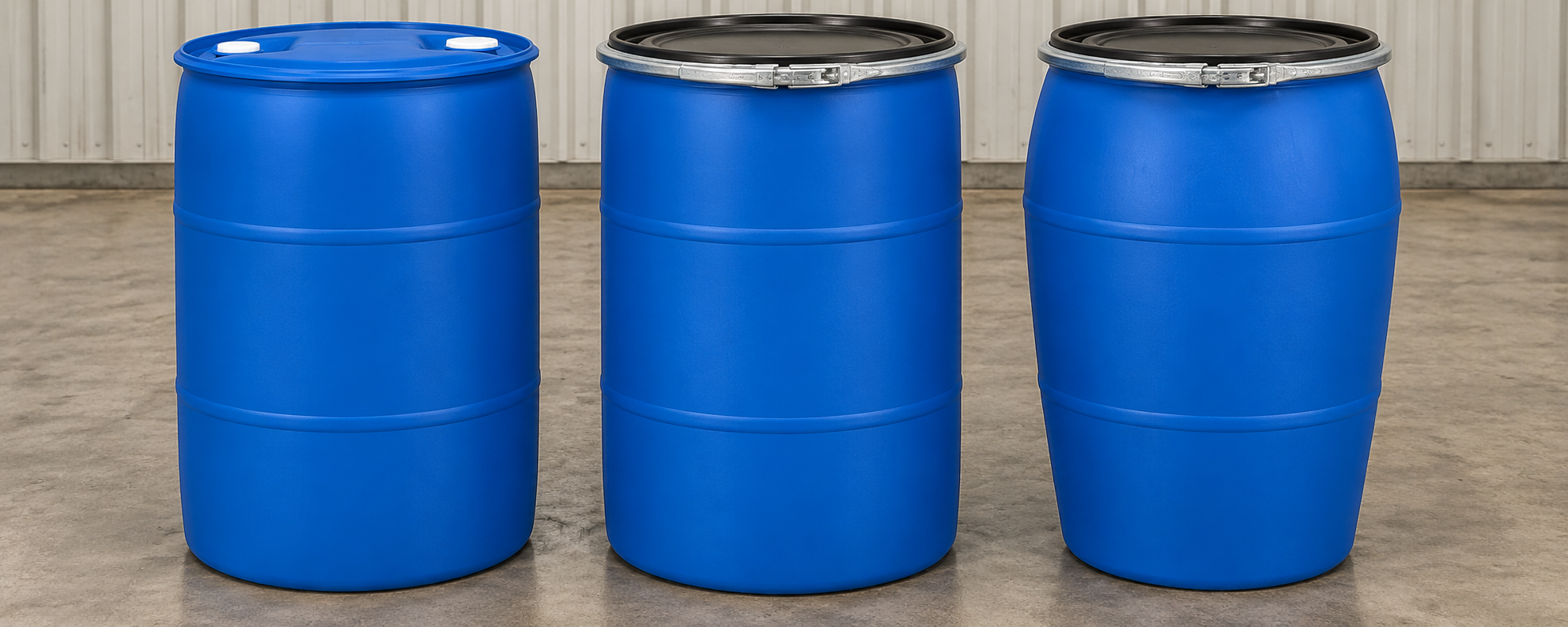
A 55 gallon drum is about 23" to 24" wide whatever the style, so the real differences are height and weight. Tight head and straight-sided open head drums both stand around 35" tall. The taper-sided open head drum is taller, at roughly 39", and weighs 1-1/2 to 2-1/2 lb less than the straight-sided version. The straight-sided open head drum is the heaviest of the three at around 25 lb, and the tight head drums are the lightest at 18 to 21-1/2 lb.
Approximate figures. Actual dimensions and weights vary by manufacturer, model, and lid style. Source: published manufacturer specifications.
Because taper-sided drums narrow toward the base, empty ones can nest inside each other, which cuts the space they take on a pallet or a truck. Straight-sided drums can't nest, so the trade-off is height.
57 and 77 gallon drums
The 57 gallon drum (216 L) is an open head drum about 22.5" wide and 36.1" tall, weighing around 24.9 lb. The 77 gallon drum (291 L) keeps the footprint of a 55 at about 23.2" wide but stands 45" tall, roughly 10-1/2" taller than a straight-sided 55 gallon drum. At about 18.5 lb it weighs less than most 55 gallon open head drums. The specification I reviewed lists no UN rating for it, so confirm the marking on the drum before you use it for regulated material.
55 gallon vs the 220 L metric drum
A 220 L metric drum has nearly the same footprint as a US 55 gallon drum, but the height differs. Mauser's brochure lists its 220 L tight head drum at 581 mm by 935 mm (22.9" by 36.8"), about 2" taller than a typical US 55 gallon tight head drum. Its 220 L open head drum, at 23.0" by 38.4", is slightly narrower and shorter than the taper-sided 55 gallon drum. If your racks, pallets, or fill line are built around one footprint, check the height before you swap.
To see what we have in stock now, browse our 55 gallon plastic drums or used plastic drums.
Overpack and salvage plastic drums
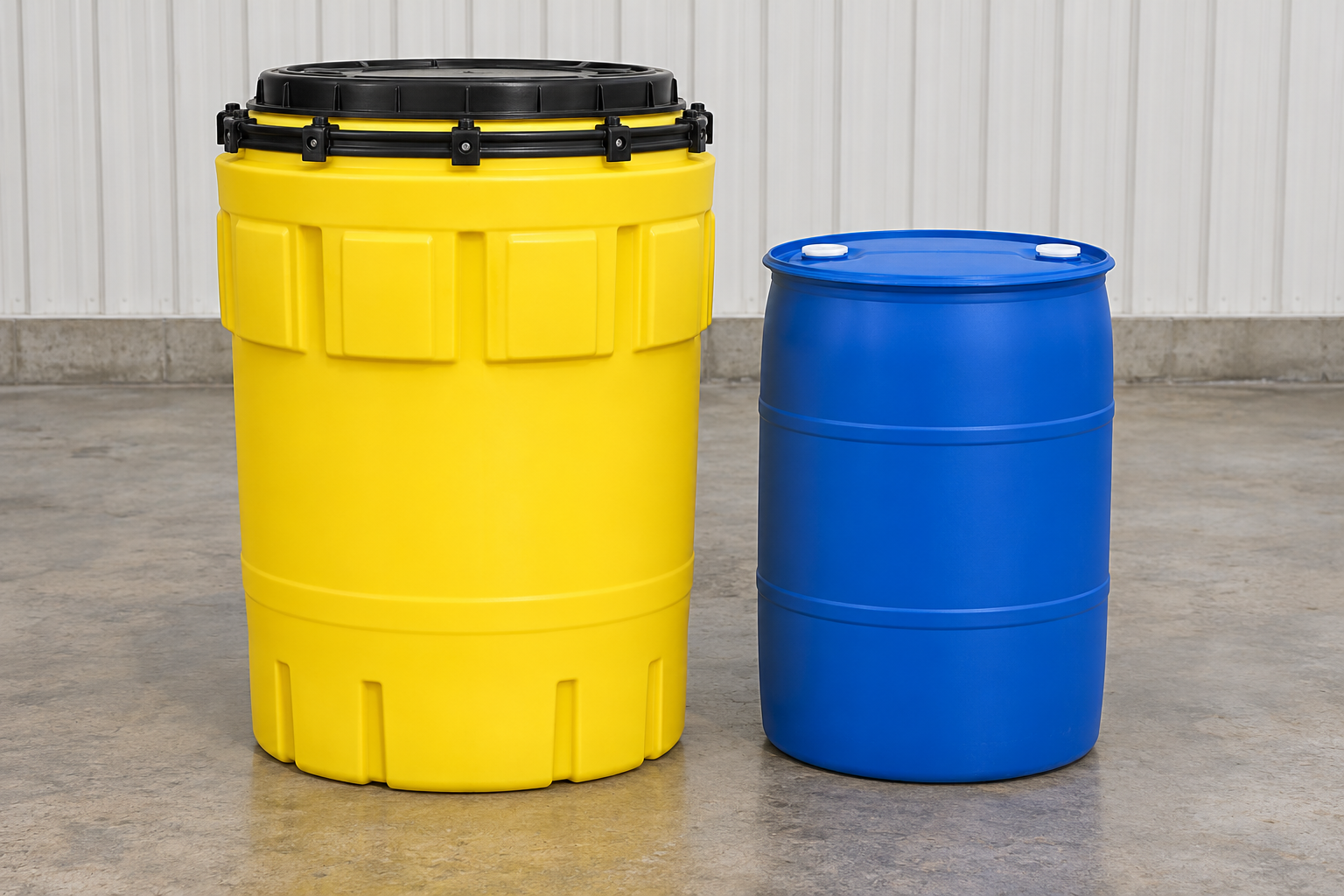
Overpack, salvage, and lab pack drums are built to hold other containers, such as a smaller drum, a damaged package, or a set of small lab containers. The larger ones are sized around what they need to fit, so they run much wider than a standard drum: a 95 gallon salvage drum can be 34" across, against about 23" for a 55 gallon drum.
The 65 gallon size is the smallest overpack that clears a 55 gallon drum (about 23.3" by 34.8") on outside dimensions, at 29" to 34" wide and 36" to 39" tall, but confirm the inside dimensions of the specific drum before you count on the fit. Above that, the range runs through 95 and 103 gallons to a 180 gallon drum that stands 57" tall and weighs around 102 lb empty.
Closures change the footprint
The 95 gallon size shows it best. The bolt ring version measures about 27.5" by 38", while the screw-on lid versions run 31" to 34" wide and 41" to 48-1/2" tall. That makes the bolt ring drum roughly 3-1/2" to 7" narrower and 3" to 10-1/2" shorter for the same nominal capacity.
Smaller lab pack and salvage drums
Salvage and lab pack drums also come in 20 and 30 gallon sizes. The 20 gallon versions are wide and short, at about 20" to 22" in both directions, which sets them apart from the tall 20 gallon open head drum in the size chart. The 30 gallon versions are close to the standard 30 gallon open head drum, at 21" to 22-1/2" wide and 28-1/2" tall.
Size limits and ratings
Under 49 CFR 178.509, a UN plastic drum is limited to 450 L, or about 119 gallons. The 65, 95, and 103 gallon drums (246 to 390 L) fall under that cap, and the specifications I reviewed list them with UN 1H2 ratings. The 180 gallon drum (681 L) is over it, which fits with the missing UN rating in the specification I reviewed. Ratings differ from one drum to the next, so read the UN marking on the drum and confirm requirements with your shipper or compliance contact before you rely on an overpack or salvage drum for regulated material.
For the standard sizes that make up most of what we sell, see our plastic drums.
Tight head vs open head plastic drums
Every plastic drum in this guide is one of two types, defined in federal regulation by how the top is built. Under 49 CFR 178.509, a plastic drum with a non-removable head is coded UN 1H1 and one with a removable head is coded UN 1H2. In everyday terms, a tight head drum has a fixed top with small threaded openings, and an open head drum has a lid that comes off.
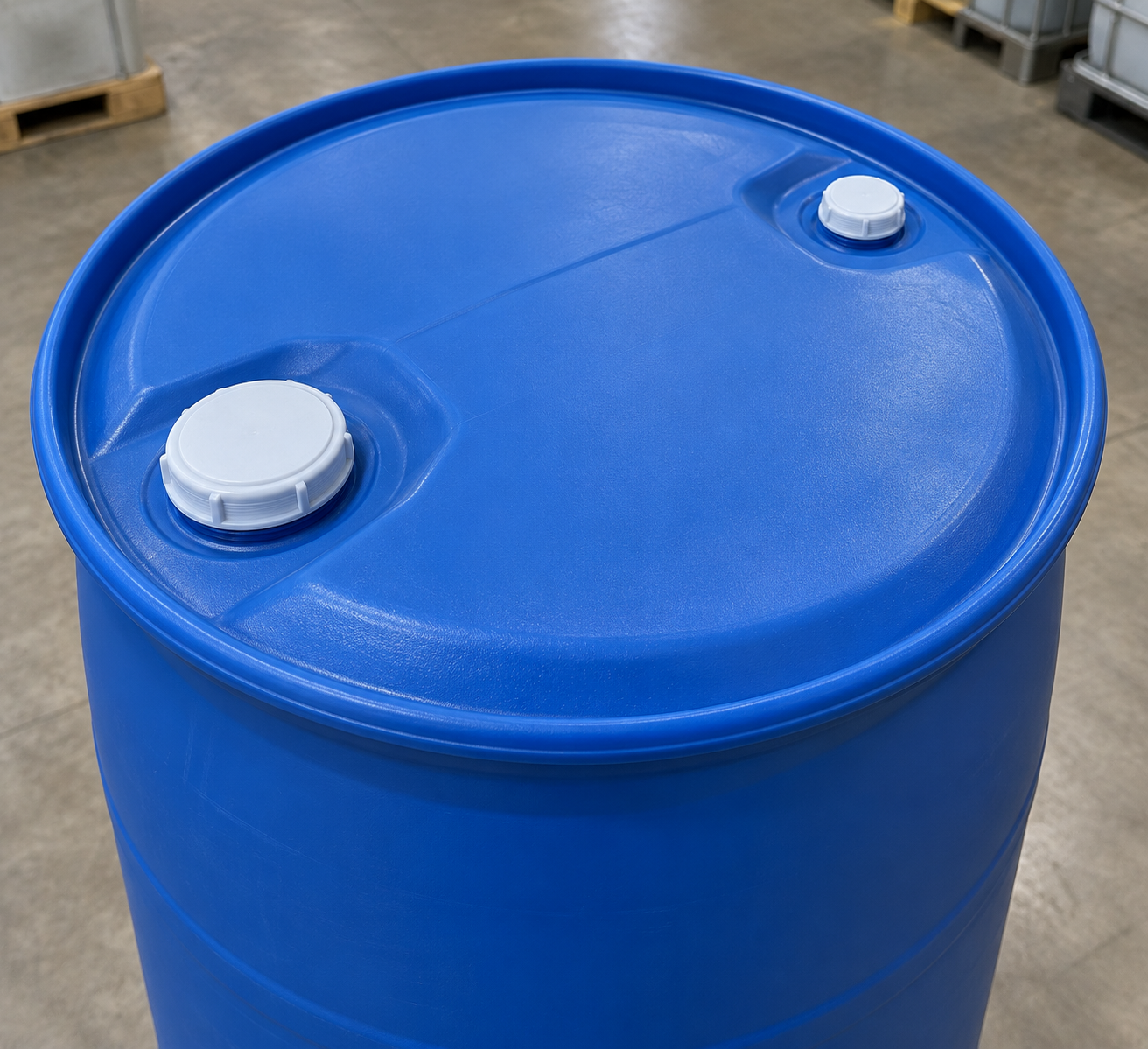
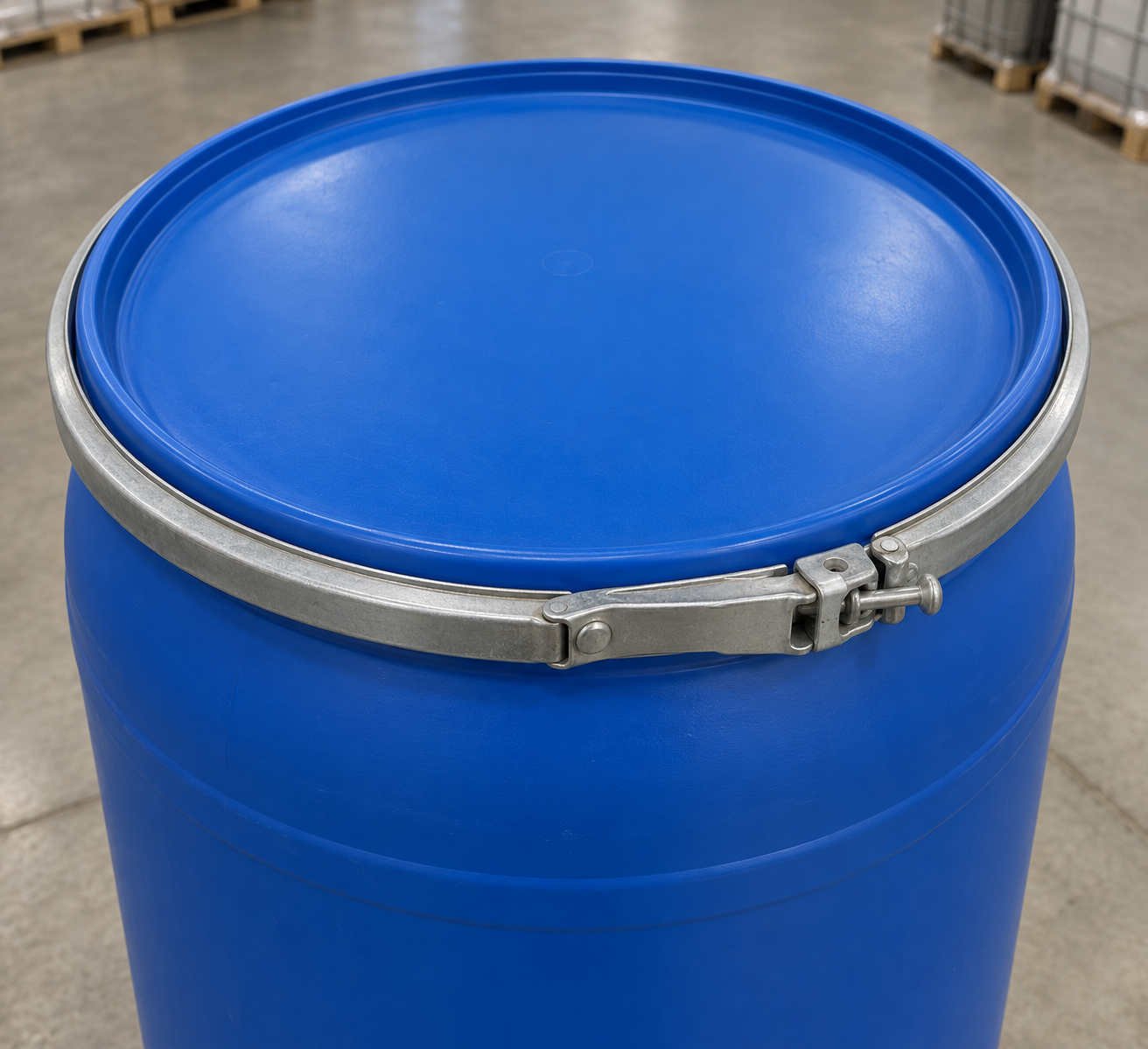
Weights are approximate and vary by manufacturer and model. Source: 49 CFR § 178.509; Mauser Packaging Solutions closing instructions for plastic drums; published manufacturer specifications.
Tight head openings and closures
A tight head drum is filled and emptied through openings in the fixed top. The federal rule caps those openings at 7.0 cm (3") in diameter, and a fixed-head drum with larger openings is classed as a removable head drum instead. In practice the openings are much smaller: Mauser's L-Ring drums have two, about 58 mm and 52.5 mm across (roughly 2-1/4" and 2"), and North American drums commonly use 2" and 3/4" plugs.
Mauser says to use only the plugs and gaskets supplied with the drum, because swapping parts voids the UN marking. That's worth checking on used and reconditioned drums, where a replacement plug or gasket may not match the original.
Open head lids and rings
An open head drum has a lid with a gasket that sits on the curl at the top of the body and is held down by a ring. Mauser's removable head drums use a lever lock ring, a bolt ring, or a plastic lock ring. A bolt ring is tightened until its ends are 3/8" or less apart. Some lids also carry 2" and 3/4" plugs, so the drum can be filled without taking the ring off.
Which style fits the job
Tight head drums suit liquids you pour or pump through a fitting, since the contents stay sealed until a plug comes out. Open head drums suit contents you need to scoop, pack, or clean out, and drums you plan to reuse, because the whole top comes off and the inside is reachable. For cleaning steps, see how to clean plastic drums.
Plastic drum wall thickness and empty weight
Wall thickness and empty weight both tell you how much plastic is in a drum. Weight is easy to find. Wall thickness is harder, because the manufacturer specifications I reviewed, including Mauser's brochure, list weights but not wall thickness. The published figures I could find come from drum patents: about 3/16" (4.8 mm) for a rotationally molded 55 gallon tight head drum (U.S. Patent 4,257,527), 0.140" to 0.160" (3.6 to 4.1 mm) for a blow molded design (U.S. Patent 6,419,109), and as thin as 1/4" (6.35 mm) for a cross-linked polyethylene storage drum (U.S. Patent 4,169,537). Each describes a different design, so treat them as a sense of scale rather than a spec.
What sets empty weight
A 2015 life-cycle study of industrial packaging modeled a 55 gallon tight head plastic drum at 21 lb, made from about 53% virgin and 47% recycled plastic, which sits inside the 18 to 25 lb range in the size chart. Performance level moves the number too. Mauser's 220 L L-Ring tight head drums all measure 581 mm by 935 mm (22.9" by 36.8"), yet the standard model weighs 8.2 kg (18.1 lb) and the high-performance models weigh 8.5 to 10.5 kg (18.7 to 23.1 lb), a gap of about 5 lb at the same size.

Style matters as well. For its O-Top open head drums, Mauser lists body weight only, 7.0 to 7.5 kg (15.4 to 16.5 lb) at 220 L, and the lid and clamping ring come on top of that. Check whether a listed weight includes the lid before you compare open head and tight head drums.
Weight per gallon
Among standard drums, the small sizes carry the most plastic per gallon. An 8 gallon drum is about 0.65 lb per gallon, against roughly 0.33 to 0.45 for a 55 gallon drum, and the 77 gallon open head drum is the lowest in this guide at 0.24. Overpack and salvage drums run heavier, from about 0.5 to 0.8 lb per gallon. These are my own calculations, dividing the empty weights in the size chart by nominal capacity.
Weights vary by maker even within one size and style, so I'd treat them as planning numbers. If a weight limit matters for your job, weigh a drum from the lot you're buying rather than relying on a listed figure. To see what we have now, browse our plastic drums.
Federal size limits for plastic drums
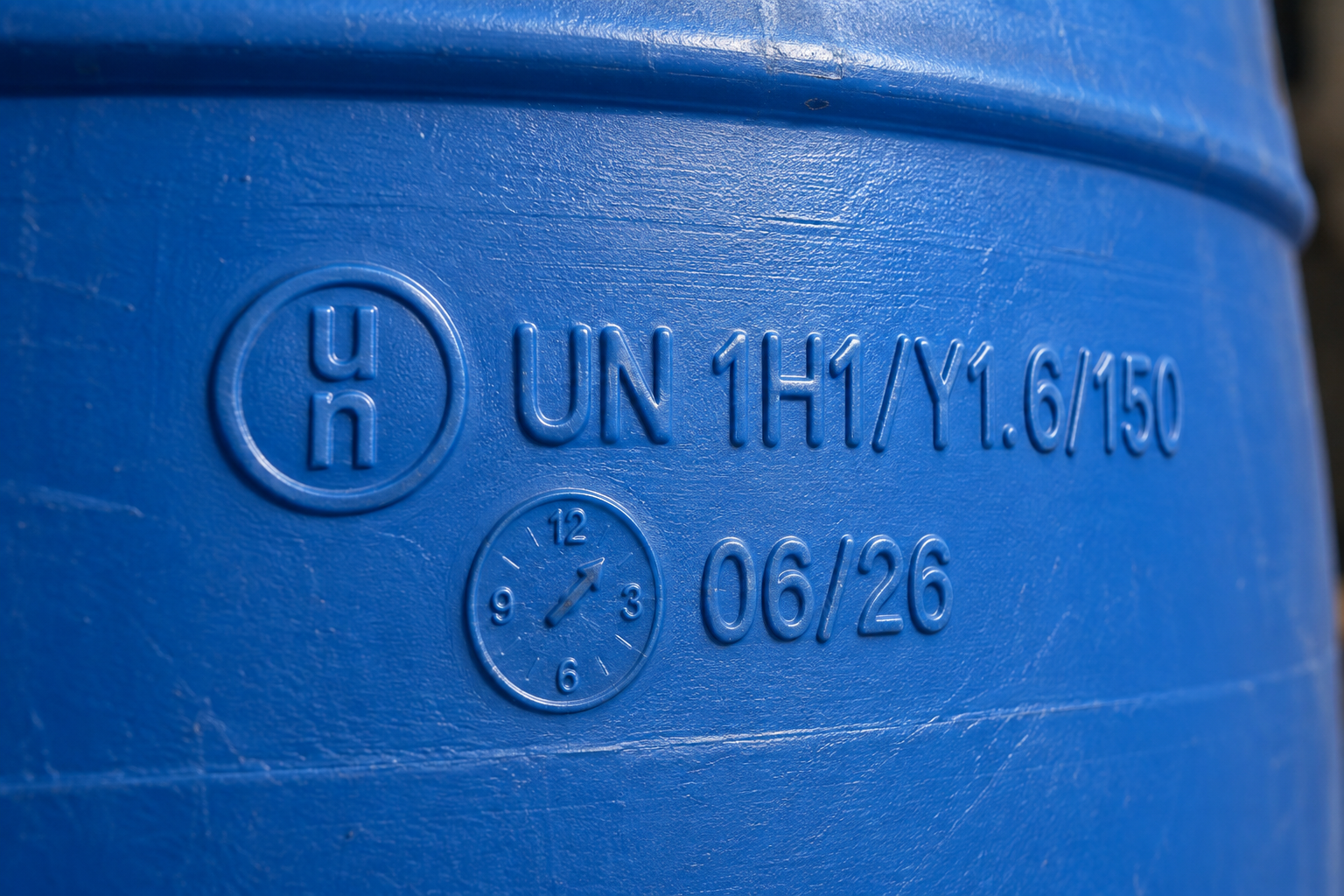
Federal rules cap how large a UN-rated plastic drum can be. Under 49 CFR 178.509, 1H1 and 1H2 plastic drums are limited to 450 L (119 gallons) and a maximum net mass of 400 kg (882 lb). Plastic jerricans, coded 3H1 and 3H2, top out at 60 L (16 gallons) and 120 kg (265 lb).
For scale, a full 55 gallon drum of water holds about 458 lb (208 kg) of contents, well under the net mass cap.
Where the sizes in this guide fall
Every standard drum from 8 to 77 gallons is under the 450 L cap, along with the 65, 95, and 103 gallon overpack and salvage drums (246 to 390 L). The specifications I reviewed list the 65, 95, and 103 gallon drums with UN 1H2 ratings, and the 103 gallon drum is the largest in this guide with a rating listed. The 180 gallon drum (681 L) is over the cap, so it can't be built to the UN drum standard, which fits with the missing UN rating in the specification I reviewed.
Reading the UN marking
A UN-rated drum carries a mark that gives its rating in a fixed order. Take UN 1H1/Y1.9/100. The 1H1 is the drum type, a plastic drum with a non-removable head. The letter is the performance level: Y means the design passed the Packing Group II and III tests, X adds Packing Group I, and Z covers Packing Group III only. The number after it is the specific gravity the design was tested for with liquids, or the maximum gross mass in kilograms for solids, and the last number is the test pressure in kPa, replaced by an S for solids.
The mark goes on to give the year, the country, and the manufacturer. For plastic drums intended for reuse or reconditioning, it also includes the thickness of the packaging material in millimeters.
Source: 49 CFR § 178.503 and 49 CFR § 178.509.
Ratings differ from one drum to the next, even within a single size, so read the marking on the drum and confirm requirements with your shipper or compliance contact before you rely on a drum for regulated material.
Choosing a plastic drum size
Choosing a size comes down to three questions: what goes in the drum, where it has to fit, and how many you need to move at once. A few checks cover most of it.
Match the drum to the contents
Look at weight as well as volume. A full drum of anything denser than water weighs more than the 55 gallon water figure above, so a smaller drum may suit dense material better. Then pick the head style: tight head if you pour or pump liquids, open head if you scoop, pack, or clean out the inside. If the drum will carry regulated material, confirm that its UN marking covers the contents before you buy.
Match the drum to the space and the load
Check footprint and height against your racks, shelves, and pallets using the size chart above. Drums that share a diameter can still differ in height by several inches, so measure height before you swap one style for another. For freight, most of our 55 gallon listings show roughly 190 to 400 drums per truckload, and nested taper-sided open head drums go up to about 650.
What we sell
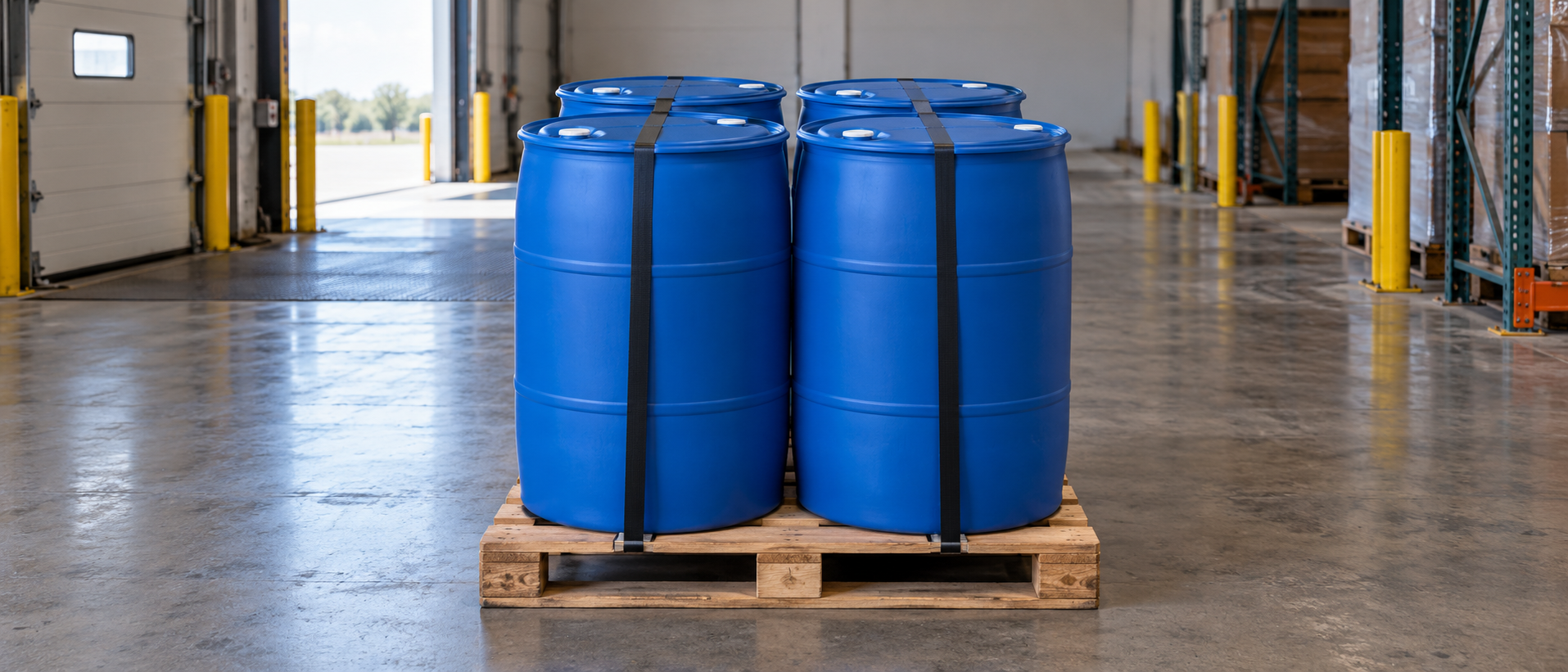
Since January 2024 we've sold more than 12,000 plastic drums across more than 140 orders, and every one was a 55 gallon drum. More than 80% were closed top (tight head) drums. We list used and new 55 gallon drums, so for any other size, use the chart above to compare specifications before you buy.
To see what we have now, browse our used plastic drums or our full range of plastic drums.
Frequently asked questions about plastic drum sizes
Does a 55 gallon drum hold exactly 55 gallons?
Not necessarily. Drum sizes are nominal, meaning the rounded capacity a drum is sold as. Manufacturers also publish a brimful volume, which is what the drum holds when filled to the very top of the opening. Mauser lists its 220 L tight head drum at 222 L brimful and its 220 L open head drum at 225 L brimful. The gap is wider on smaller sizes, with its 60 L open head drum listed at 65 L brimful. Up to the brim is the most a drum can physically hold, so treat the nominal volume as your working number.
How do metric drum sizes compare with US sizes?
Divide liters by 3.785 to get US gallons. Mauser's open head sizes of 30, 60, 120, 150, and 220 L work out to about 8, 16, 32, 40, and 58 gallons. Capacity can match a US size while the shape doesn't. Mauser's 150 L open head drum is about 19.8" wide and 37.6" to 38.0" tall, while a US 40 gallon open head drum is about 23.8" wide and 31.1" tall. That makes the metric drum narrower and taller for about the same volume. Compare diameter and height as well as volume before you swap one for the other.
How do I work out what a full drum weighs?
Multiply the gallons by 8.34 lb, the weight of a gallon of water, then by the specific gravity of what's inside, and add the empty weight of the drum. For example, 55 gallons of a liquid with a specific gravity of 1.2 is about 550 lb of contents, and a 22 lb drum brings the total to about 572 lb. If the drum won't be filled all the way, use the actual fill volume.
Can I store drinking water in a plastic drum, and how many would I need?
Only in a drum made for food contact that has never held chemicals. CDC recommends FDA-approved food-grade water storage containers and says to avoid any container that previously held toxic chemicals such as bleach or pesticides, so don't use a used drum unless you know what it held. CDC also advises a cool spot (50°F to 70°F) out of direct sunlight and replacing stored water every 6 months. For quantity, CDC suggests at least 1 gallon per person per day for 3 days, and a 2-week supply if possible. A 2-week supply for four people is about 56 gallons, so one 55 gallon drum comes close.
When does federal law consider a plastic drum empty?
Under 40 CFR 261.7, a container of 119 gallons or less that held hazardous waste is empty once everything that can be removed by normal means has been removed. After that, either no more than 1 inch (2.5 cm) of residue can remain on the bottom, or no more than 3% of the container's capacity by weight. For containers over 119 gallons, the limit is 0.3% by weight. Containers that held acutely hazardous waste have stricter requirements, such as triple rinsing, so confirm with your compliance contact.
Sources
The dimensions, weights, and size limits in this guide come from federal regulations, manufacturer specifications, and patent descriptions. The sales figures come from Verde Trader's own order and listing records. They answer different questions, so we keep them separate.
Regulations (what is defined)
- 49 CFR § 178.509. Standards for plastic drums and jerricans. Defines the UN 1H1 and 1H2 drum types, the 450 L and 400 kg limits, and the 3 in (7.0 cm) opening limit for non-removable heads. Used in the tight head vs open head and federal size limits sections.
- 49 CFR § 178.503. Marking of packagings. Sets the order of the UN marking, including the packaging code, the X, Y, or Z performance letter, and the thickness mark for plastic drums intended for reuse. Used in the section on reading the UN marking.
- 40 CFR § 261.7. Residues of hazardous waste in empty containers. Sets the residue limits that make a container empty, including the 119 gallon dividing line. Used in the FAQ.
Manufacturer specifications
- Mauser Packaging Solutions PE packaging portfolio. Nominal and brimful volumes, diameters, heights, and weights for L-Ring tight head and O-Top open head drums, plus the metric size ranges. Source for the 220 L comparisons, the empty weight ranges, and the FAQ answers on brimful volume and metric sizes.
- Mauser Packaging Solutions closing instructions for plastic drums. Closure hardware for UN 1H1, UN 1H2, and UN 1H1W drums, the bolt ring gap for removable head drums, and the rule that swapping parts voids the UN marking. Used in the tight head vs open head section.
Patents (wall thickness)
- U.S. Patent 4,257,527, Plastic drum. Snyder Industries, 1981. Describes a rotationally molded 55 gallon tight head drum with a wall of about 3/16 in (4.8 mm).
- U.S. Patent 6,419,109, Tighthead drum. Russell-Stanley, 2002. Describes a blow molded drum with a preferred wall thickness of 0.140 to 0.160 in (3.6 to 4.1 mm).
- U.S. Patent 4,169,537, Storage drum. Centennial Plastics, 1979. Describes a cross-linked polyethylene storage drum with walls as thin as 1/4 in (6.35 mm).
Background (weight and water storage)
- Life Cycle Assessment of Newly Manufactured and Reconditioned Industrial Packaging. Prepared by Ernst & Young for the Reusable Industrial Packaging Association, October 2015. Models a 55 gallon tight head plastic drum at 21 lb, made from about 53% virgin and 47% recycled plastic.
- CDC, how to create and store an emergency water supply. Food-grade container, storage temperature, and per-person water guidance. Used in the FAQ answer on storing drinking water.
Our sales data (what we sell)
- Verde Trader sold-order data. More than 140 plastic drum orders from January 2024 through September 2026, all of them 55 gallon drums. The order counts and the closed top share in the choosing a size section come from these records, and the per-truckload ranges come from our product listings. Archived and dead-deal orders are excluded.
