

How to stack, store, and handle fiber drums in a warehouse
What the DOT stacking test, moisture data, and drum design actually tell you about warehouse handling.
Published July 31, 2026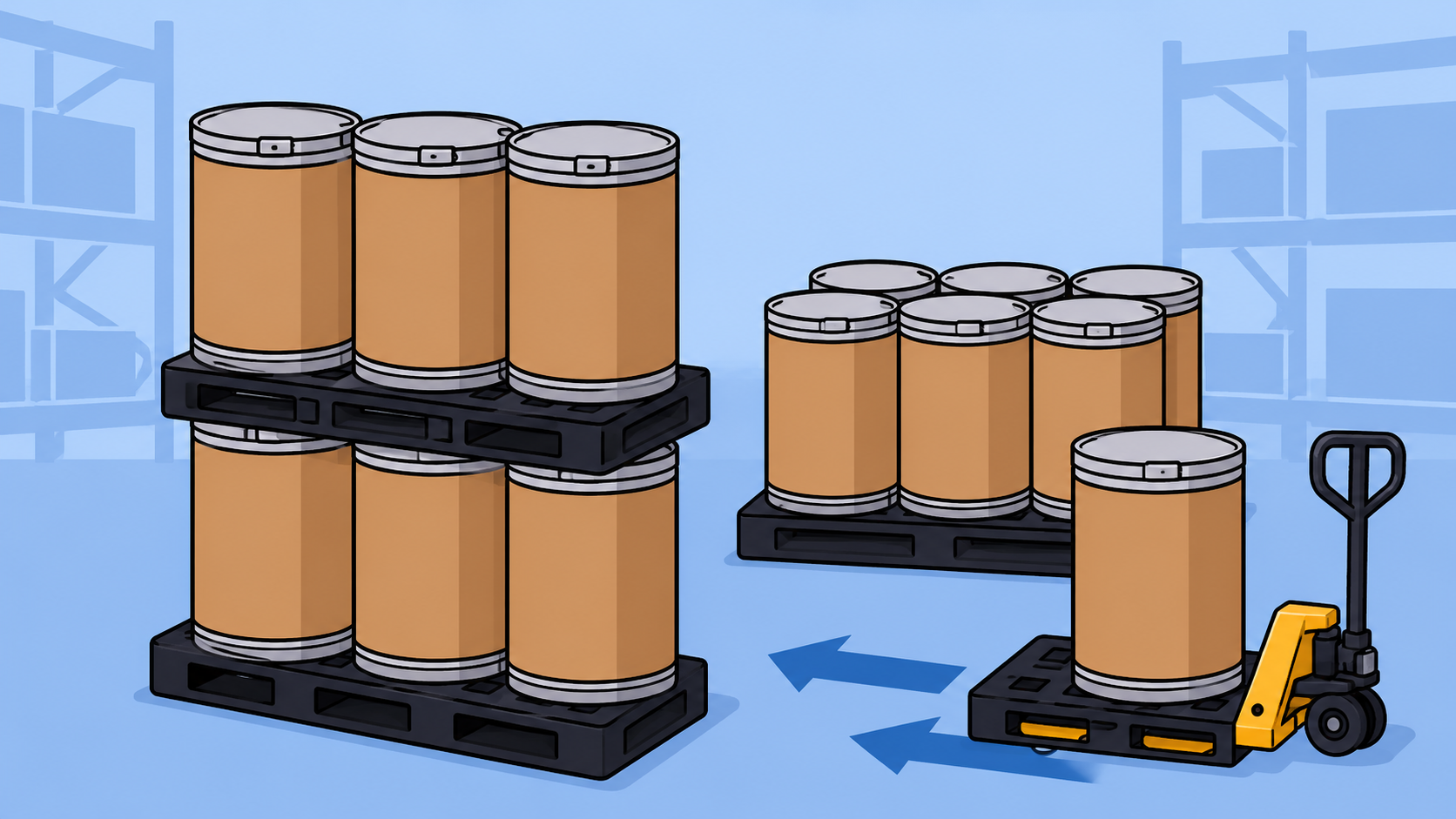
By John Anderson, Owner of Verde Trader
10+ years buying and selling used industrial packaging.
I get the same question a lot from warehouse managers who just took on a load of fiber drums: how many can you stack, and what actually breaks them down. Fiber drums are cylindrical or square-cornered containers built from multiple plies of paper or fiberboard laminated together, and they behave differently under load than a steel or plastic drum does. Their strength comes from the fiber network itself, which means humidity, stacking height, and how they're handled all affect how long they hold up.
This post walks through what the DOT packaging rules, industry testing standards, and drum manufacturers actually specify for stacking, storing, and handling fiber drums, so you're working from real numbers instead of guesswork.
Key takeaways
- Weight limit: DOT-regulated fiber drums (1G) max out at 450 L capacity and 400 kg (882 lb) net mass, though practical pack weights are usually 25 to 50 kg for handling safety.
- Stacking test: hazmat-rated fiber drums must pass a stacking test simulating a stack at least 3.0 m (10 ft) tall held for 24 hours before they're certified.
- Humidity matters: fiber drums absorb and release moisture with the surrounding air, and strength properties change as moisture content changes.
- Square drums save space: square cross-section drums with rounded corners palletize more efficiently than round drums, cutting wasted floor space.
- Empty drums nest: some fiber drum designs nest inside each other empty, roughly doubling how many fit per truckload or storage bay before filling.
Why stacking and storage matter
A fiber drum is built from multiple plies of heavy paper or fiberboard glued or laminated together, without corrugations, into a solid wall. Unlike a steel drum, its strength comes from the fiber network and the bonding between layers, not from a rigid metal shell. That means the loads it can safely carry, both static (sitting under other drums for weeks) and dynamic (a forklift drop or a truck vibration), depend on how the material is built and how it's stored.
Loaded fiber drums are routinely stacked one on top of another in storage and shipment, which puts the most stress on the walls of the bottom drums in the stack. Get the stacking height, pallet pattern, or storage environment wrong and you're not just risking a collapsed pallet, you're risking product loss and a warehouse safety incident.
How high you can stack fiber drums
If your fiber drums carry regulated hazardous materials, they're not just built to a spec, they're tested to one. Under DOT rules, a fiber drum design (identification code 1G) has to pass a stacking test before it's certified: a force equal to the weight of a full stack of identical drums is applied to the top of a sample, with the stack height set at a minimum of 3.0 m (10 feet), and the load held for 24 hours. After that, two more filled drums are placed on top and have to stay stable for another hour before the design passes.
That 3.0 m benchmark is a useful reference point even if your drums aren't hazmat-rated. A rough rule of thumb from that test: if a drum design can't hold a 10-foot stack for 24 hours without buckling, it shouldn't be stacked anywhere near that high in your warehouse either, loaded or empty.
Regulated fiber drums also carry hard limits on size and weight: a maximum capacity of 450 L (119 gallons) and a maximum net mass of 400 kg (882 lb). In practice, most warehouses fill drums well under that ceiling. Common pack weights run 25 kg (55 lb) or 50 kg (110 lb), which keeps individual drums manageable for workers to lift, tip, and stack by hand or with basic equipment.
[IMAGE PLACEHOLDER]
Straight-on photo of a palletized stack of fiber drums in a warehouse aisle, showing several drums high with visible pallet wrap or banding - suggested ratio 16:9
Palletizing and nesting empty drums
Drum shape has a real effect on how much floor space a warehouse gives up to storage. Traditional cylindrical fiber drums waste space between adjacent units because circles don't tile together, and that wasted space multiplies every time you stack another layer. Square cross-section drums with rounded corners solve this by sitting flush against each other on a pallet, which is why they've become more common for palletized storage and distribution.
Some square drum designs, like Greif's Ro-Con line, are also built to nest inside each other while empty. Nesting two same-size drums together lets you ship or store roughly twice as many empty drums in the same footprint compared to keeping them separate, which matters if you're stocking up ahead of a fill run or returning empties to a supplier.
A telescoping cover design (the lid slips down over the outside of the drum body rather than fitting inside it) also adds stacking stability once the drums are filled, since the overlap helps keep the load centered under the drum above it.
Controlling humidity and temperature
Paper and paperboard are hygroscopic, meaning the cellulose fibers absorb moisture from humid air and release it in dry air until the material reaches equilibrium with its surroundings. As moisture content changes, strength properties change with it, which is why laboratories test paper and paperboard at a fixed, standardized condition (50% relative humidity, 23 degrees C) rather than whatever the ambient conditions happen to be.
This matters most where humidity swings are large or sudden. Moving drums from a cold storage area into a warm, humid production floor can cause moisture to condense on the material's surface, which you may not be able to see but which the fibers will absorb, leading to curl or dimensional distortion. Conversely, drums left too long in low-humidity, high-temperature conditions can dry out and become brittle.
Practically, that means keeping fiber drum storage areas at a stable temperature and humidity, avoiding direct placement against exterior walls or loading dock doors where conditions swing the most, and giving drums time to acclimate after a temperature change before stacking heavy loads on them.
[IMAGE PLACEHOLDER]
Photo or simple graphic showing a warehouse thermometer/hygrometer near a rack of stored fiber drums, illustrating climate-controlled storage - suggested ratio 4:3
Handling equipment and technique
Fiber drums are frequently subjected to rough handling in normal use: dropped from a truck tailboard or loading platform, or used as a base for other containers stacked on top. The most common fiber drum style uses a metal chime at the top and bottom, which secures the head to the sidewall and gives handling equipment, straps, and banding something solid to grip without damaging the fiber body.
Rounded corners on square-profile drums aren't just for space savings, they also make drums easier to roll and reposition by hand over short distances. For longer moves or heavier loads, hand trucks and lift trucks designed for drum handling reduce the risk of denting a sidewall or crushing a corner, both of which weaken the drum well before it looks visibly damaged.
Multi-drum units strapped together for shipment reduce handling charges and reduce the number of individual lifts, but banding needs to be checked before stacking, since a loose band lets drums shift and puts uneven load on the walls below.
Hazmat-rated drums
If your fiber drums are shipping or storing hazardous materials, DOT rules under 49 CFR Part 178 apply on top of everything above. Fiber drums used for hazmat carry the identification code 1G and must be constructed from multiple plies of heavy paper or fiberboard, without corrugations, firmly glued or laminated together, and the assembled drum has to be water-resistant enough not to delaminate under normal shipping conditions.
These drums are also subject to the design qualification and periodic retesting requirements in 49 CFR Part 178, Subpart M, which cover drop testing, leakproofness, and the stacking test described earlier. If you're buying or reselling fiber drums for regulated freight, confirm the drum's UN/DOT markings match the packing group and hazard class of what's going inside, not just the drum's rated capacity.
Certain waste shipments qualify for narrower exceptions under 49 CFR 173.12, but those exceptions are specific to the material being shipped, not a general pass on drum construction or stacking limits, so they're worth reviewing with your compliance team rather than assuming they apply.
Frequently asked questions about fiber drum storage
Can I stack fiber drums directly on a concrete floor, or do they need pallets?
Pallets are strongly recommended even though they're not a DOT requirement in themselves. A pallet keeps the bottom drum off a potentially damp or uneven floor and lets you use standard material handling equipment. Direct floor contact increases the drum's exposure to moisture wicking up from concrete, which is one of the more common causes of bottom-drum failure in long-term storage.
How do I know if a fiber drum has been weakened by moisture before I stack more on it?
Look for softening or give in the sidewall when you press it, visible curling or waviness in the fiber layers, or a musty smell, all signs the material has picked up moisture. A drum showing any of these should go on the bottom of a new stack at most, not have additional weight added on top of it.
Do empty fiber drums need the same storage care as filled ones?
Less so for compression, since there's no weight bearing down, but humidity control still matters. Empty drums left in damp storage can absorb moisture and lose stiffness before they're ever filled, which then affects how much they can safely carry once loaded.
Are square fiber drums stronger than round ones, or just more space-efficient?
The Excel-linked sources in this post point to square drums as a space and handling advantage, particularly for palletized storage and nesting empty units, rather than a strength claim. Strength depends more on ply count, board grade, and construction quality than on cross-sectional shape.
What's the difference between the DOT stacking test and how I should actually stack drums in my warehouse?
The DOT test is a design qualification check, done once per drum design to certify it for hazmat use, not a guarantee for your specific warehouse conditions. Your actual stack height should also account for your floor's load rating, your racking setup if you're using one, and how long drums sit in a stack, since the 24-hour test doesn't tell you what happens after weeks of storage.
Sources
This page draws on two kinds of sources: published federal regulations and industry testing standards that define how fiber drums must be built and tested, and academic and manufacturer references that explain how the material actually behaves in storage.
Regulatory and industry standards
- 49 CFR 178.508, Standards for fiber drums. Sets the 1G identification code, construction requirements, and the 450 L / 400 kg capacity and mass limits cited throughout this page.
- 49 CFR Part 178, Subpart M, Testing of non-bulk packagings and packages. Covers the stacking test (178.606), drop test, and other design qualification and retesting requirements referenced in the stacking and hazmat sections.
- 49 CFR 173.12, Exceptions for shipment of waste materials. Basis for the note that certain waste shipments qualify for narrower packaging exceptions.
- 49 CFR Part 178 (full), Specifications for packagings. General context for how fiber drums fit into the broader 1A/1B/1D/1G/1H drum identification system.
Manufacturer specifications
- Greif, Ro-Con Fibre Drum. Source for the square cross-section, rounded-corner, and empty-drum nesting design details covered in the palletizing section.
Education and research
- Kirwan (ed.), "Fibre drums," Handbook of Paper and Paperboard Packaging Technology, 2nd edition (Wiley, 2012). Source for typical fiber drum capacities, common pack weights, and the space-saving rationale behind square cross-section drum designs.
- Kirwan (ed.), Paper and Paperboard Packaging Technology (Wiley, 2005). Source for how moisture content and relative humidity affect paper and paperboard strength properties, referenced in the humidity and temperature section. (Not linked in the Sources Excel - listed by title/publisher only.)
